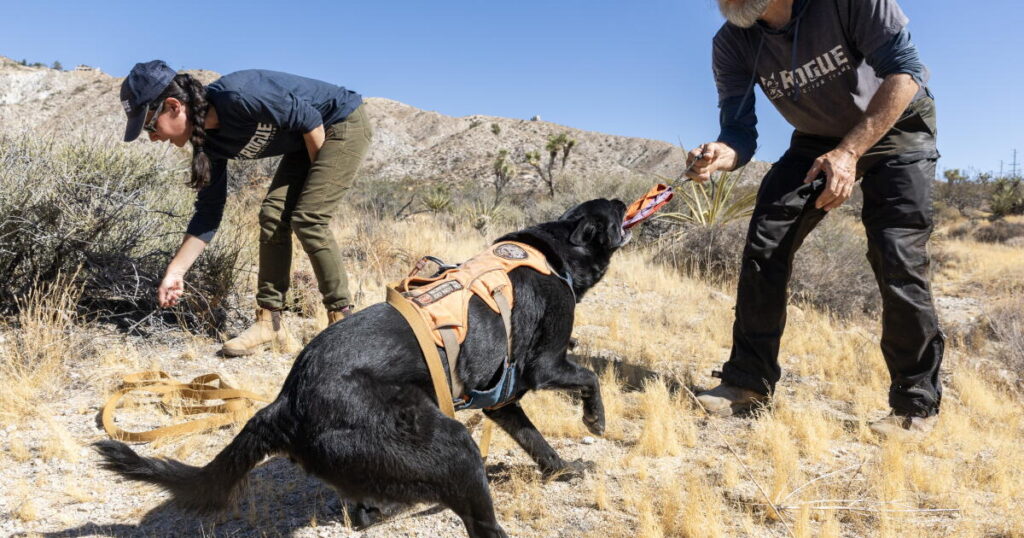
JOSHUA TREE, Calif. — Rescue dogs Merlin and Siska are readying for an important mission out in the Mojave Desert: find animal poop.
As the fall brings cooler temperatures, the pups will trot among the Joshua trees wearing orange vests, “doggles” to shield their eyes from the sun and booties to protect them from the prickly cholla cacti. As wildlife biologist Christina Aiello searches for droppings of bighorn sheep, which are relatively abundant, the dog duo from Rogue Detection Teams will sniff out harder-to-find bobcat and mountain lion scat.
Here, conservationists are planning to build two wildlife crossings over State Route 62, which connects Los Angeles and Joshua Tree National Park and is the site of hundreds of collisions between cars and wildlife every year. Dead sheep and bears strewn along the pavement have disturbed local residents for years, but ecologists fear the road may also cause a much slower and quieter die-off, with mountain lions inbreeding as they are cut off from other lions. As California works to build dozens more crossings like these around the state, researchers are hoping their animal poop surveys will show that the benefits of these crossings extend hundreds of miles beyond the roadway.
“The isolation, long-term, of those populations could mean that those wildlife species aren’t viable into the future,” Aiello, a biologist with Wildlands Network, said. “You can lose those populations even though you have a large protected space,” like Joshua Tree.
Traditional surveys of carcasses along roadways have shown that crossings do reduce wildlife collisions. Now the researchers working along SR 62 plan to go a step further by analyzing the location and DNA of dozens of poop samples for each species, before the crossings are built and after. That will enable the scientists to measure whether the bridges result in wildlife roaming far beyond their isolated islands, increasing genetic diversity as animals find mates other than their cousins.
Few have done this type of research before. A review of more than 300 studies on wildlife linkages around the globe found that only 14% assessed whether the crossing notably changed animal movement.
“The rest, they found, did not have adequate monitoring … to show that they were effectively improving conditions for wildlife,” Aiello said. “So, there’s this huge gap in our knowledge of how well these projects are actually working.”
With some mountain lions stuck in Joshua Tree National Park to the east of SR 62 and others stuck in the San Bernardino Mountains to the west, conservationists say they’re already seeing kinks in their tails — a sign of inbreeding.
Losing these predators could harm the entire park’s ecosystem.
“Joshua Tree National Park is known internationally, now,” said Geary Hund, wildlife crossings project manager at the Mojave Desert Land Trust, the nonprofit leading the SR 62 efforts. “The loss of apex predators could result in a domino effect throughout the whole ecosystem that could dramatically degrade the park, and you could even lose other species.”
In recent years, California has increasingly prioritized wildlife crossings in its conservation strategy. Four were completed in the state last year, and 37 more are underway, the California Natural Resources Agency wrote on social media in March. A series of recent laws, including one signed by Gov. Gavin Newsom last month, now require the California Department of Transportation and city governments to include wildlife connectivity considerations in highway and local planning.
However, one particularly ambitious wildlife crossing over the 101 Freeway in L.A. County has brought the structures under more scrutiny. The Wallis Annenberg Wildlife Crossing, scheduled to open in December, was initially projected to cost $90 million. The figure is now $114 million, which project leaders say is the result of “inflation, labor shortages and construction complexity.”
Yet this colossal project is not the norm. The average price of last year’s completed crossings was $16 million, with the ones currently under development expected to come in around $15 million each, according to the Natural Resources Agency.
Since the SR 62 crossings are still in the planning phase, the Mojave land trust doesn’t have a projected cost yet. Hund said he anticipated them to be “closer to … the more standard price tag” but noted that because it’s a geologically active area, seismic considerations could raise the cost a bit.
The land trust plans to finish most of the planning by 2029. Once it secures enough funding, construction is expected to take roughly two years.
Officials have known of the wildlife problems along SR 62 for decades. In the early 2000s, ecologists identified the spot as one of the 15 most crucial disconnects along the south coast, and wrote that without a plan to restore wildlife corridors, “several thousand square miles of the very best southern California wildlands would be irreversibly jeopardized.”
Animals do have a few small underpasses they can use along the route — and one larger one where SR 62 goes over a bridge — but bighorn sheep avoid covered areas like these where they are vulnerable to predators.
Locals, meanwhile, have watched the isolation and carnage firsthand: A bighorn staring at an underpass but never entering. A jackrabbit thwarted mid-highway by a tall concrete median. Carcasses, constantly.
“Coyotes are fairly common; bobcats are fairly common,” said Arch McCulloch, a board member of the Morongo Basin Conservation Assn. “But when you get things like bears being hit by cars and killed, that gets people’s attention.”
So the land trust began acquiring land along both sides of the route near Yucca Valley in anticipation of an eventual crossing. In 2016, the federal government designated the Sand to Snow National Monument, 154,000 acres of wildlands that extend from alpine conifer forests in the San Bernadino Mountains to the floor of the Mojave Desert. The designation, which sought to preserve habitat linkages, included land on both sides of the highway near Morongo Valley.
Meanwhile, Joshua Tree National Park has seen its visitor numbers nearly triple since the 1990s. As traffic on the road has increased with that meteoric rise, the problem has only grown more pressing.
When Caltrans released a study for crossings in 2021, it identified both spots — near Yucca Valley and near Morongo Valley — as prime candidates. Over a 13-month period that included the COVID-19 shutdown, the study identified 232 animal carcasses along the route, including bighorn sheep, mountain lions, squirrels and snakes.
In February, the state’s Wildlife Conservation Board awarded the Mojave Desert Land Trust $5.5 million to design the crossing. It has also received just over $500,000 from a state conservancy and $100,000 from Caltrans to fund planning and the poop surveys.
Aiello, standing in the land trust’s headquarters in Joshua Tree, acknowledged the research methods are “creative.” Whisper, another rescue dog with Rogue Detection Teams, rolled around enthusiastically with her rope toy in the courtyard after successfully identifying some scat. But behind Whisper’s goofiness, Aiello sees a strategy to transform how crossings are built:
“Do it faster, do it cheaper, do it more effectively for wildlife.”
The post This Joshua Tree highway keeps killing wildlife. Enter the poop-hunting dogs appeared first on Los Angeles Times.