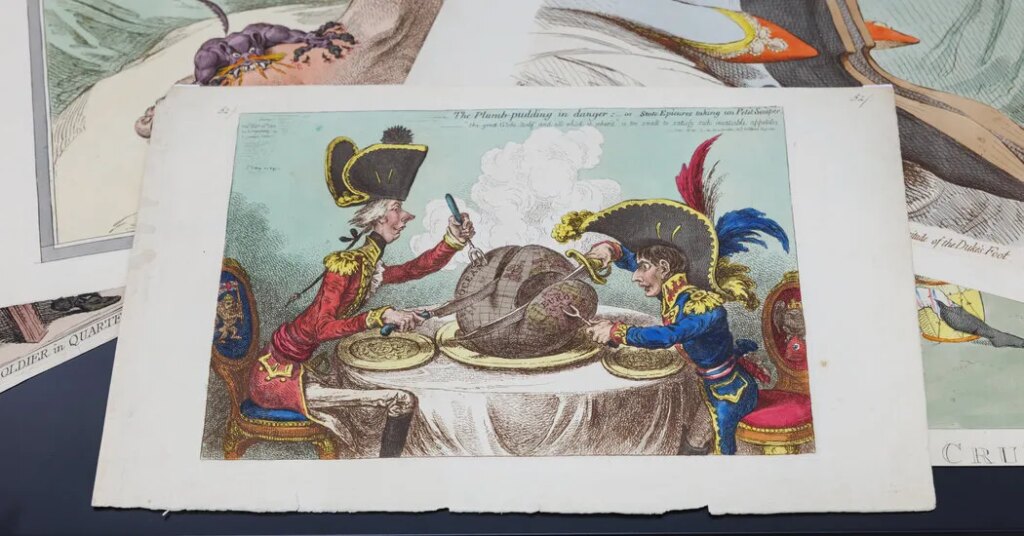
Napoleon Bonaparte and William Pitt the Younger, the youngest prime minister in Britain’s history, leaders of the so-called great powers of their day, are carving up a steamed pudding in the shape of the world. France is helping itself to most of Europe; Britain is taking a big slice of the Atlantic Ocean. To 21st-century eyes, this 221-year-old cartoon could be an uncannily prescient commentary on the colonialist fever dreams of today’s would-be Napoleons.
“It’s James Gillray’s most famous caricature,” said Daniel Crouch, a London-based dealer in prints and maps, holding up an original, hand-colored example of “The Plumb-pudding in danger” in the windowless bowels of a high-security art storage unit on the outskirts of London. Gillray’s knife-sharp satire dates from 1805, when Napoleon’s expansionist wars were raging across Europe and beyond.
“Of its type, this is the top,” added Crouch, in a recent interview, extolling the quality and condition of the unframed etching, before carefully returning it to its protective plastic sleeve.
Crouch and his assistants were busy cataloging the vast private collection of English satirical prints and drawings amassed over a lifetime by Andrew Edmunds, a prominent art dealer and restaurateur, who died in 2022, at 79. The genial Edmunds became best known as the founder of his atmospheric namesake eatery in Soho in London. But he also happened to be Britain’s foremost collector of 18th-and early 19th-century caricatures, based in his much quieter shop next door.
The Andrew Edmunds collection comprises more than 10,000 prints and drawings, dating mainly from the 18th-and early 19th-centuries, when the British increasingly used humor as a way to cope with and critique the follies and injustices of the time. Crowds would gather in front of the windows of London’s print shops, eager to see what artists would make of the latest controversy to jolt Georgian England.
Gillray, widely recognized as the father of the political cartoon, William Hogarth and Thomas Rowlandson were the outstanding practitioners of this caustic craft, all of whom are represented in this sprawling archive. Edmunds held Gillray — who was published by the influential print seller Hannah Humphrey — in particularly high regard, as evidenced across 1,200 prints, the most of any artist in the collection.
It also includes memorable prints by less well-known talents. There are more than 200 by the publisher and caricaturist Mary Darly, who, alongside Humphrey, was one of the notable women in this movement and lampooned the absurdities of London’s latest fashions.
“I’ve looked at every single print and drawing at least once. It took me two days,” said Crouch, who knew Edmunds well, and has been entrusted by his heirs to catalog and sell the entire archive.
“Every single print in the collection is the best possible impression, in the best possible condition. If it has color, it’s the original color,” Crouch said. “No one will do this again. No one cares.”
Crouch will be offering the fully-cataloged collection for sale, presented in about 80 leather-bound boxes, at the Frieze Masters fair in London, running from Thursday to Oct. 18. It will be priced at 12 million pounds, or about $15.9 million dollars.
Political satire, using laughter to tell truth to power, has a long tradition and myriad forms. It stretches back to Aristophanes in ancient Greece, Juvenal in ancient Rome and extends to today’s takedowns of overweening authoritarians, whether it be Pussy Riot ridiculing President Vladimir V. Putin of Russia, Count Binface contesting a U.K. parliamentary seat against Britain’s populist firebrand, Nigel Farage, or “South Park” renaming itself “South America.”
Satirical prints enjoyed an upsurge in Britain in the 18th century.
“Britain was seen as liberal compared with European countries that were mostly ruled by absolute monarchs. We had executed our monarch in the 17th century,” said Sheila O’Connell, a former curator of prints at the British Museum and the author of “The Popular Print in England: 1550-1850.” “Although the monarchy was restored after a few years, its power was limited. Kings had to work closely with parliament. Both were the target of satirists,” added O’Connell.
But what relevance do these centuries-old images have today? For example, could Gillray’s prints mocking a king who balloons his nation’s debt by waging a costly, long war on the other side of the world in fact serve as timeless reminders that satire can hold a mirror to society and its rulers?
“It’s the last line of defense,” said Amy Bree Becker, a professor in the department of communication and media at Loyola University Maryland, who has taught and written on the effect of political comedy on society, in a video interview. “In America, there’s a very unhealthy distrust of the mainstream media. Comedians aren’t really comedians any more. These are public figures that people are turning to instead of journalists,” Becker added, naming Jon Stewart, Jimmy Kimmel, John Oliver and, until May, Stephen Colbert as being among America’s most popular satirical commentators on television.
Becker pointed out that though most of her students might not watch TV, they do watch clips of these satirists on social media. This is the 21st-century equivalent of how 18th-century Londoners enjoyed a quick laugh at a Hogarth or Gillray in the window of a print shop.
In 2020, during the Covid pandemic, Sarah Cooper’s videos on TikTok and Twitter, lip-syncing the ramblings of President Trump, garnered hundreds of thousands of likes. But now Cooper is skeptical about how much difference satire can make to the political discourse.
“My honest view is that it doesn’t work,” she said in an email interview. “From what I’ve seen, and experienced, political satire tends to reinforce the very thing it’s mocking. It pretty much hands the target a playbook,” added Cooper, whose comedy now focuses more on the realities of everyday people.
“Sadly, what political satire often does is give powerful people ideas for how to grab more attention,” she said. “And in our social media-saturated culture, that means saying the craziest thing the loudest.”
But Becker still sees the enduring value of satire calling out absurdity. It keeps her students “looking at things a little more critically,” she said. “It points out the ridiculousness of politics. We like humor, we like to laugh and see things criticized,” Becker added.
The Andrew Edmunds Collection shows us where much of this all began.
The post The Timelessness of Satire. An 18th-Century Reminder. appeared first on New York Times.