Jonathan Blow’s latest video game is the ultimate expression of a question that has bedeviled him since childhood: What makes the universe run?
It is one he explored in the two previous games he developed, including The Witness from 2016, in which players solved increasingly complicated line-drawing puzzles on an eerie, beautiful island and occasionally encountered audio logs with ruminations by thinkers from Sophocles to Simone Weil. The game has been likened to the novel “Finnegans Wake,” Bach’s “Goldberg Variations” and the art of Sol LeWitt. Often it felt less like a game and more like an interactive meditation on consciousness, science and spirituality.
That game cemented Blow’s reputation as one of the most audacious game makers, a developer-philosopher intent on expanding notions of what’s possible. It’s a reputation that has been partly eclipsed, in recent years, by his inflammatory commentary on current events.
On Thursday, Blow returned with Order of the Sinking Star, which is, by any meaningful metric, the biggest puzzle game ever created. While a typical play-through of The Witness may take about 25 hours, Blow estimated that Sinking Star will take 500 hours.
From the beginning, Blow wanted his next game to be much, much smaller than The Witness. That game took seven long years to develop, and Blow thought his next would take, oh, two or three years at most.
Five years into the process, Blow realized he was only half done.
“So I had this choice,” Blow said in a video call in September. “You give up on your dreams and you cut it down. We’ve all seen games that did that. They’re usually kind of disappointing. And did I want to make something disappointing? No, I didn’t. I wanted to go all the way.”
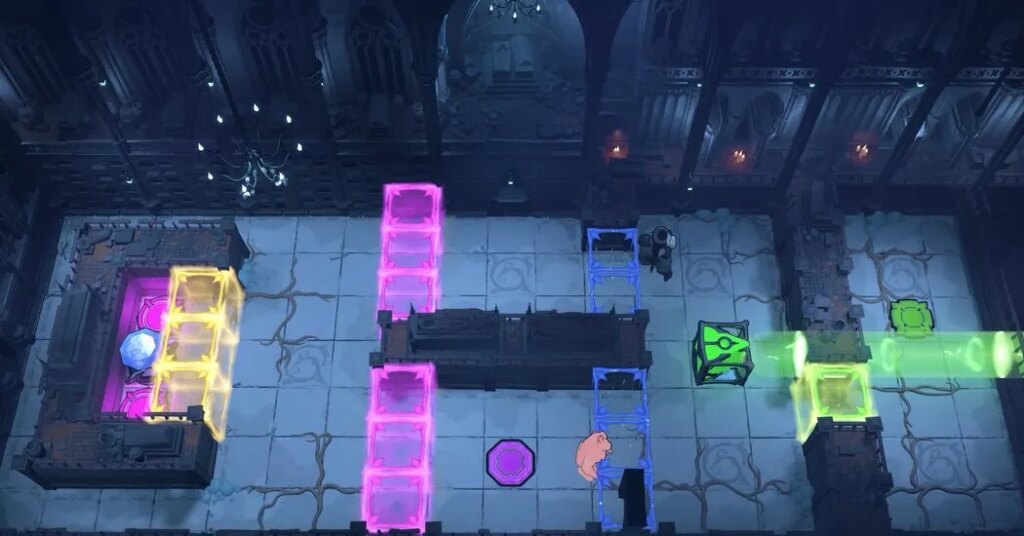
At first glance, Sinking Star seems to be four separate games. Each is in the sokoban style, in which a player moves around a rectangular grid, viewed from above. There are baddies to thwart, switches to activate, blocks to maneuver, crystals to collect and abilities to master and strategically deploy. It’s a style of game that requires players to plan several moves ahead, to investigate and experiment, to fail and try again.
But then things get a little crazy. The four separate game worlds crash together. An immense, interconnected meta-game emerges, involving a mind-exploding interplay of puzzle rule sets.
If The Witness was Bach, Sinking Star might be what Wagner would have come up with if video games were his medium.
The puzzles ask a lot of the player, said Patrick Traynor, a play tester and puzzle editor on the game, and an indie puzzle game creator himself. “But the player can also get a lot out of them.” The ostensibly straightforward puzzle grid is a rich stage for delight, he said; an “unexpectedly large iceberg of deep and surprising consequences” can arise out of an “intriguing, but simply stated premise.” Situations feel impossible right until the exhilarating moment when inspiration strikes.
Blow’s approach to puzzle design evolved as he made the game. “At the beginning of the project, I was like, dude, I know how to design puzzles, I’ve got my thing that I’m doing,” he said. “But you have to re-figure out some things.”
This time around, he thought more about player satisfaction, he said. He and his designers strove to avoid creating puzzles that felt like work. “What exactly is every single puzzle supposed to be giving you? What do you need to put in?” Blow said. “We can’t just give you the answer. It has to feel satisfying.”
The four sokoban games that provide the foundation for Sinking Star — The Promise, The Hearty Heroes of Hauling, The Mirror Isles and Skipping Stones to Lonely Homes — were not created by Blow. Those games (by Jonah Ostroff, Alex Hazelden and Sean Barrett) were already free to play in very rudimentary, very pixelated form on the internet.
It was Blow’s idea to license and recreate them — with gorgeous visuals and sound, and better all-around gameplay — and combine them, as he put it, in a “game design supercollider.”
Blow observed how often other games reached a certain point of mechanical complexity and then, in his estimation, kind of fizzled out. What gaming transcendence might be achieved, he wondered, if the gameplay mechanics in this one kept being piled on and on?
There was no blueprint for this kind of game. A good chunk of the last decade was spent chasing all the possibilities of that super collision, Blow said. “I just always want it to be the best version of what it could be.”
“He cares so deeply about the things we work on,” said Kenzie Paulus, the manager at Blow’s Denver studio, Thekla, Inc. “He has his own complexities, emotions and limitations. But his dedication to the crafts that are important to him — game design, programming, etc. — are pretty unfailing.”
Blow, 54, grew up in Southern California, the fourth of five children; his father was an aerospace engineer, his mother was — briefly, Blow emphasized — a nun. His parents were “pretty awkward people,” he said. He felt little in the way of connection to his siblings. “I was not super well socialized,” Blow said. From early on, his principal interests were science, math and computers.
Around the age of 10, something came over him — an all-consuming, debilitating desire to comprehend the universe. “I would say the operative word is probably ‘confused,’” he said. “I was just confused a lot.” As years passed, Blow learned how to suppress that existential itch, but it never quite went away. And there was always reassurance in the predictability and comprehensibility of computers.
He studied computer science and English at University of California, Berkeley. In one literature class, he discovered Italo Calvino’s “Invisible Cities,” which made a big impression. But he dropped out a few weeks before graduating.
In the years that followed, he wrote business software, started a game company, folded it, worked as a game development contractor and consultant, wrote a technical column for Game Developer magazine and played a lot of Counter-Strike. He also became a central figure in the experimental gaming community.
In the early aughts, he decided it was finally time to get serious about game development. On vacation in Thailand, he began working seriously on an idea, inspired by “Invisible Cities,” the novel “Einstein’s Dreams” and the film “Mulholland Drive.” It was a 2-D puzzle platformer in which time behaved in unexpected ways; in one level, any horizontal movement caused time to go forward or backward.
The resulting game, Braid, was a huge success. It kick-started a whole movement of inventive indie games and inspired a generation of creators.
With its reality-bending mechanic, Braid also spurred Blow to revisit the existential obsessions of his youth. He eventually hit upon a unifying theory of life, the universe and gaming: What is a video game, really, but its own small self-contained reality?
That line of thought has found perhaps its ultimate expression in the story of Sinking Star.
“One of the topics that we go into in the game is the world as a system of game rules running on a computer,” he said. The Tao Te Ching, Blow explained, views the universe as a dynamic system evolving over time — as does much of Western physics, “which is a lot like what a video game does. And that’s an interesting juxtaposition, right?”
In the 10 years it has taken to develop Sinking Star, Blow has become a controversial figure in the gaming community. Already outspoken on the state of the industry, he has more recently become known, on Twitch and other social media, for his praise of Donald Trump (“the best president in my lifetime”) and his critiques of diversity efforts, pandemic lockdowns and Covid vaccinations.
Last December, Hazelden, the creator of Mirror Isles and Skipping Stones, criticized Blow on social media for his right-wing politics; Ostroff and Barrett endorsed Hazelden’s posts. “I’m bummed about who Jon Blow has become over the years,” Ostroff wrote on Bluesky. Ostroff praised the game, but added, “it’s unfortunate that he’s the face of it.”
Blow said he pays zero attention to the discourse. “I’ve just got my head down working on the game,” he said. A big motivator is the prospect of looking back from the afterlife on his portfolio. “How much more or less can you achieve based on how focused you are?”
When I spoke with him, three weeks before release day, he was on a break between voice-over recording sessions, and still writing, editing and fine-tuning. One of the things he was contemplating — speaking of a meaningful use of time — was the appropriate amount of philosophy to include.
“If somebody’s giving a lecture in the middle of a level that you want to just focus on and solve, that doesn’t feel that good,” Blow said. “Although,” he added, with a wry smile, “there are one or two times when we do that.”
Undoubtedly, some players will skip the lectures. But Blow hopes that, for those willing to puzzle it out, Sinking Star will hold deeper meaning.
“I’m very concerned with making works that have longevity,” he said. “That does mean trying to find things to make the games about that are less ephemeral.”
The post He Made 500 Hours of Puzzles to Explode Your Mind appeared first on New York Times.