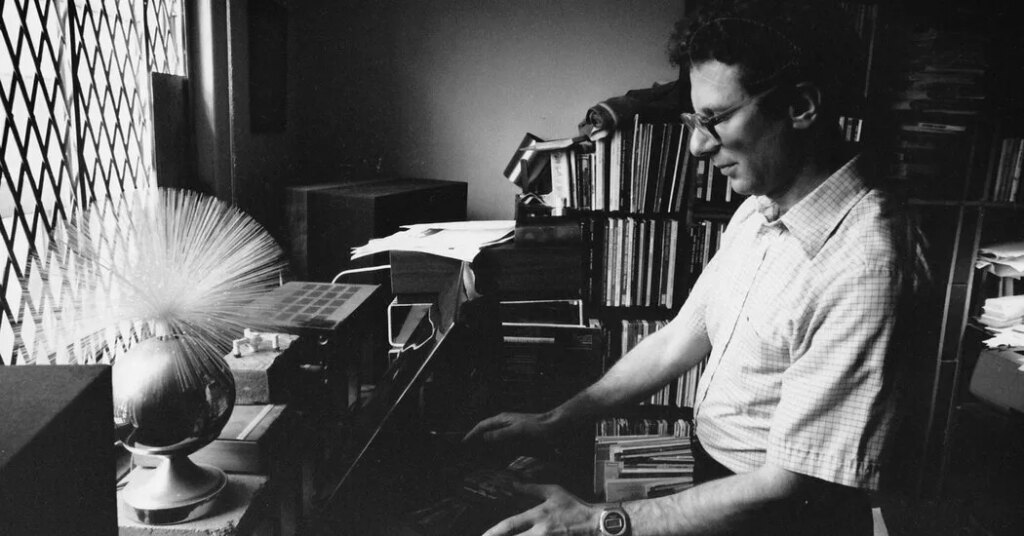
David F. Greenberg was an academic who lived modestly in a small, rent-controlled apartment in the West Village that was, by one account, piled high with papers — the sort of man who leaves a legacy of ideas, not money.
He earned a Ph.D. in physics before joining New York University, which hired him to its sociology department in 1973 even though he did not hold a degree in that field. He worked there for half a century, building an expansive body of scholarship and a reputation as a caring teacher and mentor.
He was also building something else: a retirement fund. By the time Mr. Greenberg died two years ago, at the age of 82, its balance had grown enormously. Today, the fund is worth more than $6.6 million.
But there was a problem. It wasn’t clear who should get it.
The professor, who was not married, had no children and left no will, had listed his parents as his beneficiaries, but they were already dead. He also had selected a backup beneficiary — an obscure 1970s socialist group called the New American Movement, or N.A.M. — but it had disappeared.
It didn’t take long for the fund’s managers to figure out what had happened to it. In 1982, N.A.M. merged with another group to form an organization that does exist: the Democratic Socialists of America.
The professor’s unexpected bequest could be an enormous financial boon to D.S.A., whose membership has more than doubled to about 126,000 in the past two years. Large donations are uncommon for the group, which brings in most of its money from dues. Its last publicly filed tax return, in 2024, showed net assets of $4.7 million.
Ashik Siddique, a D.S.A. national co-chair, said the group would have no qualms with accepting the professor’s funds.
“We don’t see any contradiction between being socialists and organizing to have money in a capitalist society,” Mr. Siddique said. “The more the better,” he added, “as long as it is meaningfully supporting the decisions that our members make together.”
But before any money was transferred to the organization, one of the professor’s nephews, Martin Hecht, as the administrator of his estate, filed suit, arguing that his uncle had not left his money to the D.S.A. but rather to N.A.M., which was “now defunct.” The lawsuit argued that Mr. Greenberg’s family, not the modern socialist group, would be the rightful recipient of his millions.
“Our Uncle David never missed an important family occasion, especially a birthday, because family meant more to him than anything,” Mr. Hecht said Wednesday in a statement. “Even in the months before he passed, he was working on our family lineage, reflecting the deep importance he placed on where we came from and the people we loved.”
The dispute over Mr. Greenberg’s wishes has played out in Manhattan federal court over nearly a year and a half, pitting ideological bonds against familial ones.
The court filings illuminate the origins of the Democratic Socialists of America, which has become a force in Democratic politics in recent years. They also shed light on an unassuming but prolific man — a radical thinker, in his time — who stood to become, according to the group’s records, the D.S.A.’s largest donor ever. Whether he meant to or not.
‘There Was Never a Question in My Mind’
In his 49 years with the sociology department, Mr. Greenberg was its institutional memory — “and he was also often its conscience,” according to David Garland, a fellow N.Y.U. professor.
“He spoke up clearly and forcefully, popular or not, whenever he felt we were going in the wrong direction, whenever he felt that there was departing from some past practice or some injustice was being perpetrated,” Mr. Garland said at a September 2024 memorial service for his colleague, before Mr. Greenberg’s sizable bequest became known. “He cared deeply about the department, about teaching, about students.”
He also cared about his family. Dayna Bender, a cousin of Mr. Greenberg’s from Chicago who spoke over Zoom at the service, said he was always the uncle who was free with his time and his smile. She related a story from one nephew who remembered being stumped on a physics problem. “He called Uncle David, who explained it in a way that made the problem simple,” Ms. Bender said. The nephew was working in renewable energy, she added.
Born in Evanston, Ill., in 1942, Mr. Greenberg became involved in the civil rights movement in the 1960s and 1970s. He took part in voter registration drives in rural South Carolina, where he was shot at — and, on one occasion, arrested, according to an obituary prepared by N.Y.U.’s sociology department. He also joined in anti-Vietnam War protests and in organized draft resistance, the obituary says. He argued for the abolition of prisons — a position he later dropped after an inmate wrote to him urging that he focus on more attainable goals. (He continued to believe that prisons required radical reform.)
Mr. Greenberg’s early writings on radical criminology caught the attention of the N.Y.U. sociology department, according to the obituary, and his body of work continued to expand. A 1981 collection of essays on Marxist criminology that he edited was widely used in the United States and elsewhere, the obituary says. His 1988 book, “The Construction of Homosexuality,” traced the history of same-sex relationships from ancient civilizations to modern times. The historian Nicholas B. Dirks, in a review for The New York Times, called the 635-page volume “careful, encyclopedic and important.”
“He was intensely curious about so many things,” said Mariana Veras, an N.Y.U. doctoral student with a math background. When they first met, she said, they talked about number theory.
Several of Mr. Greenberg’s former colleagues and students recall him as a shy and, at times, eccentric man whose office at the university was cluttered with papers he was unwilling to throw away. It was the same story at his Village apartment, on Bank Street, where he lived by himself.
At his 2024 memorial service, Mr. Greenberg’s cousin, Ms. Bender, read a message from an out-of-town relative who recalled staying with the professor once. “Every room was filled with corridors of paper stacked up to the ceiling,” the relative wrote. “We had to clear off a space to eat our Chinese food. And then I had to clear off space on the couch to sleep. I felt like I had walked right into a Charles Dickens novel.”
Former students said that, even years after they left school, Mr. Greenberg would send them carefully cut-out newspaper clippings on what their areas of study had been.
And he kept an open door for pupils who had questions or wanted feedback on their work, Valerie West, a former doctoral student and research assistant who counted Mr. Greenberg as a friend, said at the memorial service. Although the professor “did not give compliments lightly,” she said, he was “generous and kind in spirit.”
In a recent interview, Ms. West said she had two conversations with Mr. Greenberg, years ago, in which he made it clear he wanted to leave his estate to his family.
“It was to his sisters, and then later on he specifically said his nephews broadly,” Ms. West recalled.
She did not know how much money they were talking about, she said.
They spoke again after his sisters died. She said he reiterated his position.
“There was never a question in my mind that his relatives were going to get it,” she said.
‘Tributes, Tears and Raised Fists’
Mr. Greenberg, who once described himself as living an “abstemious, spartan lifestyle,” also left behind stocks, bonds and cash worth a total of at least $1 million, New York probate court records show. Those assets were not involved in the dispute with the D.S.A.
In 1996, he enrolled in a second N.Y.U. plan, designating his two sisters as primary beneficiaries. He listed no backup recipients for that account. By the time he died in July 2024, his sisters were already dead, and the $1.3 million in the second plan went to his nephews. There was no disagreement over that money, either.
When he enrolled in the second N.Y.U. plan, Mr. Greenberg was in his 50s and “a loving uncle to four nephews,” who themselves were starting to have children, the lawsuit said. Motivated by his growing family responsibilities, the suit argued, the professor would have assumed his choice of his sisters as beneficiaries for the smaller fund would also apply to his earlier, more valuable account.
But Mr. Greenberg only ever made one change to that first account. In 1975, a year after enrolling, Mr. Greenberg changed the form to say that if his parents were no longer alive, the fund should go to N.A.M. “or any successor thereof.”
On the question of succession, the D.S.A.’s lawyers argued that the line was clear — that the merger of N.A.M. and the other leftist group, the Democratic Socialist Organizing Committee, had been seamless, intentional and immediate.
To bolster its case, the D.S.A. submitted to the judge, among other evidence, news coverage of the vote at the March 1982 convention in Detroit that drew hundreds of members from the two organizations.
N.A.M. and the Democratic Socialist Organizing Committee each met in separate rooms to consider the resolution, according to the socialist newspaper “In These Times,” which also described an emotional scene: “N.A.M.’s finale resembled the last moments of a ’60s commune, with tributes, tears and raised fists.”
Mr. Greenberg was not only aware of the new organization, he actively supported it, according to the D.S.A.’s records. Those records show he was a member of the organization since at least 1993, when the group began keeping electronic records, and that he paid dues to the group 29 times, totaling $1,815, over the next three decades until his death.
Tiffany Gong, the organization’s development director, said it was “incredibly meaningful” for Mr. Greenberg to have designated N.A.M. or its successor as a beneficiary — at such a young age, without seeking credit.
“You’re not getting a building named after you,” Ms. Gong said.
Jeff Manza, the former chairman of N.Y.U.’s sociology department, said he wasn’t certain how Mr. Greenberg would feel about his retirement fund ending up with the D.S.A. But the nature of his politics, at least, was clear.
“He was a principled radical throughout his life,” Mr. Manza said, adding, “I think he never deviated from a belief in the possibility of a just and socialist world.”
In July, Judge Paul A. Engelmayer ruled in the D.S.A.’s favor, saying it was “emphatically” clear that the organization was N.A.M.’s legal successor — and thereby entitled to the funds.
The judge based the ruling not just on old newspaper clips but also declarations from former N.A.M. leaders and other records. Last month, the judge ordered Mr. Greenberg’s retirement funds — which then stood at $6,609,236.13 — to be deposited in a court account until the estate’s appeal is resolved.
A recent legal filing suggested that a settlement is in the works.
The post He Left Behind Millions. Who Would Get It — His Family, or the D.S.A.? appeared first on New York Times.