Russia is escalating its campaign of sabotage in NATO countries, trying to break European support for Kyiv — and Europe is struggling to respond.
European officials say they do not expect a major Russian invasion of a NATO country; in that sense, traditional deterrence has worked. But countries are grappling with how best to counter this heightened pattern of Russian attacks. What officials say they fear most is that, by accident or by intention, one of those attacks will cause a significant loss of life.
Moscow is “trying to break the will to support Ukraine and trying in a broader sense to change the security architecture of Europe,” said David Cattler, a former NATO intelligence official now at the Center for European Policy Analysis, a Washington think tank. Operationally, he said, the Russians are using tools “that are hard to attribute, that they believe are big enough to matter and yet small enough not to trigger” a larger war.
Internally, the debate among European officials, they said, is whether and how to retaliate by taking the fight to Russia. The first response should be to maintain calm and not fall into a Russian trap by overreacting, said Camille Grand, a former senior NATO official, while not being so complacent as to ignore reality. The Russian campaign is a continuation of a pattern, he said, but “the growth in the number and nature of the events is significant, and the dangerous nature of them.”
Europe is trying to increase deterrence against hybrid warfare — aggressive actions that fall short of direct military conflict — on three levels: first, by calling out Russia’s attacks and blaming the Kremlin directly; second, by increasing societal awareness and building stronger defenses around potential targets; and third, by imposing consequences on Moscow, whether overt or covert, with clear messaging to President Vladimir V. Putin.
“Any attack should be clearly linked to a concrete measure of response,” said Linas Kojala of the Geopolitics and Security Studies Center, a research group in Lithuania. “To make that work,” he added, “governments would need to have funding and legal authority prepared in advance, so the response is not delayed by a new political debate after every incident.”
That presumes collective European agreement on responses to unpredictable attacks that could quickly lead to war, decisions that countries have traditionally reserved to themselves. But producing such a consensus, as Mr. Cattler, the former NATO official, said dryly, “can be quite a challenge.”
Putin’s Strategy
Recent incidents directly attributed to Russia or thought ordered by Moscow include strikes on railroad infrastructure in Poland, a Russian frigate’s firing flares at a Danish helicopter, sabotage at factories, incursions by Russian reconnaissance drones and plots to kill executives of European armaments companies.
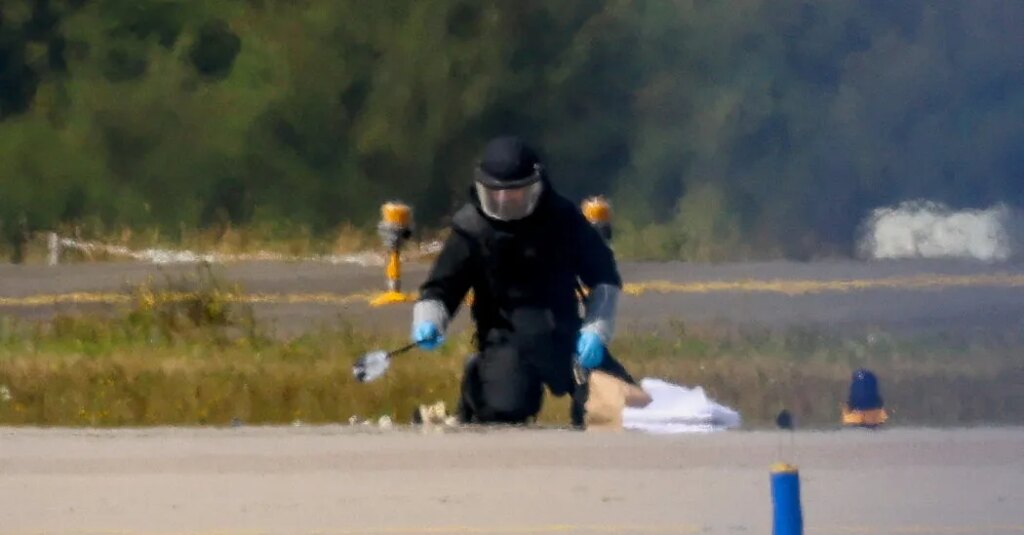
While many episodes are hard to pin on Russia, Berlin directly attributed to Moscow a recent explosive-laden but faulty drone at the Leipzig-Halle airport in eastern Germany, found near Ukrainian transport planes. The failed attack — the drone was discovered by an airport employee — was among several incidents that have spurred fresh warnings across Europe.
The drone attempt marked a shift, both for Russian risk-taking and for Germany’s willingness to point the finger at Moscow.
Claudia Major, a defense expert with the German Marshall Fund, said that Mr. Putin wanted “not only to show that support for Ukraine has a cost, but to undermine the trust of the populace that a democratic state can protect them.” Russia’s aim in Ukraine is not only territorial, she added, but also “to show that the West doesn’t hold together and can be undermined from within.”
The Russian president has been more explicit lately in warning NATO countries supporting Ukraine that they can be targeted. Russia is also suspected of trying to influence key elections in France, Italy, Poland and Spain, where far-right and pro-Russian parties are mounting significant challenges, European officials note.
Inducing fear in adversaries is a longstanding element of Russian strategy, said Hanna Notte, a Russia expert who has recently published a book about Mr. Putin’s effort to defeat the West called “We Shall Outlast Them.”
Ms. Notte noted that Sergey A. Karaganov, a hard-line Russian analyst, wrote in 2024 that for Moscow to prevail against the West, “There must be fear.” Another prominent analyst who came to support the war, Dmitri V. Trenin, she recalled, has written, “Where there is no fear, there is no security.”
Mr. Putin deterred former President Joseph R. Biden Jr. from doing more for Ukraine by threatening nuclear escalation, said Keir Giles, a Russia scholar at Chatham House, a research group in London. Under President Trump, Mr. Giles said, “It’s not the U.S. that needs to be deterred or coerced, but Europe.”
Raising the Cost to Russia
NATO is already increasing its conventional deterrence, conducting more and larger exercises along the Russian border. Europe’s efforts to increase deterrence against hybrid warfare are less advanced and less visible.
The region is increasingly focused on attribution, with leaders and intelligence agencies becoming more explicit about Russian responsibility and intentions, using words like “kinetic” rather than “hybrid,” to imply that this is a more active kind of war.
Europe is also investing heavily in protecting airports, critical infrastructure, railway junctions and important factories. Some countries, such as Denmark, Finland and Poland, are preparing citizens for potential warfare, with warnings and public-service notices. NATO countries can count such efforts toward the alliance goal of spending 5 percent of gross domestic product on defense by 2034.
Such action is necessary but cannot guard against accidents, real or intentional, that kill people and leave Western countries at a loss on how to respond, analysts said.
Resilience still leaves Russia with the initiative, Mr. Kojala said. “The response has to go beyond protection,” he noted. “It should target the networks behind these operations — identify and indict Russian intelligence officers, disrupt the recruitment and payment of local proxies.”
That is the more delicate third part of Europe’s response, which is to impose costs on Russian behavior. To identify Moscow as a culprit and not impose commensurate consequences shows weakness and encourages more attacks, said Mr. Cattler, the former NATO intelligence official. But the messaging must also be careful and collective, he said, rather than a single country’s response to a single act.
Analysts suggested, for instance, that cyber capabilities could be used to shut down a Russian town or the Moscow subway as a warning message. And if the worry is about a drone or missile strike, deliberate or otherwise, NATO countries could institute forward air defense, including over Ukrainian territory, to shoot down threats heading toward NATO territory, as Radoslaw Sikorski, the foreign minister of Poland, has urged.
While Washington can send a powerful private message to Moscow through its intelligence chief or a presidential phone call, Europe has no single person who can speak for the bloc, said Max Bergmann of the Center for Strategic and International Studies in Washington.
“Europe hasn’t integrated on defense and foreign policy so really can’t convey coherent messages,” he noted.
Ivo Daalder, a former U.S. ambassador to NATO now at Harvard’s Belfer Center, noted efforts in the European Union to propose a security protocol for consultations on incidents of hybrid war, similar to NATO’s Article 4.
But Europe “needs a menu, not another meeting,” Mr. Daalder said. NATO, he added, is better prepared than the European Union to create a list of prepackaged collective responses to hybrid warfare, and the alliance has a command structure to carry them out.
That, he suggested, is a message Russia is more likely to understand.
The post As Putin Wages Shadow War, Europe Looks for a Way to Hit Back appeared first on New York Times.