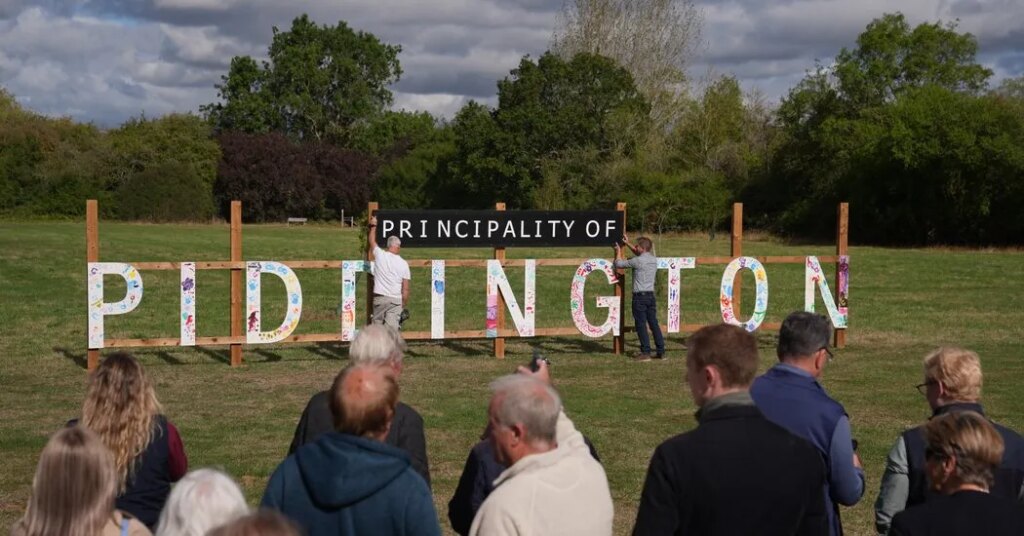
“What a week we’ve had,” a triumphant Tim McNally told dozens of his neighbors in Piddington’s village hall.
“I said to you guys, we are going to turn Piddington, this small village, into the largest village on this earth,” Mr. McNally, the chair of the parish council, said on a Tuesday night in late September. “That we are going to put it on the map.”
And they had.
The village of just over 350 people voted on Sept. 15 to become independent of the United Kingdom, in protest against a government plan to house 1,250 male asylum seekers in a nearby former military site.
Piddington has not, in fact, broken away from the United Kingdom, as the referendum had no legal basis. But it catapulted the rural village in Oxfordshire to the top of news sites and social media feeds, a publicity coup that Mr. McNally likened to a “blueprint” for other places facing the possible arrival of asylum seekers.
Piddington swiftly became an example of how a small place could challenge a national government over concerns that inhabitants felt were being ignored. In this case, how could a small village with no shops or pubs cope with more than a thousand unemployed men suddenly on its outskirts?
The campaign, which at times amplified far-right talking points about immigrants, also illustrated how divisive migration has become around Europe. In Britain, while asylum applications are down since a peak late last year, they remain consistently higher than the pre-2021 average.
The highly visible arrival of migrants crossing the English Channel, almost all of whom apply for asylum, has become a flashpoint, though these small boat arrivals have also declined since their highest level in 2022.
The Piddington vote underlined a dilemma confronting many European governments: Where should asylum seekers be housed as their applications are processed and anti-immigrant sentiment becomes more forceful and widespread?
Among the locals opposing the plan was Melise Witkin, 59, who said the proximity of the site to a village green, the Jubilee Reserve, was worrying.
“No one in their right mind is going to want to walk around the Jubilee worried that they might come down the road and there might be 20 of them,” Ms. Witkin, 59, said of asylum seekers. “They might be the loveliest, loveliest guys, but what if they’re not?”
That perceived threat to women and children from the arrival of many unemployed men was a focus of the village vote. In Britain, asylum seekers have been barred from working since the early 2000s, and the government has a legal obligation to provide accommodation while claims are processed.
The former military site, on the village outskirts, would house 18- to 65-year-old men, according to the proposals. They would be allowed to come and go during the day.
Rachel Marsh, 54, also opposes the plan, believing the location unsuitable and the militarized setup inhumane. But she was one of 26 residents who voted against independence, after becoming uncomfortable with the campaign’s tone.
“They have fallen for the fear rhetoric — hook, line, and sinker,” she said of some neighbors. She felt sad, she said, that misinformation about immigrants being disproportionately violent or criminal was being used “to whip people into this radicalized frenzy.” (While data is limited, researchers say there is little evidence that immigration has an impact on overall crime rates.)
The independence campaign’s Facebook account, which Mr. McNally and others run, shared an A.I.-generated animation that depicts an idyllic-looking village populated by white people, who appear terrified and dismayed as shirtless Black men march and leer at young girls, while men in turbans scare children out of a playground.
The campaign, and Mr. McNally specifically, tagged and thanked right-wing activists and figures such as Elon Musk, who has regularly used social media to attempt to influence British politics. In an interview, Mr. McNally said Mr. Musk’s resharing of a campaign post was a positive turning point.
“I thought, right, we’re definitely onto something here,” he said, adding that it helped push a “narrative” about the risks to the community. When asked about accusations that xenophobic and racist imagery was used in campaign videos, he said he did not create the clips. “I don’t see it as racism at all,” he said, adding, “It’s telling the story of Piddington and as far as I am concerned, that is an accurate representation.”
In Britain more broadly, anger over immigration has grown in recent years and protests against asylum seekers have become disruptive and at times violent.
In September, hundreds of anti-migrant demonstrators wearing balaclavas gathered in Portsmouth, in southern England, blocking port access for several hours. This week, another group clashed with the police in Gosport, a coastal town where migrants were brought ashore on a rescue boat.
The backlash over using military sites follows an earlier outcry over the use of hotels for asylum accommodation, by the previous Conservative government, to comply with social distancing rules. After the pandemic, the number of people crossing the English Channel in small boats to claim asylum rose rapidly, while the processing of claims slowed, leading to a large backlog that the Labour government has only partly cut.
Shabana Mahmood, Labour’s home secretary who is responsible for immigration policies, has embraced a hard-line approach in an effort to show the government has heard voters’ concerns. Using former military sites instead of hotels — to create the perception of a less generous and more controlled approach — is part of that.
But efforts to convert military sites can be costly, high-profile and polarizing, said Sunder Katwala, director of British Future, a research organization in London. They also give agitators a place to go, and create a situation where locals’ concerns appear to be ignored, he said.
“That’s the one thing we should be trying to do: separate out real concerns from agitation and stirring up trouble,” he said. “What we don’t want, I think, is to cross the wires, where the reasonable parish council meeting attendee is now in receipt of extreme conspiracy narratives from the very far right.”
There is little doubt that Piddington residents genuinely oppose the site. A separate initiative, Wrong Plan, Wrong Site, is mounting evidence-based legal challenges to the proposal. But it has taken a back seat to the independence campaign’s more provocative arguments.
“None of that balance was brought into the equation,” Ms. Marsh said. She added, however, that the Labour government’s failure to listen to concerns had created space for vitriolic voices, saying: “Labour’s refusal to engage with the people on this has handed it to the far right.”
She and her husband have lived in Piddington for two decades and raised their children here. She is originally from New Zealand, and her husband’s parents were from the Windrush generation of Caribbean people who migrated legally to Britain after World War II.
After Ms. Marsh was interviewed on the BBC on the day of the referendum, she and her family received an onslaught of online abuse. An anti-immigrant campaigner arrived at her home, filmed her and published the footage, showing her address. The clip was shared by far-right agitators, and she met with the police to discuss her safety.
Still, Ms. Marsh said it remained important to offer an alternative perspective. “I do think there is an agenda here to keep us divided,” she said.
Piddington has been here before. In 2001, a plan to develop asylum accommodation outside the village also drew intense opposition. It was scrapped when the government determined it wasn’t economically viable.
Prime Minister Andy Burnham said last week that the military site was being considered because voters had wanted people out of hotels.
“But I’ve heard what people are saying in Piddington and the other places affected,” he said. “I don’t ignore their concerns.”
In a statement, the Home Office said it plans to close asylum hotels and move people to alternative accommodation, including former military sites “designed to be self-contained, with 24/7 security and CCTV, to reduce the impact on local communities.”
The post A Rural Village Voted to Leave the U.K., Stirring Britain’s Migration Debate appeared first on New York Times.