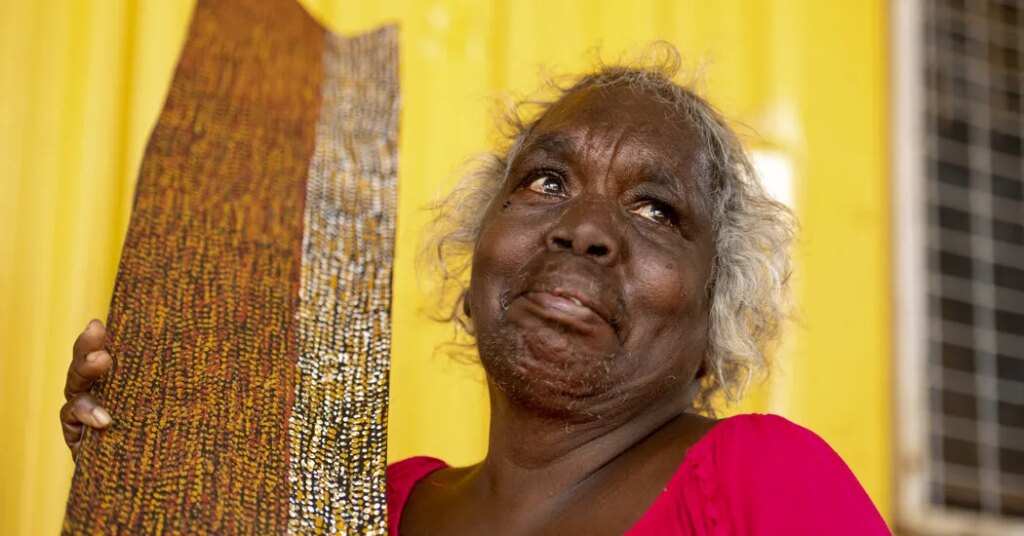
Now 72, the artist Kaye Brown didn’t pick up a paintbrush until 2012, when she retired from a career in teaching and working in libraries on the Tiwi Islands, off Australia’s northern coast.
She began painting at Jilamara Arts and Crafts, a community-owned art center. “I used to watch old people, sit with them, and they would tell me what their painting was about,” she said. One man, she recalled, “used to do a lot of painting with kayimwagakimi and brush,” referring to the traditional ironwood comb. “I tried using that one day and I liked it.”
This week, six of her bark paintings will make their debut at Frieze London.
They are being brought by Sullivan+Strumpf, a Sydney, Australia, and Singapore-based gallery that often represents First Nations artists. Brown’s works come to Frieze during a period of heightened international recognition for Aboriginal and Torres Strait Islander artists. In the past three years alone, Archie Moore won the Golden Lion at the Venice Biennale, Emily Kam Kngwarray received a major retrospective at Tate Modern, and Tate acquired a bark painting by Naminapu Maymuru-White after it was shown through Sullivan+Strumpf at Frieze London.
Brown’s six paintings depict yirrinkiripwoja, the body-painting designs Tiwi people wear in mourning. Using ocher on stripped bark, the patterns were created in narrow, repeating lines — some combed, some brushed — that echo marks once drawn directly on skin. Up close, the imperfections emphasize the handmade quality of this work.
“When people die, you paint yourself and that paint will have a meaning depending on how you relate to the person that passed away,” she wrote in an email. The same patterns she paints on bark, she said, are the ones she would paint on her own face and body for her father’s passing. “I paint on the bark like this so I can remember family who have passed away and so that I can keep [our] culture strong,” she added.
For Brown, painting keeps ancestral knowledge alive.
“I copy my ancestors, like that old man” who showed her painting with an ironwood comb, she said. “If he was alive today, I think he would be happy for my paintings from his knowledge. I grew up listening to old people talk in hard Tiwi language, now I teach my grandchildren. We cannot forget it.”
Brown hopes to inspire the younger generation. “Maybe they can go overseas one day too and they can make people in this community proud of them,” she said.
Ursula Sullivan, a director at Sullivan+Strumpf, said that what resonates most about Brown’s paintings was something that transcends Tiwi culture. “I think they touch on this very human and very universal desire to be connected with our ancestors,” Sullivan said in a phone interview.
Sullivan also distinguishes Brown’s work from the more overtly political practices of many Indigenous artists working in Australia’s cities. Brown’s paintings, she said, were less concerned with colonial politics than with ceremony, memory and spiritual knowledge tied to Country, the term Indigenous Australians use for their ancestral and spiritual connection to land.
That distinction, between art rooted in ancestral memory and art shaped more directly by the politics of colonialism, came into focus earlier this year at the Museum of Contemporary Art Australia in Sydney, in the exhibition “Tony Albert: Not a Souvenir” (through Oct. 19).
Albert, who is Girramay, Yidindji and Kuku Yalanji, one of Australia’s many distinct First Nations communities, reassembles found objects — kitsch souvenirs with racist depictions of Aboriginal people, many of them decades old — into work that is simultaneously celebratory and confrontational.
Suzanne Cotter, the museum’s director, described Albert as part of a second generation of First Nations artists who came up through the ProppaNOW collective in Brisbane, Australia, working alongside such artists as Gordon Bennett and Richard Bell, and who was the inaugural Fondation Cartier pour l’art contemporain First Nations Curatorial Fellow at the 2024 Biennale of Sydney.
What makes the art successful, Cotter said, is the tension it holds: “A joyousness, but also a brutal reality of how First Nations people have been treated and represented, which is tied to history.” Albert’s work introduces a perspective that is hard to ignore once encountered. “Something’s made visible and present,” she said. “You can’t unsee it.”
Cotter said that the recent visibility of First Nations Australian artists had been built over years of work by creators and curators, not by a single blockbuster exhibition or biennial.
“Museums have a really important role,” she said. “It doesn’t all happen in the Northern Hemisphere. The knowledge production — and that’s where curators and artistic directors who come from elsewhere, they want to learn.”
Across Regent’s Park from Frieze London, Frieze Masters is telling a different chapter of the story. While Frieze London showcases the breadth of contemporary Indigenous Australian practice, Frieze Masters “provides the context to recognize senior, established Australian Indigenous artists as central to Australian and international art history,” said D’Lan Davidson, founder of D Lan Galleries.
This year, D Lan Galleries is presenting “George Tjungurrayi: No Past Tense,” a survey of paintings by the Pintupi artist spanning 1998 to 2018. “George’s paintings challenge the conventional Western history of abstraction and invite audiences to reconsider how that history has been constructed,” Davidson said.
Christopher Hodges, who has worked with Tjungurrayi through Utopia Art Sydney since 1988, remembers watching that transformation. In the early ’90s, he said, the artist’s dots “started joining together until one day they were simply lines.” Hodges that it was the moment Tjungurrayi “found his own voice.”
For Hodges, the paintings reveal themselves slowly. “The paintings are very strong,” Hodges said. “The viewer is drawn in, and then the details can emerge and be explained, but in essence the details give only hints. The paintings are informed by much bigger things: a rich history, a powerful landscape and epic stories.”
As for Brown, she will not make the 24-hour journey from the Tiwi Islands to London. Her paintings will make that trip instead. “My work is going karrampi,” she said — a long way.
The post A 72-year-old Artist Makes Her Debut at Frieze London appeared first on New York Times.