
A lot of attention has been paid to the future of the film industry in the wake of Skydance acquiring Paramount and Warner Bros. Discovery, but few are talking about the other big entertainment play of this new merger: TV. With the acquisition of WBD, Skydance now owns nearly 190 shows, more than 70 cable channels and two major streamers.
It’s a massive portfolio that threatens to disrupt the current order of television. Over the past 12 months, networks and streaming assets owned by Paramount and Warner Bros. Discovery combined averaged about 13.3% of all TV watched, according to Nielsen’s Media Distributor report. That narrowly edges out TV’s long-running leader YouTube, which accounted for 13.2% of all TV watched during the time period, and puts it ahead of Disney, NBCUniversal, Versant and Netflix.
“This is the biggest consolidation event the media environment has seen in recent years, and it fits the pattern we’ve been tracking: companies tying together capabilities that used to sit apart. Putting Paramount+ and HBO Max under one owner, alongside CBS, CNN and two of the industry’s largest studios, hands Skydance enormous leverage over premium ad-supported inventory,” Alex Yip, the director of product strategy at the mobile marketing analytics and attribution platform AppsFlyer, told TheWrap. “For advertisers, that’s going to be something to closely watch.”
It all sounds impressive, but when you break down the TV assets that Skydance TV now owns, questions start to arise. At a time when media companies are de-emphasizing or outright spinning off their cable assets, Skydance doubled down businesses that are losing cultural relevance and subscribers even as the channels continue to provide a healthy, if shrinking, source of cash. Though there have been many attempts to reinvent cable assets for the streaming age, like Disney incorporating FX into Hulu or NBCUniversal spinning off its cable assets into Versant, very few companies have successfully managed to breathe new life into these networks.
“The fate of all of these cable channels is either to be bundled up and spun off, like Versant was out of NBCU, or to continue the status quo of what Paramount’s been doing with them since before Skydance, which is spend as little money as possible and just squeeze those nickels and dimes from the carriage fees while there’s still blood to get out of that stone,” Ken Basin, founder and author of “The Business of TV” as well as a TV consultant, told TheWrap.
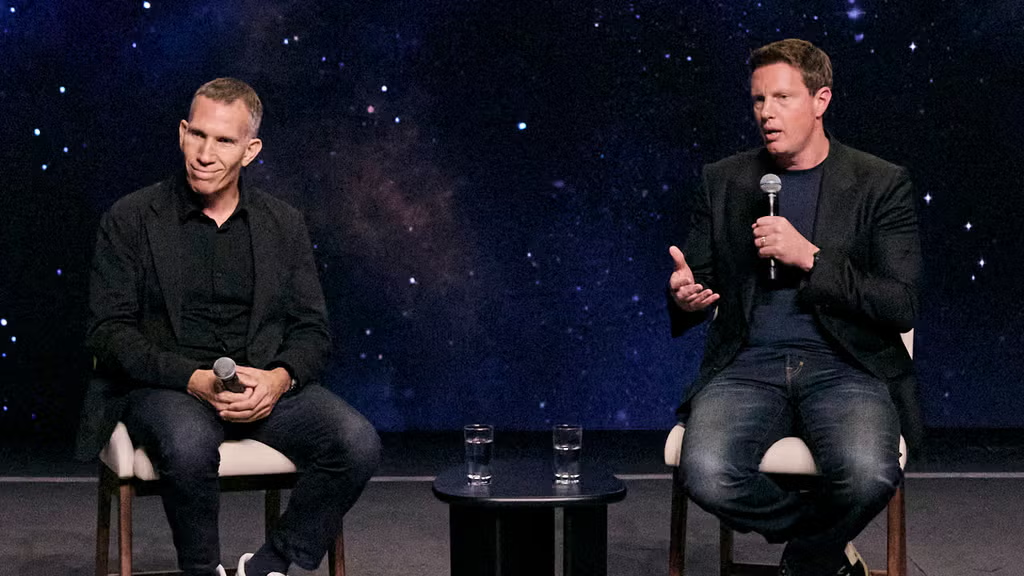
It’s unclear exactly what Skydance plans to do with its massive cable catalog. When asked about those assets at the company’s kickoff event on Tuesday, Co-CEO Ynon Kreiz focused instead on increasing output for the company’s three major TV studios: CBS Studios, Warner Bros. Television and Paramount Television Studios.
“When you do that, you can then drive growth in your [direct-to-consumer] business. You can continue to optimize your linear channels around the world, which is a large business,” Kreiz said. “That symbiotic relationship is the underpinning of the model.”
But no amount of optimization will reverse the fact that people are leaving cable, and they’re not coming back.
Meanwhile, streaming is just starting to prove that it can be profitable. For example, during its second quarter earnings report, WBD reported that its streaming division surpassed $3 billion in revenue. Co-CEO David Ellison has previously said that a combined Paramount+ and HBO Max service would have about 200 million subscribers globally, and there’s reason to believe that a lot of these subscribers will be watching ads, a key revenue stream for TV. The market data company Antenna estimated that, as of August, Paramount+ had 12.8 million ad-supported subscribers in the U.S. while HBO Max had 12.9 million ad-supported subscribers.
Even as Skydance’s streaming trajectory looks bright, the company is still facing the same question that’s haunting all of television: Can streaming make enough money to offset the end of the cable gravy train?
It’s too early for anyone to have a clear answer. But in the wake of Skydance’s latest acquisition, here are all the TV assets the company now owns, who’s in charge of what and which networks to watch in the coming months.
Skydance TV’s networks
Unlike the film side of the business, the proposed consent decree does not require that Skydance produce a set number of TV shows. However, there are restrictions that require affiliate fee negotiations for cable channels to be kept separate, meaning that Skydance cannot require a partner to take Paramount’s channels as part of a WBD negotiation and vice versa. If this term is breached, Paramount may have to divest several channels including BET, VH1, Comedy Central, Smithsonian, Destination America and Science.
But that’s essentially a slap on the wrist when you take a look at the full scope of what Skydance TV controls:
The Paramount players:
On the television side, there are five divisions within Paramount: CBS Entertainment Group, Showtime Networks, BET Media Group, MTV Entertainment Group and Nickelodeon Group. Across those divisions, Paramount owns 44 TV networks and specialized programming blocks across broadcast and cable. Specific programming blocks are included in this count because, while a network like Nickelodeon may attract a specific audience, a block like Nick at Nite has the potential to attract an entirely different kind of audience, an offering that can be attractive to advertisers. In fact, between the two examples, Nick at Nite was far more watched last year than Nickelodeon.
Here’s the full list of Paramount-owned channels and specialized programming blocks in alphabetical order. The major ones that were among the top 100 most-watched channels in 2025 are in bold:
- BET
- BET Gospel
- BET Her
- BET Jams
- BET Soul
- CBS
- CBS Sports
- CBS Sports HQ
- CBS Sports Network
- CMT
- Comedy Central
- Dabl
- Flix
- General Entertainment Content
- Logo TV
- The Movie Channel
- The Movie Channel Xtra
- MTV
- MTV2
- MTV Classic
- MTV Live
- MTV Tres
- MTVU
- Nickelodeon
- Nick at Nite
- Nick Jr.
- Nick Jr. Channel
- NickMusic
- Nicktoons
- Paramount Network
- Pop TV
- Showtime
- Showtime 2
- Showtime Extreme
- Showtime Family Zone
- Showtime Next
- Showtime Showcase
- Showtime Women
- SHO×BET
- Smithsonian Channel
- Start TV
- TeenNick
- TV Land
- VH1
The Warner Bros. Discovery players:
Compared to Paramount’s 44 networks and notable programming blocks, Warner Bros. Discovery only has 34. However, 18 networks owned by WBD were among the top 100 most-watched networks of last year compared to the 13 Paramount-owned networks that made that same list.
Here’s the full list of WBD-owned channels and specialized programming blocks in alphabetical order. The ones that made it in the top 100 are in bold:
- Adult Swim
- American Heroes Channel
- Animal Planet
- Boomerang
- Cartoon Network
- Cinemax
- CNN
- CNN Business
- CNN en Español
- CNN International
- Cooking Channel
- Destination America
- Discovery Channel
- Discovery en Español
- Discovery Family
- Discovery Familia
- Discovery Life
- Discovery Turbo
- Food Network
- HBO
- HGTV
- HLN
- Hogar de HGTV
- Investigation Discovery
- Magnolia Network
- MLB Network
- Oprah Winfrey Network
- Science Channel
- TBS
- TLC
- TNT
- TNT Sports
- Toonami
- Travel Channel
- TruTV
The streaming players:
The last part of Skydance’s enhanced TV portfolio is the part everyone wants to talk about: the company’s many streaming services. Paramount’s direct-to-consumer platforms include Paramount+; Pluto TV; SkyShowtime, which is a joint venture with Comcast and set for divestiture; and Philo, which is a joint venture with A+E Global Media, AMC Global Media and Warner Bros. Discovery.
As for WBD, the company’s DTC offerings include the aforementioned Philo, HBO Max, Discovery+, Cinemax and CNN All Access.
Eventually, Skydance plans to combine Paramount+ and HBO Max. But since that will take time, audiences can expect more streaming bundling options in the short term.
“We will definitely look to bring the tech stacks together as quickly as possible,” Ellison said during Tuesday night’s press event.
The leaders taking charge of Skydance TV
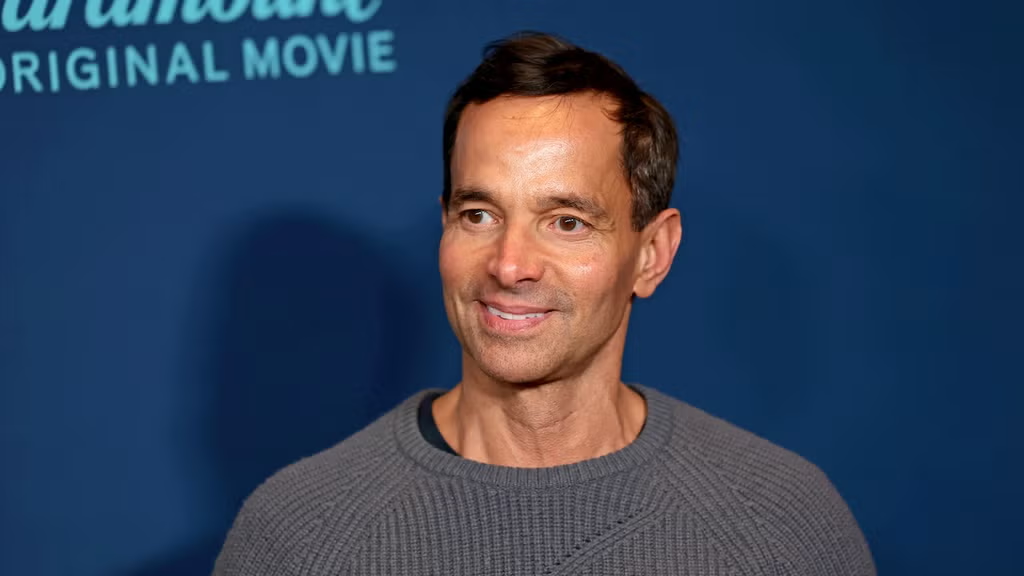
There have been a lot of promotions and reshuffling in the wake of this merger, but there are basically four TV-related buckets to keep in mind: Skydance TV, Skydance DTC (direct-to-consumer), DC Studios and the news division, which includes CBS News and CNN.
Let’s start with the big boy: Skydance TV.
George Cheeks will be leading Skydance TV as co-chair and chief content officer. Cheeks is the last Paramount CEO standing, so to speak. After Bob Bakish stepped down as CEO of Paramount Global in 2024, Cheeks replaced him alongside fellow co-CEOs Brian Robbins and Chris McCarthy. Both Robbins and McCarthy have since left the company, with Robbins founding the entertainment company Big Shot Pictures and McCarthy moving with Taylor Sheridan to NBCUniversal. But Cheeks, the longtime executive who has specialized in CBS, news and sports, stayed with Paramount during the merger. In this new role, he will have three major players — all heads of TV studios — under his watch.
Channing Dungey, the former president of ABC Entertainment and chairwoman of Warner Bros. Discovery U.S. Networks, will report to Cheeks as the chairman and CEO of Warner Bros. Television Group and U.S. Networks. Dungey is an experienced exec with a good eye for talent; she worked closely with both Shonda Rhimes and Kenya Barris when they left ABC for Netflix, and she worked with WBTG to produce massive hits like Apple’s “Ted Lasso,” ABC’s “Abbott Elementary” and HBO Max’s “The Pitt.” Dungey will take over Paramount cable networks while continuing to run Warner Bros. TV Group.
The next executive under Cheeks is Matt Thunell, the president of Paramount Television Studios. Thunell is a bit of an old timer under this new reign. He was promoted to his current position the last time Skydance acquired a multi-billion dollar media company (aka last summer). Thurnell has been behind the development of major shows like Prime Video’s “Reacher,” Apple’s “Foundation,” Showtime’s “Dexter: Resurrection” and Netflix’s “Emily in Paris.” Much like Dungey, Thunell is on the studio side. That means that while he and his team may make shows for Paramount or WBD, they’re largely platform agnostic.
Rounding out Cheeks’ direct reports is CBS Studios President David Stapf. Stapf is the longest-tenured head of a TV Studio in modern history, having run CBS Studios since 2004. A survivor of the CBS-Paramount merger that has overseen properties such as “Star Trek” and “NCIS,” it’s unlikely that he’s going anywhere soon. He and CBS Entertainment president Amy Reisenbach last renewed their deals through 2028.
Then there’s Casey Bloys, the new co-chair and chief content officer for Skydance DTC, who is taking over the role after Cindy Holland’s departure. There aren’t many TV executives whose work is well known enough to turn them into household names, but Bloys is close to that level. Bloys has overseen HBO’s programming since 2016 and has been in charge of HBO Max since 2020, leading the network through such massive hits as “Game of Thrones,” Succession” and “The Last of Us.” Bloys will oversee original programming as well as strategy, operations, communications and performance across the company’s streaming platforms, which include both HBO Max and Paramount+. He will report directly to Ellison.
The final player for both Skydance TV and Skydance DTC is JB Perrette, who will be both Skydance TV and Skydance DTC’s co-chair and chief business officer. Formerly the head of Global Streaming and Gaming at WBD, Perrette was David Zaslav’s righthand man and was responsible for the rollout of HBO Max across more than 130 global markets. In this new role, Perrette will have global oversight over distribution, advertising sales, content sales, DTC strategy, marketing and business operations. Basically, if Cheeks and Bloys are the content heads, Perrette is there to make sure everyone gets paid.
The other two TV-related divisions of the company are less complicated. On the DC Studios side, James Gunn and Peter Safran will serve as co-chairmen. Though Gunn and Safran are often thought of more as movie guys, HBO’s latest DC additions, including “The Penguin,” “Lanterns” and “Peacemaker,” prove that the duo has a plan for their superhero universe beyond the big screen. They’ve been leading DC Studios since 2022, and WBD seems happy with the fruits of their labor.
That leaves arguably the most discussed leaders in Skydance TV: CNN Worldwide Chairman and Editor-in-Chief Mark Thompson and CBS News Editor-in-Chief Bari Weiss. The former president and CEO of The New York Times Company as well as the former director-general of the BBC, Thompson is a news veteran. He took over CNN in 2023 after Chris Licht was ousted. Though he faced some criticism over CNN’s coverage of the Gaza War, Thompson seems to be generally accepted as a solid leader for the network.
That’s not necessarily the case for Weiss. A former op-ed columnist for the Wall Street Journal, Weiss’ time leading CBS News has been plagued by controversies ever since she took over the position last year. She’s been accused of rewriting a script for Tony Dokoupil to be more favorable to President Trump, spiking a “60 Minutes” story about the Salvadoran Terrorism Confinement Center and firing “60 Minutes” veteran Scott Pelley – to name a few of the reasons why her name has made headlines.
Despite the fact that these two news organizations will be owned by the same parent company, Ellison emphasized that they will not be combined.
“We’re going to make sure that CNN and CBS News are completely editorially independent,” he said.
Where does Skydance TV go from here?
Though cable has been largely written off as a dying industry, there are several Skydance-owned networks that have value beyond their linear viewership and whose brand equity has been unrealized. For example, MTV was once a revolutionary hub for youth culture just as Comedy Central used to be a vital venue for developing emerging comedic talent.
“These were really meaningful brands, brands whose meaning were disproportionate to their economic heft, even at the best of times,” Basin said.
These networks may not mean as much to Gen Z or Gen Alpha viewers, but older generations have a great deal of affinity for them. It would be shortsighted not to capitalize on those networks, especially as Ellison and Kreiz seem dedicated to increasing Skydance’s content output.
In addition to MTV and Comedy Central, Cartoon Network, Nickelodeon, Adult Swim, BET, Food Network, Investigation Discovery, HGTV, TLC and CMT all fall into this category. Basin could see a reality where certain cable networks could become bigger players in the streaming age, either through designated network tiles highlighted on streaming services or in other ways.
“Not all of these cable channels have enough brand equity left — if they ever did — to sustain that independent identity. I don’t know that truTV gets you very far or that TBS means much to people anymore,” Basin said. “But the things that are closely associated with a genre, culture or an audience, I think streaming services will continue evolving toward looking like MVPDs or cable satellite providers.”
Specifically, Basin could see a combined ad sales team for Cartoon Network and Nickelodeon, two longtime leaders in children’s entertainment. During a time when YouTube is so popular with Gen Alpha, having a contained entertainment hub is an appealing value proposition for parents.
“I don’t think that you’re going to bring in some energetic new leader and all of a sudden Cartoon Network is gonna have a roaring comeback. But I think that Cartoon Network has a lot of brand equity,” Basin said.
Last year, after Skydance officially acquired Paramount, former Paramount Skydance Corporation President Jeff Shell told TheWrap that there were no plans to spin off any of the company’s cable assets. Shell also noted that the company still saw a great deal of value in both MTV and Comedy Central but that it was unlikely the future of these brands would continue to live only in the linear space. Though Shell has departed, it seems likely that’s the general sentiment.
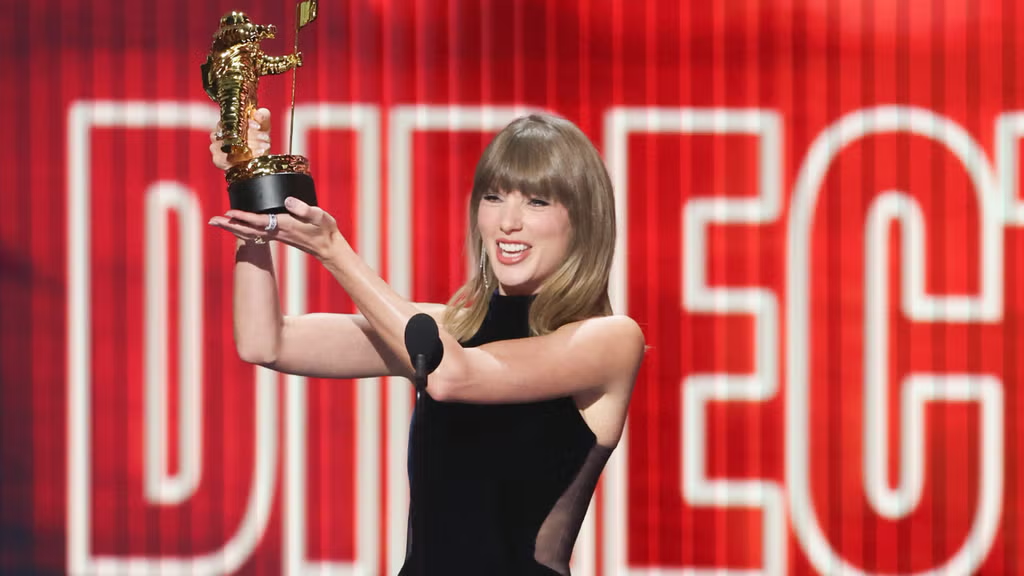
Some of these specific cable networks have already been experimenting with new ways to stay relevant. The VMAs aired on MTV and CBS for the first time in 2025 and secured the awards show’s largest audience since 2015 this year. And prior to the merger, Food Network partnered with TikTok to release a creator-focused “Hot List” as well as a live show on TikTok, while both Adult Swim and Cartoon Network have a long history of new talent coming to them because of their legacies.
Whatever lies ahead, Ellison seems keen to correct the squandered potential around several of Skydance’s assets.
“With all the respect in the world to everybody that has existed at these companies prior, how we got here to a place where Paramount could be acquired and Warner Bros. could be acquired is that the businesses didn’t disrupt themselves over a decade ago. They allowed Netflix to disrupt their business. They allowed Amazon Prime Video to come and disrupt their business,” Ellison said. “They didn’t transform, and they held on to the past for too long. It is a certainty that if you don’t disrupt your business, somebody else will do it. This [merger] is the solution to basically that problem. By putting these two companies together, both of which were late in their initial transition to streaming, you dramatically accelerate that growth.”
The post Skydance’s New TV Empire Explained: Who’s in Charge and What May Be Ahead | Analysis appeared first on TheWrap.