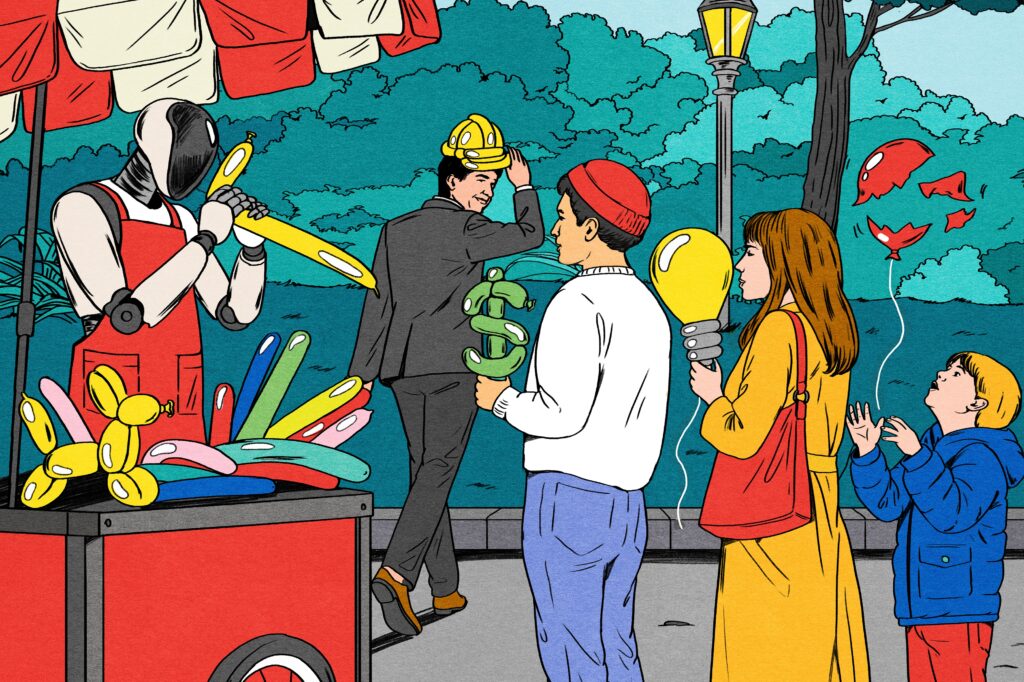
Some economic repercussions of the artificial intelligence boom are impossible to miss. There are data centers measured in miles and retirement accounts soaring from the stock market’s AI mania.
But like waves pounding a coastline, AI is steadily reshaping parts of the U.S. economy in ways that aren’t immediately obvious. Zooming in on those changes reveals how the AI investment boom is creating economic dynamism but also instability.
In San Francisco and New York, AI companies are grabbing office space fast enough to revive commercial real estate — and also drive up rents for everyone else. Across the United States, the data center construction spree is boosting employment in some sectors and buoying once-fringe ideas for energy generation — but also fueling anxiety about what happens if the AI boom goes bust.
As the U.S. economy increasingly depends on AI, optimism about the technology’s potential is tempered by a growing awareness of its economic headaches and the risk that the AI boom could collapse, threatening Americans’ prosperity, corporate profits and the country’s growth.
A bright spot for U.S. manufacturing jobs
While Americans fear a white-collar job wipeout from AI, the data center construction boom has provided a dose of good news for the U.S. manufacturing sector, which has shrunk by hundreds of thousands of jobs in the past few years.
Employment for people who build the equipment and parts that data centers run on — including gas turbines to generate power, wiring, electrical switchboards and other specialized components — is one of just two categories of manufacturing jobs that have consistently grown in the past few years, according to an analysis by Jiaxin He, a research assistant at the bipartisan think tank Economic Innovation Group.
He found that wages are also surging for those specialized electrical component jobs. (Aerospace-related employment is the other growing category of manufacturing.)
That manufacturing boost, combined with extra employment of electricians and skilled trade workers on site at data centers, suggests that President Donald Trump has a point about the unpopular data center building spree: It has been an economic boost in some ways.
If the data center building mania only lasts a few years, the jobs it creates might not sustain a full lifetime of work.
But Rachel Lipson, a research fellow at the Harvard Kennedy School and author of “The New American Frontier: Job Training for the Next Technological Age,” believes that data center-related manufacturing and construction work will hold up at least for awhile, even if the AI boom doesn’t. She said there’s a big backlog of data center projects that can last for years, and that existing data centers require a permanent, specialized workforce.
Lipson said, though, that would-be employees get spooked when manufacturing projects are canceled or delayed. She said the fear that job opportunities won’t last can create a talent drain, as workers look to alternatives.
Jet engines remade into power plants
As power-guzzling AI data centers mushroom across the country, more are being built with their own private power plants to help supply the electricity they need.
That has kicked off a transformation of the energy industry and of the Wall Street money machine to pay for the projected explosion in electricity demand. One piece of machinery has become essential in the data center energy mania: hulking industrial generators.
These machines, some of which are essentially jet engines, have doubled or tripled in price over the past five years, said Mark Axford, who advises companies on deals for natural gas-powered generators known as gas turbines. Data centers have ordered so many that he says the typical wait time for popular models has stretched to four years.
“Nobody has ever waited that long for a gas turbine,” said Axford, a 45-year industry veteran and president of Axford Turbine Consultants.
Data centers are generating their own electricity partly to move faster than utility companies and in response to complaints that they’re straining U.S. electric grids and driving up household utility bills. Some local communities and environmentalists are now alarmed about pollution caused by Silicon Valley companies that previously pledged to lower planet-warming emissions.
But the new interest in power generation is creating opportunities for what have been less popular or unlikely energy ideas that could benefit everyone or go nowhere.
Axford and Whitaker Irvin Jr., chief executive of Q Hydrogen, say that alternatives to fossil fuel energy such as hydrogen, solar and nuclear power are getting a fresh look in an era of soaring AI energy demand.
“It’s shocking how quickly everything changed,” Irvin said.
Axford has seen energy booms turn into crashes before and he’s worried about another deep freeze if the AI boom falters. “The real question sitting out there is how long will this continue,” Axford said. “We’ll find out.”
A real estate boom built on chatbots
For years after the coronavirus pandemic hit, vast tracts of office space sat empty in New York and San Francisco towers. Now, deep-pocketed AI companies are helping propel a commercial real estate revival.
In the city at the heart of the AI boom, AI companies account for about half of newly leased office space in San Francisco this year, according to real estate firm CBRE. Another real estate firm, Savills, said AI companies are responsible for about one-third of new leases.
San Francisco’s office vacancy rate remains much higher than it was before the pandemic. But flush AI tenants are great for landlords and for the vitality of San Francisco, where business corridors turned into ghost towns starting in 2020.
The downside is that the AI money is creating tough competition for every other would-be tenant.
“Other companies are having a harder time finding space because of the AI demand,” said Colin Yasukochi, executive director of CBRE’s tech insights center. Highly paid AI workers are also making San Francisco’s expensive housing market even crazier.
Michael McCandless, a veteran San Francisco real estate executive with Savills, said there’s a risk of a dot-com style implosion in “the boom-bust historic San Francisco way.” AI may be new but the risky economic dynamics it’s creating are not.
Even in much larger New York, AI companies are big factor in what CBRE estimates is a decade high in Manhattan office leasing. That’s causing both glee and worries about the future.
Last week, an influential pro-business group in New York said it was worried that AI companies are overextending themselves on office leases while AI is potentially eroding local jobs in industries such as finance and media.
Office leasing growth should not be “mistaken for broad-based economic opportunity,” said the report from the Partnership for New York City.
More ads everywhere
AI is also one of the biggest forces behind a near-record surge of advertising across the web, mobile apps, streaming video services, television and newspapers, according to an analysis by Madison & Wall, a technology and media consulting firm.
Both young and more established AI companies are spending gobs of money to promote themselves to people and business customers, including in a blitz of Super Bowl TV commercials this year.
AI technologies are also making it easier for businesses to create, target and buy advertising messages placed with Google, Meta and others. Because AI has squeezed the fees that firms can charge for human-created ads, companies have more budget to spend on ads, said Luke Stillman, managing director at Madison & Wall.
Stillman estimated that those AI influences are adding tens of billions of dollars to the yearly total that businesses spend on advertising.
Stillman noted that the advertising market had been healthy for years before AI recently became an economic force. But if the boom cools or collapses, he said it would likely dent consumer and business confidence as well as economic growth, ultimately shrinking what businesses spend on marketing.
“There are not other obvious pockets of demand with enough scale to fully replace the AI-related tailwinds if they disappear,” Stillman said.
The post The unexpected ways that AI is reshaping the U.S. economy appeared first on Washington Post.