Last year, Mickael Mauger got his hands on a tiny electrical switch unlike any he had ever seen.
Dr. Mauger is in the business of building equipment that pumps electricity into the world’s computer data centers. This requires specialized switches that can detect a dangerous power surge and shut down the flow of electricity.
But these circuit breakers are always flawed. Dr. Mauger had to choose between an old-fashioned mechanical switch the size of a baseball, which is painfully slow, and a superfast sliver of a switch built from silicon, which wastes enormous amounts of electricity.
Then he discovered a switch that was fast, efficient and small enough to sit on the end of his index finger. When he spoke to the company that made it, he asked, “How is this even possible?”
This unusual device came from a start-up called Atomic Machines, which is taking a new approach to industrial design and manufacturing. Drawing on the power of artificial intelligence, the company is building what it calls a “matter compiler” — an automated manufacturing system that turns computer code into a physical device, much like a software compiler that transforms code into a working software application.
The company’s new electrical switch is the first device to emerge from this multifaceted system, but as the company refines and expands its technique in the years to come, it hopes to create many more.
“A matter compiler allows you to make machines you cannot make by other means,” said Jeff Holden, the company’s founder, who once ran the self-driving car project at Uber.
He envisions building unusually small gears and motors that drive what he calls “microrobots.” These could help perform surgeries — or further improve manufacturing techniques. He even foresees a device that can instantly run medical tests on a few drops of blood — the very thing that was promised by the disgraced entrepreneur Elizabeth Holmes and her start-up, Theranos.
“Building the Theranos device requires a different kind of manufacturing technology,” Mr. Holden said.
Atomic Machines is among several high-profile efforts to apply the latest A.I. techniques to physical tasks, including robotics, drug design and other forms of scientific discovery. Much as chatbots can learn to write by analyzing enormous amounts of text culled from across the internet, other A.I. technologies can learn skills by pinpointing patterns in data collected in the physical world.
But efforts to revamp manufacturing in this way are rare and enormously difficult, said Eugene Chow, an electrical engineer with the Lawrence Livermore National Laboratory in Livermore, Calif. “The U.S. desperately needs more of this,” he said. “We have seen an explosion in A.I.-driven design, but how we realize these designs physically is still very primitive.”
Inside a small industrial center in Emeryville, Calif., Mr. Holden and his team of electrical engineers aim to revamp what are called microelectromechanical systems, or MEMS — tiny devices made from both electrical and mechanical components. These devices include things like tiny gyroscopes installed in smartphones and microphones inside hearing aids.
Traditionally, companies manufacture these devices much like computer chips, using photolithography to etch microscopic designs into silicon and other semiconductors. But the possibilities are limited by the physical properties of a semiconductor.
A circuit breaker etched into a silicon wafer can switch off very quickly, which can help stop a power surge. But by definition, semiconductors do not conduct electricity as well as other materials, which means they waste valuable power and emit prodigious amounts of heat. That is a growing problem inside the world’s data centers, which have grown increasingly large and power hungry.
Using the same techniques that drive a chatbot, Atomic Machines is building A.I. technology that can discover new ways of designing extremely small devices. By analyzing thousands of experiments involving standard manufacturing materials and finding patterns in how these materials interact, it learns to piece them together in ways that produce viable devices.
These experiments might involve mixing and matching different materials, heating them to a range of temperatures, assembling them in various combinations and testing the behavior of each.
“We work to find the best materials for the job,” said Eric Meshot, director for process engineering at Atomic Machines.
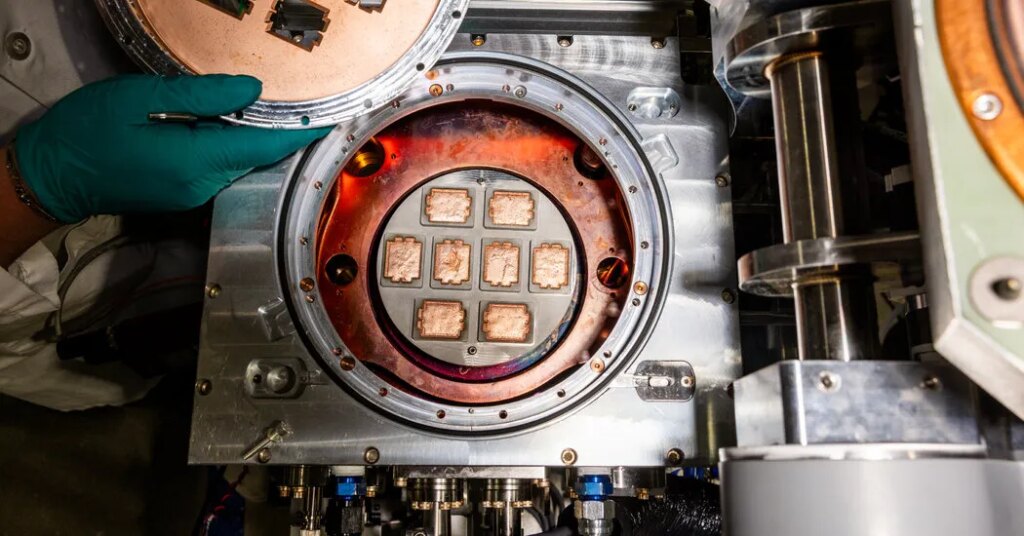
This A.I. system merely provides a blueprint for each device. But it can feed this blueprint into Atomic Machines’s matter compiler — a chain of 13 automated manufacturing machines that build and test the device’s many components.
“A software compiler gives you digital output,” Mr. Holden said. “A matter compiler gives you physical output.”
Today, this process still requires the helping hand of electrical engineers like Mr. Meshot. Though the machines can build and test each component, the engineers move the components from machine to machine and help piece them together into the final device.
The hope, however, is that the machines can eventually recreate the blueprint on their own. The more devices the company builds, the more data it generates. “We are building real devices,” Mr. Meshot said. “And along the way, we are gathering data that can improve that process.”
The post The Start-Up That Wants to Build ‘Microrobots’ With A.I. appeared first on New York Times.