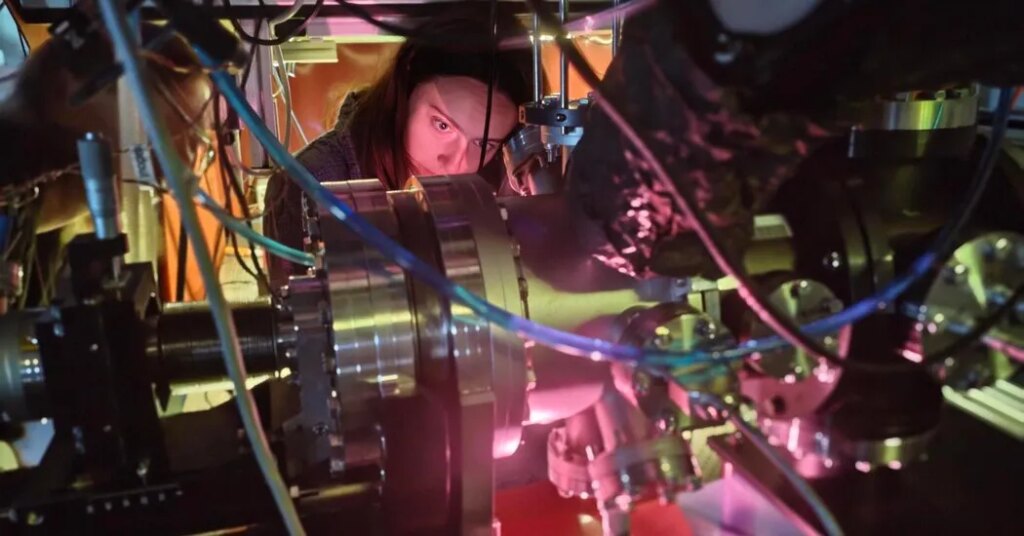
Telling time is an affair of counting ticks and tocks. Whether it’s the dulcet swoosh of a pendulum in a grandfather clock, or the rapid oscillations of electrons in an atomic clock, the principle is the same.
Two independent teams in Vienna and Beijing have now simultaneously built the first clocks that keep time by counting the squishing and unsquishing of the atomic nuclei of thorium, a heavy radioactive element.
These nuclear clocks are so precise they would lose one second once every few million years or so. The findings were reported in the journal Nature on Wednesday.
Experts who reviewed the study before publication lauded the results as a major breakthrough and a significant milestone for the emerging field of nuclear clocks. This field is “moving at breakneck speed,” said Eric Hudson, a physicist at the University of California, Los Angeles, who also works on nuclear clocks but was not involved in the latest research.
The first nuclear clocks are not going to immediately supplant the worldwide network of atomic clocks, whose steady ticking we rely on for GPS and the definition of a second. Nor have they captured the record for most precise timepiece; the best atomic clocks are about 10,000 times more reliable and would take more than 100 billion years to lose one second.
But nuclear clocks hold a bevy of potential advantages over existing atomic clocks. One day, they could be more reliable than the leading atomic versions, and nuclear clocks could be made more portable. They even hold the ability to search for certain kinds of dark matter — the invisible stuff whose clumps make up 83 percent of the matter in the universe. If a particle of dark matter passed through the thorium nuclei, it could register as a wobble in the nuclear clock’s otherwise steady ticktock.
The clocks thus offer “a new window” into dark matter’s effect on the nucleus, said Elina Fuchs, a theoretical particle physicist at Liebniz University Hannover in Germany who was not involved with the latest studies.
A nuclear clock works by shining a laser on the nucleus of an atom and counting how rapidly the nucleus toggles between two configurations called isomers. During this process, the nucleus resembles an American football being squeezed into a pear shape and then allowed to spring back, said Thorsten Schumm, a physicist at TU Wien and a leader of the Vienna team.
Atomic nuclei require a lot of energy to squish, with one exception: the isotope thorium-229.
In 2003, researchers realized that they should look for the resonant frequency of thorium-229. Much like an opera singer hitting just the right frequency to make a wineglass ring, the scientists could shine a laser with that exact frequency to make the nuclei vibrate between squished and unsquished states. By counting the rapid oscillations, they could have a clock. After a two-decade search, several groups of researchers pinned down thorium-229’s frequency: 148 nanometers, well into the ultraviolet spectrum.
With that knowledge in hand, several teams around the world began racing to create a working clock. But they had to contend with difficulties like the scarce availability of thorium-229: It’s an extremely rare substance that is obtainable only from the decay of weapons-grade uranium.
And there was an even hairier problem: No one had ever made the necessary type of laser with a frequency as high as 148 nanometers.
Researchers are finding ways around these obstacles. The Beijing team had only one microgram of thorium-229 to bake into a crystal of calcium fluoride. To compensate, its members developed a way to make a powerful 148 nanometer frequency laser using a heated gas of cadmium. The Vienna team lacked such a powerful laser but was able to secure access to thorium-rich crystals.
The last element of a clock is a feedback loop. Similar to a pendulum clock that slows its swing and needs to be wound up, the laser’s frequency can drift. To address this problem, the Beijing and Vienna teams devised setups to measure and correct the laser — stabilizing the clock’s tick.
Then it was time to count. Both teams fired their lasers into the thorium-doped crystal and measured the rapid oscillation of the nuclei: football, pear, football, pear. Ultimately, the two approaches resulted in similar performances. The Vienna clock would lose a second every few million years. The Beijing clock was a little better; if it had run since the asteroid impact that wiped out the non-avian dinosaurs 65 million years ago, it would have lost only about two seconds.
Researchers chasing nuclear clocks are optimistic that these first versions will be built on in leaps and bounds, as better crystals and more powerful lasers make their way onto the scene.
“There’s still much room for improvement,” said Shiqian Ding, a physicist at Tsinghua University who was a leader of the Beijing team. “It’s just the beginning of this field right now.”
The post In Vienna and Beijing, the First Nuclear Clocks Begin to Tick appeared first on New York Times.