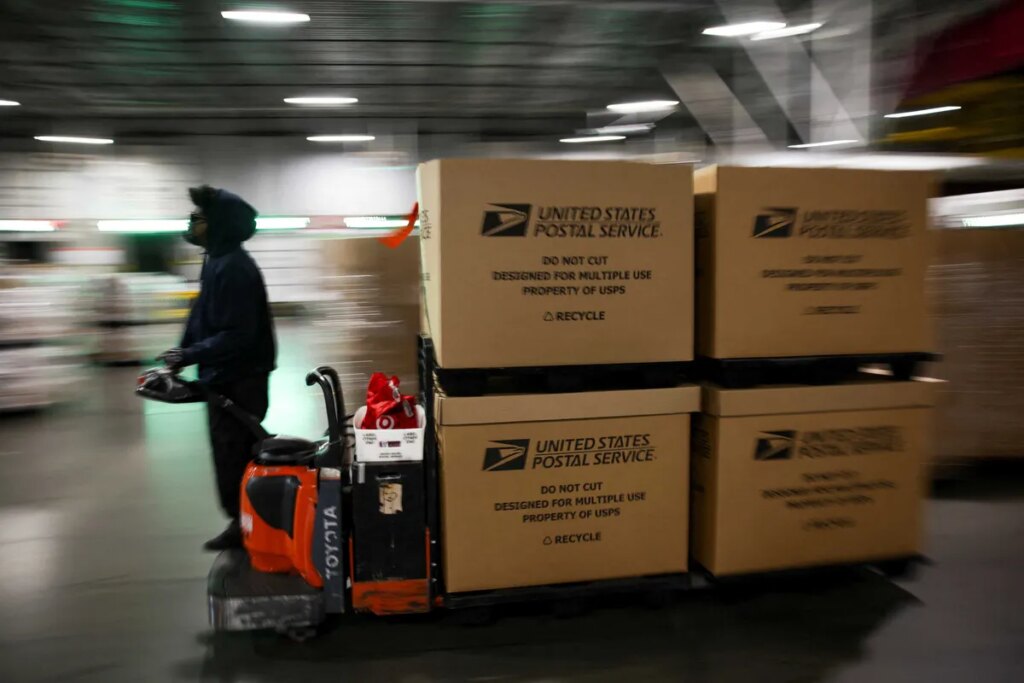
Alarms are blaring as the United States Postal Service orders an influx of contracted-out armed security at facilities just weeks before the midterm elections.
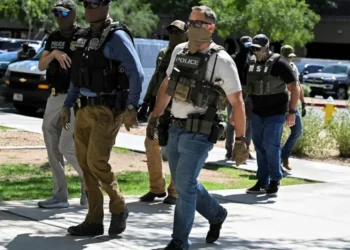
Nearly 1,000 armed security officers (ASOs) have been deployed in at least 55 USPS facilities through a private contractor, multinational security firm Prosegur, which has a history of alleged human rights abuses and price fixing, according to a recent Raw Story investigation.
President Donald Trump waged a war on mail-in voting earlier this year when he issued an executive order limiting who would receive mail-in ballots. But, six months later, the Supreme Court rejected his push for USPS to impose some mail-in voting restrictions.
This week, Trump made an about-face from his frequent criticisms of mail-in voting to encourage Republicans to vote by mail for the Nov. 3 elections.
Still, the timing of installing armed guards employed by a private security company has left many worried, including current and former USPS employees.
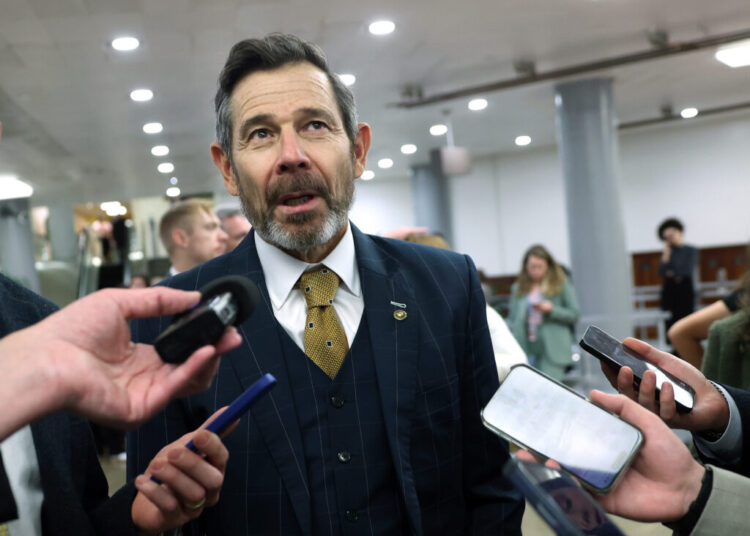
“The Trump administration is clearly taking every step they can to control voting, and they’re going to use the Postal Service to do that,” said Mark Ungar, a political science professor with the John Jay School of Criminal Justice in New York who has studied privatized security firms like Prosegur.
“Any contract with Prosegur, any way that removes accountability from the American people of the Postal Service, which they’re already doing, I think, is concerning at the very least.”
Claire McKean, a postal contractor and investigative researcher, said she was “alarmed” when she started seeing armed security guards deployed in mostly “deep blue states or swing states.”
ASOs are located at USPS facilities coast-to-coast in places like Atlanta, Chicago, Denver, Indianapolis, Phoenix, San Diego and Tampa, according to internal memos.
They are most commonly deployed at facilities with 1,000 or more employees, said Frank Albergo executive director of the Postal Police Officers Association union, which is notified whenever a new facility plans to deploy ASOs.
“No one from the postal service will be supervising these armed guards. It will be completely a private contractor who controls these armed guards, so you basically have private contractors in and around ballots without any federal control. To me, that’s crazy,” Albergo said.
“It just could be a red flag. Will it have an impact on the election? Who knows? But you certainly could argue that it has an effect … it might give Trump an excuse to call into question the integrity of the election. That’s the problem. It’s the perception of it.”
In response to multiple questions from Raw Story, a spokesperson for the United States Postal Inspection Service (USPIS), the law enforcement arm of USPS, sent an emailed statement.
“At key facilities throughout the country, we have had a mix of armed and unarmed contract security officers in addition to the current career employee Postal Police Officer (PPO) complement,” the spokesperson said.
“They are deployed to provide security and act as a deterrent to criminals or employees who may wish to compromise the mailstream or potentially harm the people inside. To maintain operational security, we do not disclose specific locations of security force deployments. The deployment of armed guards is part of our overall security plan and is not specific to elections.”
In response to Raw Story’s inquiry, a Prosegur spokesperson sent an emailed statement.
“We looked into the allegations you raised and could not find any incidents or complaints as you referenced,” said Fernando Geijo, a spokesperson for Prosegur. “Further, we are not in a position to discuss the USPS account for confidentiality reasons.”
‘Really suspicious’
Founded in Spain 50 years ago, Prosegur has expanded to multiple regions — from Africa to Australia to Central America, South America and Asia.
The company has been accused of violations of human rights and labor codes, threats to union workers and unsafe working conditions, particularly in Latin American countries.
“They are now contractors to the U.S. Postal Service to provide security for the huge regional distribution and processing facilities all over the country here, and it’s like what the hell? My head is exploding,” McKean said.
“How can this be happening with this company, that has this background, has this footprint, that’s been involved in all of this stuff, sending armed guards into our postal facilities just before the midterm elections?”
Jim Bjork, a former postal police officer (PPO) and current armed security guard for a different federal agency in the Chicago area, said PPOs historically have been 80 percent minorities and tend to be Democrats, stationed in large metropolitan areas.
The union for PPOs has been embroiled in a six-year battle with USPS after the agency effectively benched its own officers from patrolling the streets where crime against letter carriers was spiking.
“My biggest concern with these armed contractors is the election. The timing is just really suspicious to me. Without being too political, Trump always seems to have a second or third avenue in everything he does,” said Bjork, a former president of the Postal Police Officers Association.
“It’d be hard to manipulate your own police force to do your bidding because there’d be accountability that would concern them, that our own people are involved in whatever hijinks are afoot in terms of ballots that are coming into a postal facility.
“Whereas with a contractor, you just disavow any knowledge of it, but you still have them do it.”
‘How do we know?’
McKean questioned the intentions behind the deployment of private security armed guards, particularly those provided by an international company involved in cash management, security and armored car services.
“How do we know that they’re not going to have armored trucks pull up, load up all the ballots into armored trucks while the armed security officers stand there and make sure that nobody interferes?” McKean said.
Albergo theorized Trump could issue an executive order about private security. Trump has long supported the idea of privatizing the agency.
“Trump could issue a direct executive order that says, ‘Oh, by the way, all federal security will be done by American companies.’ He hasn’t done that, but what if he threatens that?” Albergo said.
“Now he would have control over Prosegur. Prosegur would do basically whatever he said.”
‘Very curious’
Miriam Bell, president of the Charlotte Area Local American Postal Workers Union (APWU,) said the hiring of ASOs is likely an attempt at union busting, since PPOs are unionized.
Her chapter has filed complaints about Prosegur-contracted armed security guards at a regional processing and distribution center (RPDC) who made members feel unsafe, in one case allegedly shoving a worker to the ground and punching her in the face.
In another case, Bell called out security guards for sleeping on the job.
Bell said the ASOs are hired at a local building that processes packages, not standard mail.
“I think it’s really strange. If they were going to have security guards, they would have them in both places if it were just for the election,” Bell said.
“They were supposed to be patrolling the parking lot to keep things secure, but now they’re all inside, and they’re only putting these in these RPDC buildings, not in the buildings that process the actual mail, which is very curious to me.”
With USPS consistently losing billions of dollars in recent years — clocking $2.5 billion in net losses in the third quarter alone this year — contracting with Prosegur for millions of dollars in security costs could just be a poor business decision, Albergo said.
“What I found with the Postal Service is never ascribe malice where just complete incompetence can also explain something,” Albergo said.
But, he added, “It’s absolutely conceivable that this is part of some larger strategy.
“Is there a track record of the Postal Service in favor of things that somehow separate a ballot from a voter. Yeah … and can armed guards be used in that way? Maybe. Who knows?”
The post Fears swirl as armed guards swarm USPS weeks before midterms: ‘Really suspicious’ appeared first on Raw Story.