Jay Mathews was a Washington Post reporter and columnist from 1971 to 2022.
I was lost in Fontana, California, late for the funeral of a friend’s wife. I stopped at a pawn shop, hoping for help from a bearded man at the counter. But I didn’t understand the first words he said to me: “Thank you for your service.”
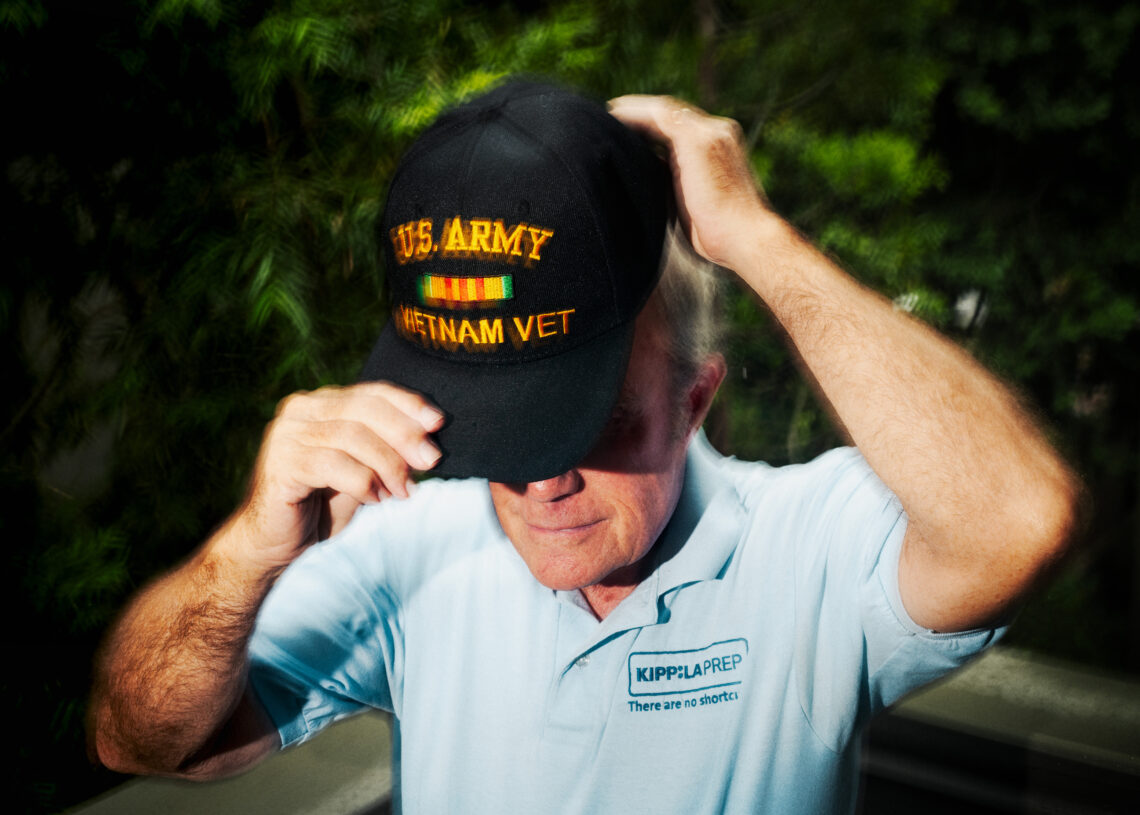
Huh? Oh, right. He was focused on my cap, the one I sometimes wear for solemn occasions. It says “U.S. ARMY VIETNAM VET,” with a replica of the green, yellow and red Vietnam service ribbon. As usual, I had forgotten I had it on. That’s why I am often confused by unexpected expressions of gratitude.
I thanked him back, and he gave me good directions. It occurred to me, not for the first time, that while our country may be torn by political battles, it is united in respect for long-standing institutions like the military. This realization has grown out of a decision I made when I was very young — one of the most important of my life.
It happened in 1967, just after the memorable day when I graduated from college and married my brilliant classmate Linda McVeigh. I was in a good place, ready for a big life. So I surprised even myself when, although neither I nor any of my friends supported the then-raging Vietnam War, I volunteered for the draft.
A college friend who graduated the year before had done the same thing. I assumed that his wealthy and powerful family could have found a way for him to stay out of the Army, but he chose to serve.
Coming from the middle class, I too had taken advantage of the four-year college deferment, and I could have done the same for graduate school. (A year later, the grad school deferment was mostly eliminated.)
But I thought about it for some time, then decided to follow my friend’s example. Due largely to college deferments, three-quarters of Americans who served in Vietnam came from low-income or working-class backgrounds. And I had long been bothered by racial and other societal inequities. So it occurred to me, as a future journalist, that signing up would teach me about people with backgrounds different from mine — as well as about my country and that particular moment in its history. Linda, who was headed for a job at the Los Angeles Times, was wonderfully tolerant of my offbeat instincts.
At basic training in Fort Lewis, Washington, I shared barracks with recruits who turned out to be just as smart as I was, but had grown up in different circumstances. Talking to them was valuable. Some observations were more intense — like the fistfight between a Black soldier and a White one that resulted in some blood but no long-term damage.
Apparently the Army knew I’d spent more college hours at the student newspaper than in class, so they made me an information specialist — first at Fort Ord, California, and then at Long Binh Post, an Army base near Saigon. I eventually achieved the rank of Specialist 4, writing and editing stories for the Army Reporter, which was delivered weekly to our troops.
I was pleased to discover that the major who supervised our office had a sense of humor. For our regular Q&A column, I once got the question: “Do we gain or lose a day when we cross the International Date Line?” The major approved my reply: “The way I look at it, we lose a year.”
Though I took helicopter trips to various parts of the war zone, the only serious dangers I encountered were the explosives and firebombs the Vietcong occasionally launched at our barracks. I arrived too late to see the enemy’s massive Tet Offensive in early 1968, and the Communist forces’ attempt to attack our base again during Tet 1969 resulted in only one U.S. death. Later that year, I did encounter a frightening charge by a mob of wives and girlfriends as our group of troops arrived in Honolulu for R&R. Linda signaled me from the back of the horde.
Today we again have huge clashes in America over foreign wars. But there is something reassuring about our country in such circumstances, measured in a weird way by the thanks I get from strangers for the service I provided long ago.
My intriguing two years as a GI left me convinced of the rewards of making a decision that seemed sudden and odd, but had the potential to expose me to people I really ought to know. And I have been pleased that my cap gives the impression in public that I am a decent person — a very old but good American, worth helping if I seem to be in need of something, as I was that day in Fontana.
The post How divided is America? My veteran’s cap says it all. appeared first on Washington Post.