A great idea doesn’t have to be grand.
Greg Chester, the designer of the sublime young label Townwear knows this. On Sunday morning, I visited the reserved Brit at a Marais showroom of his year-old brand.
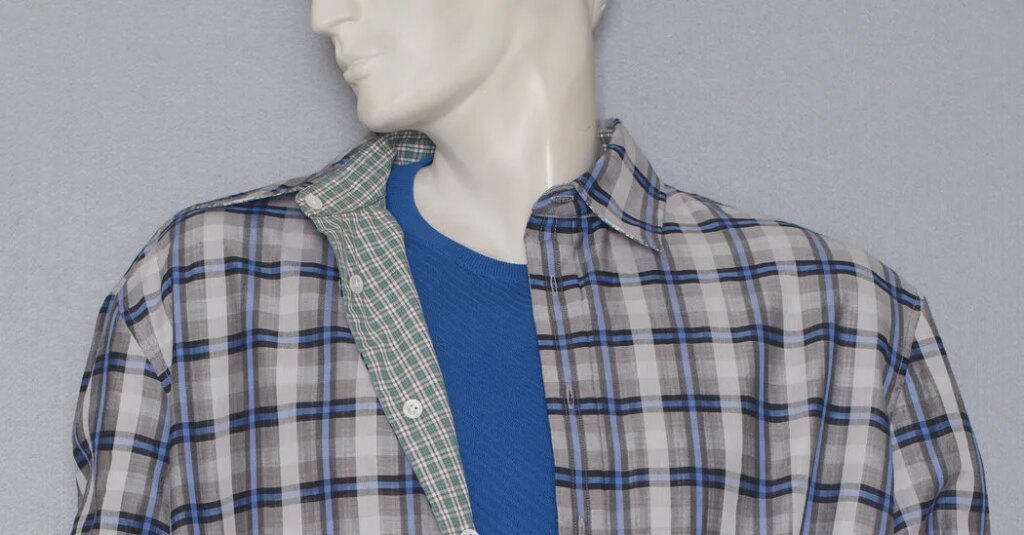
Instantly, I was reeled in by a striped dress shirt. It appeared conventional, but the cuff was flipped up to reveal a pique fabric inside, screen printed to mirror the parallel lines of the front. It was so cunning. I kept turning the cuff back and forth, observing just how flawlessly the print matched. The pique gave the shirt a comforting coarseness, a bit of crunch.
There’s only so much you can do with dress shirts. Over the past two weeks, I’ve watched many labels wrestle with this reality. They’ve exploded them into inflated tarps, shrunk them to child size. Chester has unlocked something wondrous by thinking smaller. The shape just needed a little heft; the patterning, an “I’ve got something up my sleeve” wink. Simple, but so, so smart.
Cunning combos are Chester’s cornerstone. When I first saw the brand at Dover Street Market in London this July, I’d been fooled by his cashmere sweaters. They looked as if a V-neck and a tee had been hung together by mistake. These knits, though, were actually a single garment: a blue crew neck stitched into a gray V.
In Townwear’s showroom, more of these two-in-one sweaters hung, this time in silk. The color combos were sprightly and flattering: cherry red under scarlet, pool blue under emerald, pink under pumpkin. They shared genes with other color-curious labels that have lately sent shoppers swooning, especially Auralee. Chester said he often tripped upon the juxtapositions by looking at paintings. That added up: These knits were a shortcut to looking Hockney-smart with color.
“That’s what probably takes the longest for me, trialing the colors,” he said.
Chester studied at the Central Saint Martins school of design in London and trained on Savile Row. He continues to work in the pricey, archival designer resale market and remains preoccupied with aged clothes. Crawling through the racks in the Paris showroom, he had zero interest in debriefing the week’s runway shows, but he was eager to show off the stacked typography on the label of a vintage jacket he had just bought. He’d chosen the name Townwear because it was plain-spoken, he said, like a sportswear company you’d dig up in an issue of Apparel Arts from 1948.
Chester had the familiar unease of a youngish designer who would much rather discuss a fabric than himself. He grew most giddy when showing off how he’d figured out that by layering a somewhat translucent fabric over a plaid, it created the illusion of a new check. The effect was dazzling, like staring at a tartan curtain through a sunlight-streaked window.
Before I met Chester, I’d wondered how far he could take his fusions. Pretty far. This season he experimented with terry-lined skirts, some brilliant sheer sweaters over built-in white cotton T-shirts and a shirt-weight blazer.
But the shirts and knits (which start at around $500 and $600, respectively) remain the reason to know the brand. They’re everything I crave in clothes now: a common shape, bent, but not broken, by a crisp, “Hey, what if I tried that …” idea. It doesn’t have to be radical, and it certainly shouldn’t feel like trying. It just has to look clever.
Left Bank shopping
After the Sacai show Monday morning, I swung by a pair of Left Bank boutiques that loom large for nonlocal shoppers. First, Beige, a men’s shop that cooks French prep with Japanese ingredients.
In the couple years since I last visited, Beige has made more allowances for brands with buzz. I was surprised to see how many A. Presse jackets it stocked, for instance. More alluring were the brands I was less acquainted with: Lavenham’s British-made quilted coats (a lot like the barn jackets that Gucci just showed on the runway, only at a sliver of Gucci prices); petrol blue cords from Big Yank, a dusty American brand revitalized under Japanese ownership; and Lemmermayer’s cloudlike alpaca sweaters.
From there, I walked to Rubirosa’s, with its macaron-box shirts, which recently doubled the size of its storefront. Much like the handful of other English speakers who crowded the shop, I zombie-walked to the label’s Mongolian-made cashmere sweaters, arranged in a prismatic arc in built-in cubbyholes. I asked for the V-neck in black, the one color Rubirosa’s appears allergic to. The saleswoman instead steered me instead toward brown, which, to quote her, “is the new black, anyway.”
It fit great over my white tee, the neck just plunged enough. It was around $700. I let it go back onto the shelf.
Other things worth knowing about:
-
Miu Miu’s zip-ups and running shorts were a “sort of late addition” to the sporty wave in women’s fashion, Vanessa Friedman wrote in her review. I was drawn to the “Cowboy Cut” jeans, a collaboration with Wrangler. The stringed waist was too tricksy, but their cornflower wash and modest flare looked ideal, worthy of emulation. Those Miu Mius will probably be four figures, but stock Wranglers? Sub $100.
-
Two standouts from this season’s stunt casting: a pregnant Ciara stomping down the runway at Junya Watanabe, and Olivia Colman in a leather skirt suit at Miu Miu. (I also have to call out John Malkovich in some excellent starchy jeans and a pink shirt in the front row at Chanel.)
-
Rei Kawakubo is the master at forcing us to stare down what’s unsettling — and to locate the beauty in it. This season, the Comme des Garçons designer showed a dress that looked like a skeleton framed with oozy guts all around. It was grotesque. It was gorgeous. It was an article of clothing more about what goes on inside us than what we put on us.
-
The performance artist Alexis Stone dressing as the deceased designer Thierry Mugler to that brand’s show gave Tupac hologram vibes in the worst possible way.
-
Back in New York, the designer Rachel Comey is reading at an event tonight hosted by Hagfish Books, the small press she worked with for her runway show last month, which was inspired by the art and writings of Rosalyn Drexler. (We profiled Hagfish last fall.)
-
The fashion writer Liana Satenstein is starting her own clothing brand, Oksana Worns. The first piece is a tangerine clasp top.
What we’re reading and watching:
-
The Vanity Fair editor Mark Guiducci’s interview with Sam Altman.
-
A new photo book of work by Tina Barney, famous chronicler of the elite. This one, though, is dedicated to her fashion photography for brands like Gucci and mags like Vogue.
-
This Substack thread offering name ideas for Plum Sykes’s new horse.
Style Outside
The post A Shirt That Works Double Time appeared first on New York Times.