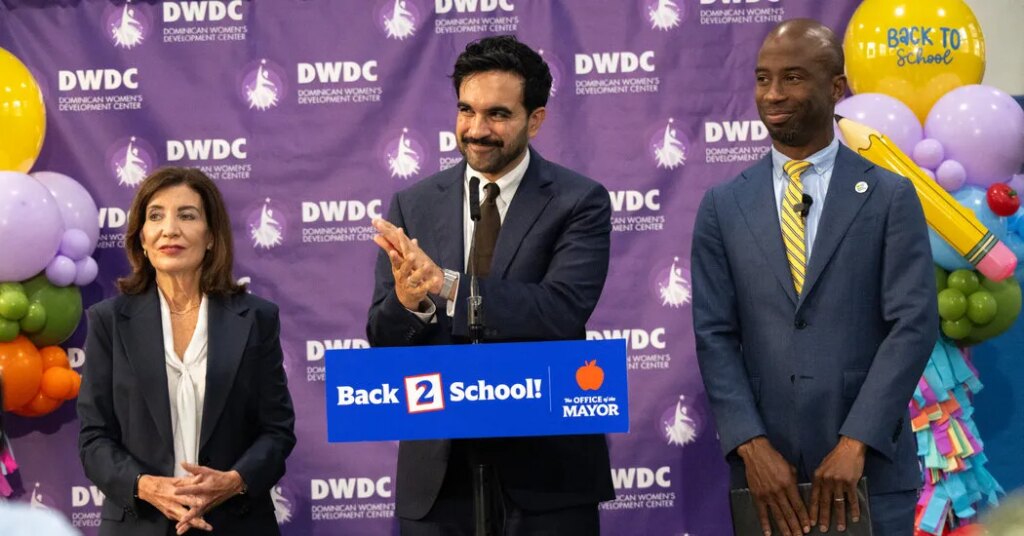
A few days before the start of school in September, Kamar Samuels stood before a room of lawyers in Manhattan and outlined his vision for New York City’s public schools. He wanted safe schools, academic rigor and a third goal that he said set him apart from his predecessor.
“I’m the first chancellor to come in and speak directly to school integration,” said Mr. Samuels, who offered few details at a New York Law School event before excusing himself for an engagement in Brooklyn with the mayor.
More than 10 months into his job overseeing the nation’s largest public school system, Mr. Samuels has barnstormed across the city, repeating his pledge to take on desegregation in school meetings, television interviews and legislative hearings. The goal is shared by the mayor, Zohran Mamdani, who called segregated schools a crisis during his campaign and selected a chancellor who in previous city positions had merged and closed schools in an effort to foster integration.
“We are speaking about the most segregated school system in the United States of America,” Mr. Mamdani said this week on WNYC’s “The Brian Lehrer Show,” referring to the findings of a landmark 2014 report that helped spur an integration movement in the city that fizzled in the pandemic.
While Mr. Mamdani and Mr. Samuels have spoken about desegregation with urgency, prominent integration proponents in the city say that their early optimism has turned into growing alarm. Nearly a year in, the administration’s rhetoric has not yielded a citywide integration plan or specifics on how it intends to pursue desegregation.
Nyah Berg, the executive director of New York Appleseed, a group that supports integrated schools, said that the administration’s approach reminded her of past efforts that had stalled when city leaders did not move from talking about integration to doing something.
“It’s not that I’m at the point of disappointment,” said Ms. Berg, who served on the mayor’s youth and education transition committee. “We are gravely concerned that this is not moving forward.”
In interviews with leading integration proponents and people close to the school system, all expressed broader concerns that while the Mamdani administration has laid out detailed plans on major issues like housing and universal child care, it has not released a comparable vision for education.
As is the case in only a handful of large American cities, New York’s mayor controls the public schools, which have many challenges, including shrinking enrollment and declining reading scores. Schools also play an enormous role in whether families stay in the city or move, and the school system’s roughly $40 billion budget is the largest of any city agency.
During the campaign, Mr. Mamdani did not release a comprehensive education agenda. As mayor, he still has not articulated one.
“The Bible says, ‘Without a vision, the people will perish,’” said NeQuan McLean, a parent leader in Bedford-Stuyvesant in Brooklyn. “So where’s the vision?”
The topic of segregated schools dominated conversation in education circles and far beyond last month after The New York Times Magazine reporter Nikole Hannah-Jones wrote about wrestling with her choice to send her daughter to a high-poverty elementary school in Brooklyn that was almost entirely Black and Latino. On Friday, New York Appleseed announced that it would hold a town-hall-style event about school integration with Ms. Hannah-Jones and Mr. Samuels later in October.
Still, while Mr. Mamdani and Mr. Samuels have brought more attention to segregation in the city’s schools than the previous mayor, they have only offered vague commitments to addressing it.
In June, Mr. Samuels created several neighborhood working groups responsible for issuing recommendations on topics that included smaller class sizes, under-enrolled schools and integration. New groups will be rolled out across the city during the next two years. In a citywide racial equity report released last month, Mr. Mamdani called for more integrated schools by 2034 without specific goals or next steps.
The city’s Department of Education has provided few details about the groups and has not released a list of members. (Mr. McLean said that he was serving on one and that his group would not address integration.) Integration advocates said that department officials had briefed them on the groups but that they were still unsure of their goals or how Mr. Samuels defines what he calls “true integration.”
“The working groups are one piece of the puzzle, but if that’s the only piece that they’re pursuing, that’s a problematic strategy,” said Matt Gonzales, a former member of a citywide school diversity advisory panel under former Mayor Bill de Blasio who also served on Mr. Mamdani’s transition committee.
Mr. Gonzales and other advocates called on Mr. Samuels to use the advisory panel’s recommendations as a blueprint for integration.
New York is among the most diverse cities in the country. But few of its more than 1,800 public schools reflect that diversity. Black and Hispanic students make up about 66 percent of the school system. About 14 percent are white, while 17 percent are Asian students. More than three-quarters of children come from low-income families.
Fewer than 2 percent of schools resemble the racial composition of the city, according to a new analysis from the Research Alliance for New York City Schools at New York University. At nearly half the schools, Black and Hispanic students make up more than 90 percent of the students.
The disparities are stark in its most coveted schools. Just 16 percent of the students at the five citywide gifted schools are Black and Hispanic, down a few points from before the pandemic. Those populations make up 13 percent of the city’s elite specialized high schools.
The school system has shifted in recent decades toward school choice for families, allowing students to attend schools outside their neighborhoods, and more gifted and screened schools, all of which have been blamed for worsening segregation. The number of middle schools with selective admissions was reduced several years ago. Some parts of the city have greatly reduced their screened schools, including a progressive part of Brooklyn that eliminated them for middle school.
Decades of research show that integration can lift educational and social outcomes for all children. Diverse schools are more likely to receive additional funding and resources. Still, racial segregation can persist inside diverse schools, studies show, with Black and Hispanic students having less access to advanced courses.
“What the research shows pretty compellingly is it only works when it’s associated with actually reallocating resources within the schools,” said Alexandra Freidus, an associate professor at the University of Connecticut who published a book last year on diversity efforts in New York City schools.
Mr. Mamdani has said he would phase out the gifted and talented program but no changes have been made. He recently said that the admissions test for specialized high schools should not change. (Mr. Mamdani graduated from one, the Bronx High School of Science.)
“We are exploring every single tool that we have at our disposal to ensure that this is going to be a very different school system moving forward,” he said on “The Brian Lehrer Show.”
In a way, integration advocates want to recapture the traction they had leading up to the pandemic, when another chancellor also made desegregation a signature issue. Back then, pressure on elected officials had mounted, led by activist groups and students, who had staged rallies, walkouts and lock-ins. Students planned to elevate the issue with a citywide walkout in April 2020. But when April arrived, school had moved to remote learning.
Since then, some groups have disbanded, those students have since graduated from college and the momentum has faded. Lawsuits challenging segregation have been tossed. Past promises and recommendations went unrealized.
Any effort by the Mamdani administration to integrate schools would undoubtedly touch on thorny issues and popular programs in the school system. It would also face fierce resistance from some parents. And there are entrenched barriers: Only about a third of the school system’s districts reflect the demographics of the city.
Kathryn Hill, the research director at the Research Alliance for New York City Schools, said that a citywide integration effort could require sweeping but potentially unpopular changes.
“If the system really wanted to push integration, they probably would have to redraw community school district boundary lines or school catchment areas,” Dr. Hill said.
Bianca Pallaro contributed reporting.
The post N.Y.C. Leaders Want Integrated Schools. Advocates Want a Plan. appeared first on New York Times.