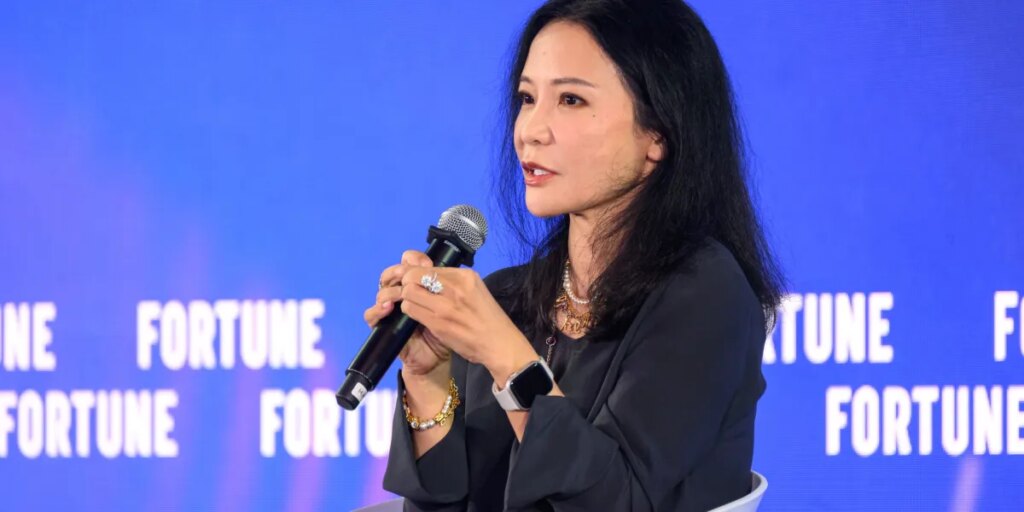
Christina Zhu, the head of Walmart’s China business, remembers when Chinese shoppers did not have much choice.
As a child, she watched her parents wake up at 4:30 a.m. on Sundays to go to the wet market. “They had to haggle, and high-quality produce wasn’t always guaranteed,” Zhu, born in 1973, recalled at the Fortune Leaders Forum in Macau in September.
Today, Chinese shoppers are “probably the group with the most choices [in the world],” and they have become “the most demanding customers,” she said.
Meeting those rising expectations has become the defining challenge for retailers in China, and Walmart has managed it better than most. It entered China in 1996 with a Supercenter and a Sam’s Club in Shenzhen. Three decades later, the U.S. retailer is thriving in the world’s second-largest economy even as other foreign brands struggle.
China represents 3% of Walmart’s overall business, but it is growing, generating $24.6 billion in sales in its past fiscal year, a 19.3% jump. Sales grew 20.7% last quarter, faster than the 5.9% reported by the company as a whole.
Those figures are even more impressive given China’s ongoing consumption slump. Consumer-goods retail sales in China grew 1.1% in the first eight months of the year, compared with 4.6% growth over the same period in 2025, and just 0.4% year over year in August. High unemployment and a real-estate crisis are weighing on spending.
“Sam’s Club is positioned very clearly: We serve upper-middle-class families in Chinese cities. We think of ourselves less as a retailer, less as a channel, [but as] buying agents for members.”
Christina Zhu
Walmart has defied the downturn by meeting the dual needs of the discerning Chinese consumer: extreme convenience, in the form of lightning-fast delivery, and an in-person shopping experience so novel that stores have become a holiday destination for shoppers throughout the region.
Walk into the Sam’s Club in Shenzhen’s Qianhai district, and the store feels disorientingly similar to one you might find in middle America. It has cavernous ceilings and shelves stacked with goods sold in generous bulk portions—only here it is gift boxes of mooncakes and abalone for the Mid-Autumn Festival instead of large tubs of mac and cheese or packs of beef franks.
The big-box membership warehouses are Walmart’s primary growth engine in China. Sam’s Clubs contribute about 70% of Walmart revenue in China, estimates Fitch Ratings senior director Cathy Chao, and the business has expanded from 15 clubs in 2016 to 67 in May.
“Sam’s Club is really the secret sauce to everything,” says Cameron Johnson, a senior partner at Tidal Wave Solutions. “People like the fact that it’s cheaper, and it still feels very premium and curated.”
Sam’s Club had 10.7 million members in China as of June, each paying at least 260 yuan ($39) per year for a basic membership. “Sam’s Club is positioned very clearly: We serve upper-middle-class families in Chinese cities,” Zhu said. “We think of ourselves less as a retailer, less as a channel … We are the buying agents for members.”
Staff at the Shenzhen Sam’s Club say that during holiday periods such as Chinese New Year, customers line up for more than an hour to get in. The clubs have even become a draw for tourists from Hong Kong, a city once synonymous with cross-border shopping in the other direction. Visitors hop across the Hong Kong-mainland border to fill their trolleys with roast chicken, toilet paper and bumper-size bottles of laundry detergent they cannot find at home.
In 2023, Hong Kong travel agencies began running package tours to Shenzhen’s Sam’s Club and competitor Costco: dinner and karaoke on day one, warehouse shopping on day two, and shipping back across the border arranged for anyone who bought too much to carry home. Today, a door-to-door car charter to and from the Qianhai Sam’s Club costs 540 Hong Kong dollars ($69) on the travel platform Klook.
Walmart hasn’t always been a hit in China. Since 2016, it has closed underperforming stores in favor of expanding Sam’s Club and its online offerings. Walmart is now generating more revenue than it did in 2019, when its China footprint was at its largest.
Much of Walmart’s China revival has happened under Zhu’s watch. In May 2020, the McKinsey and Honeywell alum joined Walmart as China president and CEO, becoming the first woman and first native Chinese person to hold the job.
Since then, her biggest priority has been making Walmart China digital-first. Its stores double as fulfillment centers, and Sam’s Club sits at the center of a “cloud warehouse” network that can deliver groceries to customers who do not live near a store.
“Convenience” for those living in other developed markets might mean receiving an order within three days. “Here, it’s 30 minutes,” Zhu said. Then-Walmart CEO Doug McMillon said last year that 80% of orders in China arrive within an hour. A Westerner might tolerate a 30-minute drive to a store, but a Chinese customer accepts only an eight-minute walk, Zhu said.
Foreign brands have struggled amid China’s economic slump and fierce domestic competition. Starbucks and Nike are losing ground to the likes of Luckin Coffee and Anta Sports.
Yet Walmart has “kept its foreign halo,” Johnson says, owing in part to high food-safety and quality-control standards and how well it has customized its offerings. “They’ve localized the marketing, the digitization, the supply chains, but they’ve kept their American-style service standards,” he says. Walmart China, for instance, has shrunk portion sizes to match households’ smaller appetites.
Even China’s notorious price wars—called neijuan, or “involution”—work in Walmart’s favor. They have forced the retailer to close or renovate weak stores and digitize operations to keep customers engaged.
When asked why Walmart has surged as other foreign brands stumble, Zhu put her own spin on founder Sam Walton’s most famous maxim: “I only have one boss, and my boss is the Chinese customer,” she said.
t
This article appears in the October/November 2026: Asia issue of Fortune.
The post How Christina Zhu turned Sam’s Club into Walmart’s unlikely growth engine in China appeared first on Fortune.