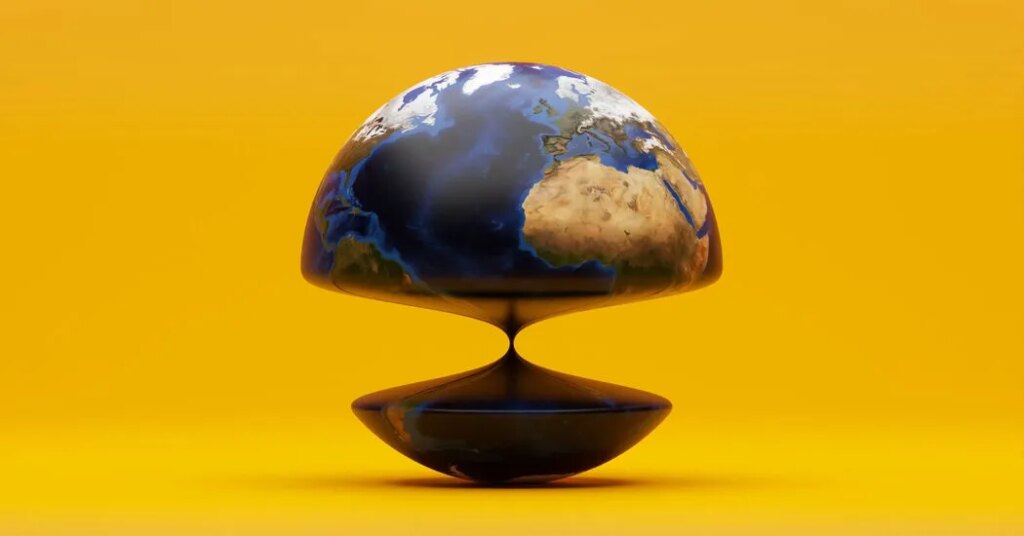
For decades we have lived in a world that seemed to transcend geography.
Information, money, goods, germs and weapons have come to defy distance. Whispered confidences and billion-dollar bounties are traded instantaneously. Smartphones, satsumas and sandals are delivered to your doorstep from across the globe. Ballistic missiles are able to traverse continents in minutes.
But such everyday assumptions have been challenged by the economic havoc wrought by the blockage of a single vital shipping and energy route in the Persian Gulf.
The conflict in the Middle East, set off by U.S.-Israeli attacks on Iran seven months ago, has driven up energy prices. It has also had a hand in pushing up interest rates, disrupting factory production around the world, jeopardizing harvests and stoking angry protests from Syria to Guatemala.
Geography is back with a vengeance.
“As we think about the global economy or the modern economy, we often forget just the basic plumbing, and that is logistics,” said Shannon O’Neil, senior vice president of studies and Maurice R. Greenberg chair at the Council on Foreign Relations. “Stuff still needs to get from here to there.”
Conflicts and climate change are causing disruption.
Countries and armed groups that can’t begin to match the military, technological or economic power of the United States have to some degree held the world’s economy hostage simply because of their position on the map.
Iran disrupted traffic in the Strait of Hormuz, the only sea passage to the Persian Gulf and the world’s most important energy chokepoint. And the Iranian-backed Houthi militia in Yemen seized control of another critical transit point, the Bab al-Mandab Strait, the narrow pathway at the southern entrance to the Red Sea.
Even now, as oil has started flowing again through the Persian Gulf, it has happened mostly by brute force — with tankers guided by the U.S. Navy.
These flare-ups are urgent reminders of how key transit routes like the South China Sea and the Suez Canal still wield enormous influence over commerce and, in turn, the welfare of tens of millions of people.
The world’s strategic and economic geography is simultaneously being reshaped by climate change, which is disrupting centuries-old passages and etching new routes across the planet’s face.
This summer, drought drained waterways like the Rhine and Danube Rivers in Europe, upending freight transport, raising shipping costs and curtailing industrial production. It also threatened electricity flows in Hungary and Romania, which use river water to cool nuclear power reactors.
In Latin America, the operators of the Panama Canal, which carries roughly 40 percent of U.S. container traffic, restricted traffic because of low water levels exacerbated by El Niño.
Thousands of miles to the north, Chinese shipping companies recently took advantage of warming waters to establish the first regularly scheduled commercial transit of the Arctic Ocean. The development promises to heighten strategic competition with the United States as President Trump’s grab for Greenland illustrates.
The postwar global order has broken down.
Geography has always been a potent force in world affairs. In the fifth century B.C., Sparta used its control over the Dardanelles strait to cut off Athens’s grain supply during the Peloponnesian War.
In our lifetimes, though, since globalization gained momentum in the 1990s, technology has often eclipsed geography.
But that international order rested on a vision of mutually beneficial global cooperation and a system of rules and laws that is eroding.
Confrontation and coercion have become go-to approaches rather than last resorts. Trust even among allies has broken down.
Mr. Trump’s speech to the United Nations last week could serve as graveside commentary to the more optimistic postwar vision. “To the victor belong the spoils,” he said of his decision to seize Venezuela’s oil reserves, an example of his winner-take-all approach to world affairs.
Mr. Trump has clearly accelerated the disintegration of the postwar order, but the roots are deeper.
The very networks that made globalization so successful are the same ones that created new types of vulnerabilities and power imbalances.
During the era of hyperglobalization that began in the 1990s, both the United States and China, for example, increasingly relied on their control of economic rather than physical chokepoints. The United States has used its dominance of the global financial system to penalize adversaries by freezing assets or cutting off commercial transactions. China has used its store of rare-earth metals to pressure rivals.
So it should perhaps be unsurprising that weaker powers would look for their own pressure points. In Iran’s case, it’s geography. In the 2000s and 2010s, Iran was under punishing sanctions but never got close to closing off the Strait of Hormuz, said Edward Fishman, a senior fellow at the Council on Foreign Relations.
“I think that it kind of signals just how far we’ve moved away from this globalization paradigm that even geographic features are being weaponized,” said Mr. Fishman, a former diplomat. “And I think that’s only going to be a continuing trend.”
Violent confrontation is one tactic. The other is financial. Iran has pressured shipowners to pay for passage through the Strait of Hormuz.
“That’s what Iran, in many ways, is fighting for now — the ability to monetize the trade,” Mr. Fishman said.
The threat is raising questions about open access to the world’s waterways, something that has been taken for granted since the end of World War II. The United States has essentially been the enforcer of free navigation, but its willingness to stay in that role has waned while other powers have been emboldened to challenge it.
China continues to flex its muscle in the waters off Taiwan, sending out patrols to assert its claims to the seas around the island.
Ukraine and Taiwan occupy critical real estate.
The neglect of geography has been a result of political myopia, argues Hal Brands, a professor at Johns Hopkins and the author of “The Landscape of Power: Geography and the Rise and Fall of Nations.”
“For the past 30 years or so, we operated under two false assumptions,” Mr. Brands said. The first was that “the struggle for influence between rival powers had become passé. And that was related to the second, which was that geography and the constraints of geography had basically been obliterated by innovation.”
Ukraine, he noted, has been a point of contention for generations because it occupies a critical piece of real estate on the Eurasian continent, a hinge between European and Asian powers that has Black Sea ports and incredibly fertile ground.
Taiwan, too, sits at a critical juncture, between Japan and Indonesia, the anchor of a chain of islands off China’s coast.
Of course, technology, industry and geography have always impinged on one another. The development of infrastructure for oil extraction and delivery in the Middle East after World War II was what transformed the Strait of Hormuz from a useful transit lane into an economic and energy chokepoint.
The ongoing disruption to key shipping routes is spurring alternatives like the construction of more pipelines that, over the long term, could again alter economic and military maps. As will advancements in technology and shifts in trade relations.
In any case, the disintegrating postwar international order is likely to bring a world of increasing conflicts. And in Mr. Brands’s view, geography will increasingly “shape the way that those struggles play out.”
The post Geography Is Back With a Vengeance appeared first on New York Times.