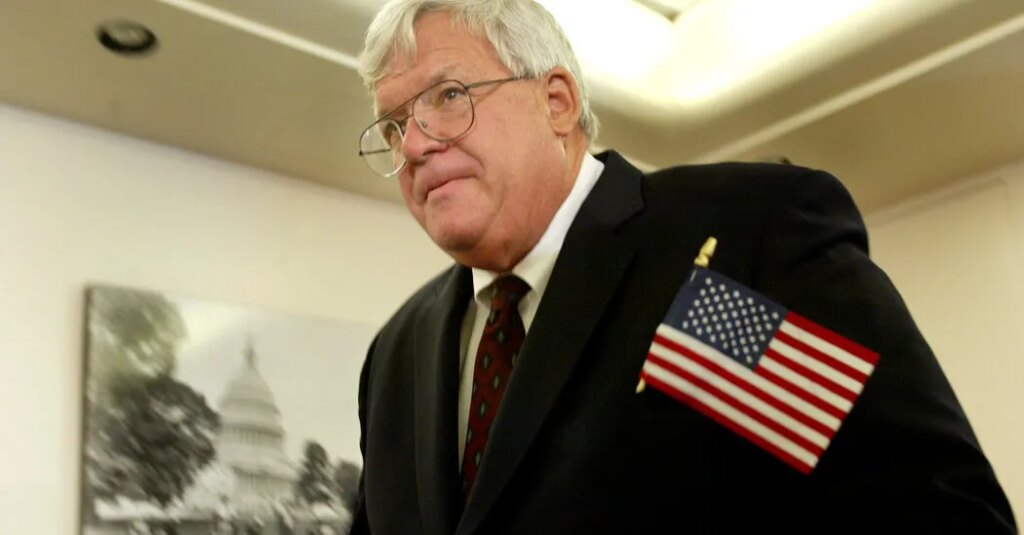
J. Dennis Hastert, a once-obscure Illinois congressman who rose to become the longest-serving Republican speaker of the House before falling from grace in a sex abuse scandal that came to light after he left government, has died. He was 84.
The coroner’s office in Kendall County, Ill., was notified of Mr. Hastert’s death on Saturday evening, according to a statement. He was pronounced dead at his home while under hospice care, the coroner said.
Mr. Hastert, a former teacher and wrestling coach, was sentenced to 15 months in federal prison in April 2016 for violating federal banking laws, having made millions of dollars in secret payments to cover up sexual misconduct with a male student. He was released in July 2017 and from then on lived out of the public eye despite his earlier prominence in Washington.
Mr. Hastert admitted at his sentencing that he sexually abused teenage wrestlers as young as 14 whom he coached at Yorkville High School in Yorkville, Ill., where he worked from 1965 to 1981. The federal judge who sentenced Mr. Hastert called him “a serial child molester.”
It was a stunning downfall for Mr. Hastert, a burly, stooped figure who had once trudged through the Capitol hallways surrounded by aides and a security detail.
He had emerged as a surprise consensus choice for speaker in 1998 during a period of partisan uproar over the impeachment of President Bill Clinton. He held the post during the Sept. 11, 2001, attacks and their aftermath, working closely with President George W. Bush in pushing a tough antiterror agenda and fighting wars in Afghanistan and Iraq.
He also forced through an expansion of Medicare to cover prescription drug costs, a long-sought benefit. But the way that vote was handled contributed to an ethical cloud that gathered over House Republicans in the Hastert era.
Mr. Hastert lost the speakership after Democrats reclaimed the majority in the 2006 midterm elections. The Democratic victory was fueled in part by accusations that Mr. Hastert and his leadership team had failed to respond aggressively to accusations that a Republican House member, Mark Foley of Florida, had behaved inappropriately with male House pages of high-school age.
Mr. Hastert chose not to seek a Republican leadership role after the repudiation of his party in 2006. He left Congress in November 2007 to pursue a lucrative lobbying and consulting career.
The federal accusations of conduct that occurred long before he was in Congress shocked many of Mr. Hastert’s former aides and colleagues, who had held him in high regard for his amiable Midwestern nature and his ability to rule the fractious House, particularly during the uncertain time after the terrorist attacks.
Known as Denny or Coach, Mr. Hastert, a diabetic who developed an expertise in health care issues, was brought into the leadership team in 1995 as chief assistant to Tom DeLay, the combative Texan who became the House whip behind Speaker Newt Gingrich when Republicans took control in 1994 after a 40-year hiatus.
By 1998, Mr. Gingrich’s hold on power had become precarious, and when the party lost seats in November he was forced aside, with Mr. Hastert personally informing him that he did not have the votes to prevail again as speaker. Mr. Hastert then toyed with trying to move up in the leadership, but Representative Bob Livingston, the Louisiana Republican who led the Appropriations Committee, was chosen by the party as the new speaker.
In his memoir, “Speaker: Lessons From Forty Years in Coaching and Politics” (2004), Mr. Hastert recalled that he was so discouraged by the changes that he considered quitting Congress and made an appointment, for Dec. 20, to talk to a corporate headhunter about a vacancy at the head of a financial services trade association. But on Dec. 19, political lightning struck.
As the House began its impeachment proceedings against President Clinton in a rare and unsettled Saturday morning session, Mr. Livingston, under scrutiny for his own marital infidelities, shocked those in the chamber by announcing that he would not run for speaker after calling on Mr. Clinton to resign.
Immediately, Mr. Hastert came under pressure from colleagues on the floor and in the cloakroom to take the job as a unifying figure. Richard K. Armey of Texas, the majority leader, had already been weakened by challenges. Mr. DeLay recognized that he was a polarizing figure and couldn’t win the gavel, and he joined other top Republicans in backing Mr. Hastert.
By the end of a tumultuous day, Mr. Hastert was in line to be elected the 51st speaker when the new Congress convened a few weeks later in January. He canceled his meeting with the headhunter.
John Dennis Hastert was born on Jan. 2, 1942, in Aurora, Ill., to Jack and Naomi Hastert. He worked at his family’s farm supply store from an early age, becoming active in 4-H in the heavily Republican area while wrestling and playing football in high school.
After graduating from conservative Wheaton College, he became a teacher and coach in Yorkville, about 45 miles west of Chicago, where he met his wife, Jean Kahl, a physical education teacher. In 1976, his small-town wrestling team won a state championship and he was named Illinois coach of the year.
In his first run for a state House seat in 1980, Mr. Hastert finished third in the Republican primary. But he later won the seat when the incumbent had a stroke and had to be replaced on the ballot. He moved up to representing the Fox River Valley region in Congress in 1986 when the one-term incumbent contracted cancer and also needed to be replaced on the ballot.
Arriving in Congress, Mr. Hastert kept a low profile but soon found himself aligned with Mr. DeLay, who became both a patron and a problem. Their partnership led Mr. Hastert up the leadership ladder and provided an education in vote counting. But Mr. DeLay’s hardball tactics, which contributed to his own resignation from Congress in 2006, helped Democrats portray the Republican reign as fostering a culture of corruption.
The ties to Mr. DeLay also led some to suggest that Mr. Hastert was mainly a puppet of Mr. DeLay, who eventually became majority leader. But Mr. Hastert was a force in his own right.
Mr. Hastert was hardly charismatic and did not have much of a media presence, though he was respected for his willingness to endure long listening sessions with needy House members. His role changed markedly in 2001 when a Republican, Mr. Bush, became president and the Republican-controlled House became responsible for turning administration positions into law.
Mr. Hastert believed that Republicans should not advance any legislation unless a majority of their members supported the bill, even if measures could pass with a combination of Republican and Democratic votes. That informal policy came to be known as the Hastert rule.
Mr. Hastert saw the expansion of Medicare as a way of neutralizing the Democratic advantage on social issues, and he pushed hard for the new benefit in 2003. When the final House vote came in November, most Democrats were lined up against the plan along with some Republican conservatives, putting approval in doubt.
To win a narrow victory, Republicans were forced to hold the floor vote open for nearly three hours — far exceeding the norm — while Mr. Hastert, Mr. Delay and others ruthlessly twisted arms in public view. The ethics committee later admonished Mr. DeLay and others but did not penalize Mr. Hastert.
In 2006, the Republican majority was staggering under corruption allegations, growing public opposition to the Bush administration’s foreign policy and an energized Democratic opposition. The final straw came when sexually explicit messages that Mr. Foley had exchanged with boys in the House page program became public at the beginning of October.
The disclosure was followed by accounts that Mr. Hastert and Republican leaders had been advised about Mr. Foley’s conduct but did nothing. Mr. Hastert said he recalled no such warnings, but the political damage was done.
A few weeks later, Democrats picked up 31 House seats and Mr. Hastert was out as speaker. He formally resigned his House seat on Nov. 26, 2007. He spent several years as a highly compensated lobbyist before his indictment in 2015 on the banking charges, but left his firm the day the charges became public.
Mr. Hastert’s alma mater Wheaton College had established the J. Dennis Hastert Center for Economics, Government and Public Policy but removed his name from the center after the federal charges were lodged.
Mr. Hastert pleaded guilty in 2015 to withdrawing $952,000 from his accounts at four banks in at least 106 separate transactions that he kept small enough to allow him to evade reporting requirements. Mr. Hastert said he gave the money to a person identified only as “Individual A” as part of a $3.5 million deal between them “to compensate for and keep confidential his prior misconduct against Individual A.”
“I want to apologize to the boys I mistreated when I was their coach,” Mr. Hastert said at his sentencing in 2016. “What I did was wrong and I regret it.”
Christine Hauser contributed reporting.
The post Dennis Hastert, Powerful Politician Disgraced by Child Sexual Abuse, Dies appeared first on New York Times.