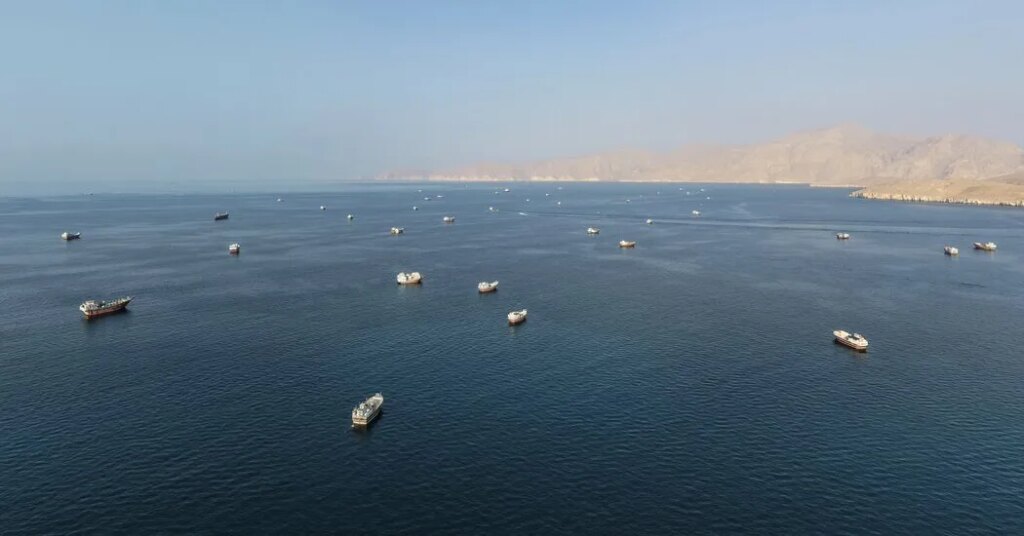
At least eight tankers have been attacked in and around the Strait of Hormuz since last Monday, a stark reminder that the recent increase in exports from the volatile region rests on a series of fragile workarounds.
The drone and missile strikes have continued as the Middle East risks plunging deeper into war, with the Saudi-backed government of Yemen on Sunday announcing a major military campaign against the Iran-backed Houthi militia. The announcement followed Houthi strikes on critical oil infrastructure in Saudi Arabia.
The attacks have underscored the unsettling reality for Gulf oil exporters. U.S. forces have provided protection for ships seeking to transport oil through the Strait of Hormuz, which Iran asserted control over after the United States and Israel attacked it more than seven months ago. But heightened risks continue to shadow the global energy trade.
“Few expected a near closure of the world’s most critical energy artery to last so long, or its impact to spread so widely,” Amin Nasser, chief executive of Saudi Aramco, the national oil company, said in a speech to the Energy Intelligence Forum in London on Monday.
He added, “This is one of the worst crises of my career, and my career is long.”
The price of Brent crude oil, the global benchmark, was little changed on Monday, hovering around $102 a barrel. Analysts said the big run-up in oil prices since the war had been held in check in recent weeks by the increase in oil exports from the Persian Gulf, which have reached higher levels than at any point since the start of the war.
And on Friday, the Group of 7 nations, which includes Britain, France and Japan, said they had agreed to release emergency stocks of diesel and crude over the next four months.
The multinational release of backup supplies — the second since March — could end up providing only temporarily relief from high prices and shortages, analysts said. A top Japanese official said on Monday that the country, which has already tapped its stockpiles, had no plans for further releases.
Mr. Nasser said the world’s current oil stockpiles were “scarily thin” and warned that replenishing national inventories could take as long as two years.
When the war in Iran began, he noted, the world had about 10 billion barrels of oil stocks — a level that has since fallen to about six billion.
“Until Hormuz fully reopens and confidence returns, the crude reality is that pressure at both ends of the barrel will intensify,” he said. He called on the international community to coordinate better on stockpiling, emergency planning and other measures.
Saudi Arabia is one of the world’s most important suppliers of oil, so any extended disruptions to its ability to deliver crude would severely destabilize global markets.
Mr. Nasser’s remarks were his first since the Yemeni government announced its major military campaign against the Houthi militia.
On Saturday, the Houthis claimed a missile and drone attack had caused fires at a facility owned by Saudi Aramco in Riyadh. Videos verified by The New York Times showed a fire at an oil refinery in the city belonging to the company.
Mr. Nasser on Monday downplayed the attack over the weekend, as well as a drone attack last month on Saudi Arabia’s critical East-West pipeline.
“Our system is intact,” Mr. Nasser said. He declined to offer details on how much damage the pipeline had sustained, which had forced the company to take it temporarily offline. “We are meeting all of our customer requirements today,” he said.
Still, Iran’s attacks on ships have increased in frequency. “Any attack comes with a global crisis,” Mr. Nasser said.
Dimitris Maniatis, the founder of Marisks, a maritime risk firm, said he believed that Iran’s burst of attacks was a response to the increase in commercial ships that have passed through the strait in recent weeks.
“What the Iranians are doing now is shooting blindly,” Mr. Maniatis said, using missiles and drones simultaneously. “Their objective is to assert control over the Strait of Hormuz through fear.”
Mr. Maniatis said Iran was trying to “overwhelm the capability” of U.S. forces that were trying to defend ships passing through the strait. On Sunday, yet another crude oil tanker, operated by Greece’s Dynacom Tankers Management, was struck by an “unknown projectile” near the Omani coast while passing through the strait, he said.
Oil executives said Monday that the war had fundamentally changed the structures for moving oil out of the Persian Gulf.
Pipelines, which one were secondary to using the Strait of Hormuz, have become critical bypass routes. Tactics once confined to sanctioned and shadow vessels, like turning off transponders or traveling “dark” to dodge missiles and drone strikes, are now routine. And nations are using more ships and taking longer routes for transporting oil at costs of millions of dollars daily.
“We have clearly entered the new and far from normal times,” Mr. Nasser said.
The post Burst of Attacks in Gulf Heightens Fears Over Fragile Energy Trade appeared first on New York Times.