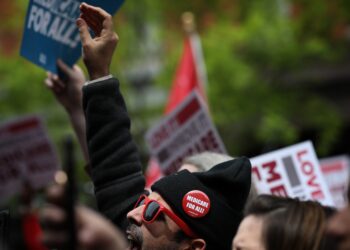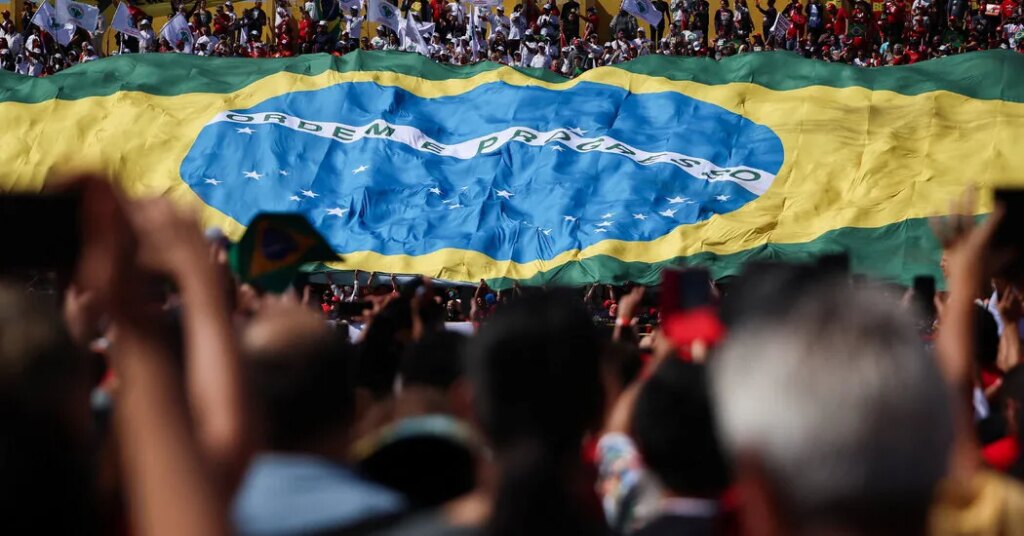
The millions of Brazilians who went to the polls on Sunday have delivered the far right its most decisive triumph since the end of the country’s military dictatorship in 1985.
The race pitted President Luiz Inácio Lula da Silva, the 80-year-old leftist incumbent known almost universally as Lula, against Senator Flávio Bolsonaro, the eldest son of Jair Bolsonaro, the former president, who is serving a 27-year sentence for plotting a coup in 2022. As it has consistently since 2014, the right outperformed its final polls in the vote, with Mr. Bolsonaro winning 47 percent to Mr. Lula’s 45 percent, and Mr. Bolsonaro’s allies winning a majority of seats in the Senate. The two will head to a runoff on Oct. 25, with Mr. Bolsonaro looking poised for a victory.
How is Flávio Bolsonaro — the son of a convicted coup plotter who is himself under criminal investigation for corruption — now the favorite against Mr. Lula, a global icon of the social democratic left?
Economic grievance, backlash against cultural change, polarization and the erosion of democratic guardrails are all among the reasons voters around the world are turning to far-right leaders. In Brazil, Mr. Lula and his supporters add foreign interference to that list, pointing to the Trump administration’s efforts to tip the scales in Mr. Bolsonaro’s favor through tariffs, visa revocations and State Department funding for groups that oppose Brazil’s Supreme Court. A Flávio Bolsonaro presidency would give Washington another subordinate partner in Latin America. It could also bring a pardon for his father and amnesty for the rioters who stormed Brasília on Jan. 8, 2023.
Another crucial answer lies in how Brazilians take part in civic life. A democracy’s health depends on whether and how its citizens participate, and in Brazil, the trends are discouraging. I’ve been conducting fieldwork on Brazil’s political movements since 2013, and what I’ve seen is that even though Brazilians vote and take action in large numbers, they increasingly do so in ways that strengthen authoritarian politics.
Until this past weekend, a casual observer could be forgiven for thinking of Brazil as a rare beacon of progressivism and democratic stability in a region that has recently swung hard to the right. Since Brazil’s transition to democracy, the country’s most marginalized groups, including peasant, Indigenous and Afro-Brazilian communities, have experienced improbable economic and social gains. From 2003 to 2014, Mr. Lula and his handpicked successor, Dilma Rousseff, made huge strides in reducing poverty, illiteracy and hunger and increasing college enrollment. Mr. Lula, a former lathe operator with an elementary school education, left office in 2011 with the highest approval rating ever recorded for a Brazilian president. So activated was its citizenry that at one point during the mid-2010s, Brazil saw more protesters take to the streets than in the rest of the world combined.
More recently, the country’s Supreme Court tried and convicted Jair Bolsonaro for plotting to stay in power after losing the 2022 election to Mr. Lula, leading many observers to celebrate Brazil’s democracy as healthier than that of the United States, where President Trump has not been convicted for his role in the Jan. 6, 2021 attack on the U.S. Capitol. Since Mr. Lula returned to power in 2023, poverty and unemployment levels have reached record lows and exports are up over ten percent this year, despite Mr. Trump’s tariffs.
A closer look at Brazil’s civic terrain tells a less triumphant story. Take the Supreme Court: a huge corruption scandal has thrown it into crisis, and Brazilians now distrust it more than any other institution. The justices’ stern treatment of Mr. Bolsonaro was never a good proxy for the rule of law; courts are an essential bulwark against authoritarianism, but they can’t do it alone.
The demonstrations that seemed such a marker of civic engagement were not representative of the country as a whole, much less of the poorer, less-educated voters who formed Mr. Lula’s base. The protests of 2013, which began over a bus-fare increase and grew into a revolt against the entire political class, including the government of Ms. Rousseff, drew crowds that were far better educated than the national average. Participants in the marches of 2015 and 2016 to impeach her were also whiter and richer than the country as a whole.
The Brazilian right has expanded its reach through a constellation of increasingly influential conservative think tanks and online grass roots networks. These movements lack formal leadership or a coherent ideological program, instead orbiting and exhibiting cultlike loyalty to figures like Mr. Trump and both Bolsonaros. They campaign year-round, say and do what a candidate cannot and recruit activists who have never before cared about politics. Their most visible figures are pastors, gospel singers and YouTubers with audiences in the millions, some of whom won office on Sunday with record vote totals.
In Brazil as elsewhere, the self-governing associations that once tied poor and working-class voters to the left have withered. Union membership has nearly halved from 2012 to 2025, and Mr. Lula has lost significant ground among low-income voters. That is in part because of the decades-long move on the part of Mr. Lula’s party, known as the PT, to abandon exhaustive local organizing and professionalize around winning elections and governing rather than tending to its base. Absent that well-organized base, the PT still depends on the aging Lula, a generational political talent with no true successor in sight.
There is one institution that stepped into that vacuum and now reaches many of Mr. Lula’s former supporters: the evangelical church. Evangelicals went to 27 percent of the population in 2022 from 9 percent in 1991, a gain of over 30 million people. In many of Brazil’s poorest neighborhoods, Pentecostal churches are far more engaging than any party or social movement. Three in four congregants attend a service, or culto, at least weekly. These church networks are now the right’s durable base, with the faithful following their pastors’ political cues to vote on moral rather than material interests.
In a party system as weak as Brazil’s, where few voters belong to or identify with any party, income and religion carry no fixed political valence, so whoever does the organizing helps determine the constituency’s politics. A poor Pentecostal woman in the São Paulo periphery is not a born Bolsonaro voter; indeed, evangelicals spent over a decade allied with the PT. But if a pastor is there every week to help her map her faith to politics, a Bolsonaro voter she will become. In return, the faithful — who get little from the state and even less from the parties that claim to speak for them — are given order, sobriety and a community that always remembers your birthday, as one local resident told me. Now, for the first time since 2014, more Brazilians identify as right-leaning than any other ideology — a shift that maps onto the right’s extraordinary success this past weekend.
A win by Mr. Lula in the Oct. 25 runoff, while not impossible, is looking increasingly unlikely. His most plausible path to victory would be to turn out some of the 33 million registered voters who stayed home in the first round — but reaching them in three weeks is work for the kind of neighborhood-level organization that his party stopped building decades ago. This should concern anyone who is anxious about an even more reactionary Bolsonaro presidency.
The long-run patterns of how ordinary Brazilians participate in public life should worry small-d democrats even more. Over the past generation, the organizations that exist to answer to a pastor, fuel online outrage or mobilize around an exclusionary figurehead have grown, while the civic organizations that are supposed to answer to their members — unions and mass parties — emptied out. Until more people belong to organizations they help govern, Brazil’s civic terrain will remain fertile ground for authoritarian politicians of any ideological stripe, no matter who wins this election.
Elizabeth McKenna is an assistant professor at the Harvard Kennedy School and the author of “The Paradox of Participation: Organizing Authoritarianism in Democratic Brazil.”
The Times is committed to publishing a diversity of letters to the editor. We’d like to hear what you think about this or any of our articles. Here are some tips. And here’s our email: [email protected].
Follow the New York Times Opinion section on Facebook, Instagram, TikTok, Bluesky, WhatsApp and Threads.
The post Brazil’s Problem Is Bigger Than Bolsonaro appeared first on New York Times.