The Saudi-backed government of Yemen on Sunday announced a major military campaign against the Houthi militia, a key Iranian ally, plunging the Middle East deeper into war.
The new operation threatens to open a new front in the U.S.-Israeli war with Iran and further entangle the United States in the widening regional conflict that it began more than seven months ago.
In a televised speech, Rashad al-Alimi, the leader of the internationally recognized Yemeni government — which depends heavily on Saudi Arabia for financial and military support — said that his armed forces were seeking to reclaim the territory lost to the Houthis over the past 12 years.
In a statement hours later, Maj. General Turki al-Maliki, spokesman for a Saudi military coalition in Yemen, said that Saudi Arabia had the right to defend itself from Houthi attacks and pledged “full operational support” to the Yemeni military to fight the militia until it is “eliminated.”
Asked about the campaign, Mohammed al-Bukhaiti, a Houthi political official, accused Saudi Arabia of waging war in Yemen to “impose its tutelage and interfere in sovereign decision-making.”
The announcement marks the second time that the Yemeni government has sought to fight the Houthis with Saudi support. In 2015, a Saudi-led intervention devolved into a grinding war that contributed to the deaths of hundreds of thousands of people from violence, hunger and disease, and failed to defeat the Houthis.
Last time, the campaign hinged on U.S. support and weaponry, and Saudi officials have sought American assistance this time, too. Last month, President Trump rebuffed the Saudi requests.
But the U.S. is providing intelligence, planning and targeting assistance to Saudi Arabia to help its Yemeni allies, according to one current and one former U.S. official, who spoke on the condition of anonymity to discuss operational matters. Saudi Arabia has sent military advisers into Yemen to coordinate a ground offensive by the government’s armed forces, they said.
More than 200 U.S. intelligence and military analysts are aiding the Saudi government in command centers inside the kingdom, helping to analyze and select targets, the officials said. The United States is also providing aerial refueling for Saudi warplanes conducting defensive air patrols, they added.
U.S. Central Command, which oversees American military operations in the Middle East, declined to comment.
Mr. al-Bukhaiti, the Houthi official, warned that whenever Saudi Arabia strikes Yemen, the Houthis would strike back by targeting the kingdom’s oil facilities.
Asked about Iran’s role in providing support to the Houthis, Mr. al-Bukhaiti said that the militia views Yemeni sovereignty as a “fixed principle” and declared that “any hand that reaches out to violate Yemen’s sovereignty will be cut off, whether it is Saudi, Iranian, or otherwise.”
It is still unclear how the new Saudi-Yemeni campaign will differ from the last one. The Houthis have made significant gains on the battlefield in recent weeks and have substantially developed their military capabilities over the past few years.
“It’s an open question if the Saudis and their Yemeni allies are any more capable of success on the battlefield versus the Houthis than the last time they took up this fight,” said Dan Shapiro, a former top Mideast official in the Pentagon.
But it is clear that the Houthis “can do some damage in Saudi Arabia,” he added.
The Yemeni government and the Houthis have been engaged in fierce battles in recent weeks, after the militia took control of the country’s Red Sea coast, increasing pressure on shipping routes and energy markets.
The Houthis and Saudi Arabia have also attacked each other directly.
Mr. al-Alimi’s remarks appeared to end any hope that a truce would be reached soon, saying that the military operations would continue “until the country is liberated.”
The Houthis also say that they are fighting to liberate Yemen, and have dismissed government fighters as Saudi mercenaries. Yahya Saree, a Houthi military spokesman, said in a statement on Sunday that the group’s fighters “will not stop carrying out further painful operations against the Saudi enemy.”
Yemen’s civil war began in 2014, when the Houthis took over the capital, Sanaa, and forced out the government. A Saudi-led military coalition intervened on behalf of the government but failed to defeat the Houthis, who created a de facto state in northern Yemen.
A truce in 2022 established a fragile peace, until the conflict reignited this year.
The Houthis have accused Saudi Arabia of launching hundreds of airstrikes in their territory in recent weeks, most of which Saudi Arabia has not acknowledged.
But the Saudi government’s involvement is integral to the Yemeni government’s military campaign, analysts say. Much of the Yemeni government operates from Riyadh, and Saudi officials assert a significant say over many matters inside Yemen.
“You can’t ignore the fact that this is probably happening with the Saudis,” said Adam Baron, a fellow focused on Yemen at New America, a Washington-based research group. He added that Mr. al-Alimi’s announcement echoed previous government efforts to “put more of a Yemeni face on joint military actions.”
In his statement, Maj. General al-Maliki, the Saudi spokesman, said that the Houthis had targeted Saudi ships and cities across Saudi Arabia and that the militia posed a threat to the freedom of navigation as well as regional and international security.
The kingdom will “stand with Yemen” until Yemen’s state and institutions are restored, and the threat posed by the militia is ended, he added.
The latest cycle of violence began in July, after the Houthis accused Saudi Arabia of bombing Sanaa’s airport. The Houthis responded by launching drone and ballistic-missile attacks inside Saudi Arabia. They also declared a blockade on Saudi shipping in the Red Sea, a key alternative route for oil shipments from Saudi Arabia, one of the world’s largest oil exporters, during the Iran war.
The Houthis have made significant gains on the battlefield since the fighting resumed, including seizing territory beside the Bab al-Mandab Strait, a choke point near the southern tip of the Red Sea.
On Sunday, the Houthis moved closer to encircling Taiz, one of Yemen’s largest cities. Their forces captured Al-Turbah, a government-held town south of Taiz on the main road linking the city to Aden, the temporary seat of Yemen’s government, according to two Yemeni officials who requested anonymity to discuss sensitive military deployments.
Control of the town gives the Houthis control over a crucial supply route and leaves Taiz increasingly isolated. The city is at a strategic crossroads between Houthi-held northern Yemen, the government-controlled south and the Red Sea coast — making it a major prize for both sides.
“We remain anxious and afraid, fearing that the Houthis may enter the city,” said Ala’a, a Taiz resident who asked that only his first name be used because of possible reprisals. “It is the first time I have seen my neighbors’ children still awake at 3 a.m. because of the bombardment.”
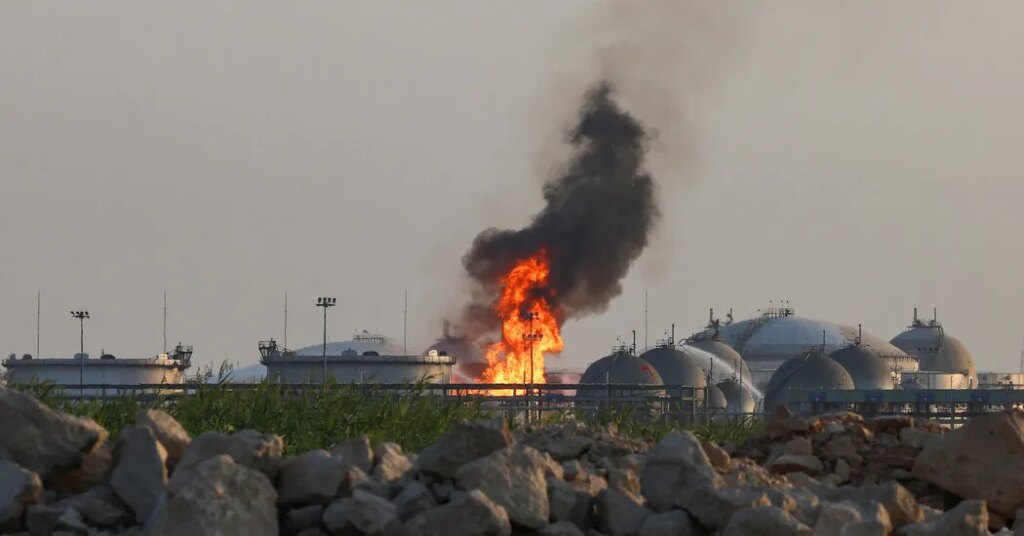
On Saturday, the Houthis claimed a missile and drone attack had caused fires at a facility owned by Aramco, the Saudi state-controlled energy company, in Riyadh. Videos verified by The New York Times showed a fire at an oil refinery in the city belonging to the company.
Maj. Gen. Turki al-Maliki, the spokesman for the Saudi-led coalition, rejected the Houthi account in comments to the Saudi-owned newspaper Asharq Al-Awsat, calling the group’s claim to have targeted Riyadh “misleading.”
Houthi-run media reported that Saudi Arabia had carried out a fresh attack on Sanaa, the Yemeni capital. Saudi officials did not comment.
The new fighting has compounded the humanitarian crisis in Yemen. More than 800 people have been killed since early August, according to the World Health Organization, while the World Food Program says more than 150,000 people have been displaced.
Shuaib Almosawa, Euan Ward and Dylan Collins contributed reporting.
The post Saudi-Backed Yemeni Government Declares War Against Houthis appeared first on New York Times.