If President Trump’s earlier political rallies felt like standing-room-only rock concerts, the latest ones are starting to feel like the first stops of a farewell tour.
The events are a ritual. He will attack Democrats. His words will probably stop making actual, logical sense for a moment, or for many moments. (It’s “the weave,” you see.) He will accuse Democrats of rigging the 2020 election (they didn’t). He will attack the news media. Then he will dance to a Village People song.
At a time when embattled Republican candidates could use concentrated attention — and money — to elevate a prospective new crop of leaders, Mr. Trump is clinging to an old strategy that has served him for years: talking mostly about himself. With a month until the midterms, he is again rallying, talking up his record, offering cash prizes and asking supporters to play pretend.
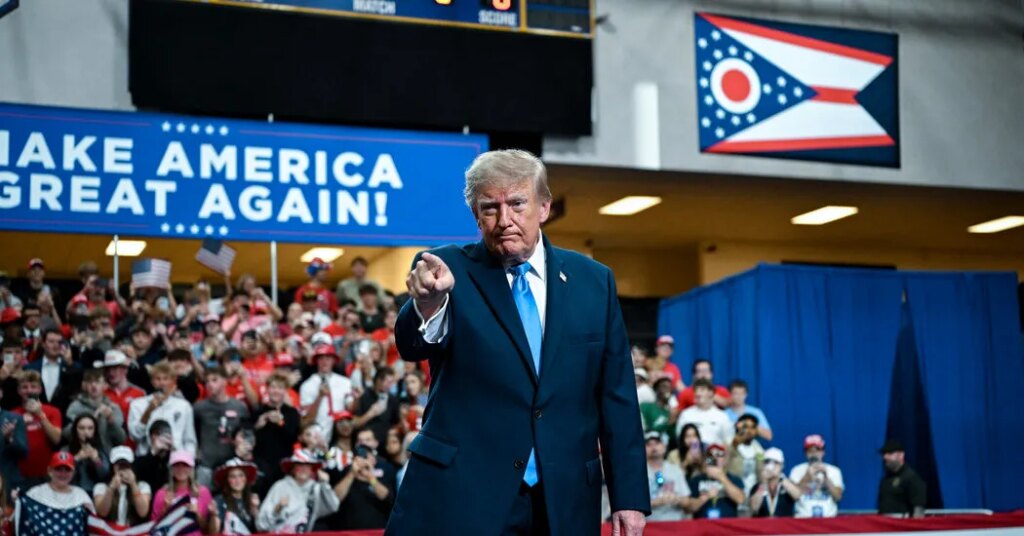
“I’m really in to win it. We want to win the midterms,” Mr. Trump told a crowd at a high school student center in Vandalia, Ohio, on Saturday evening. “If you don’t mind, please pretend that I’m on the ballot.”
I have been covering Trump rallies, on and off, for almost a decade, including one held in the packed, 7,300-person-capacity gymnasium of my former middle school in Indiana. I have covered them as three-act plays, as formulaic festivals, and as laboratories for Mr. Trump to road-test misinformation, insult a Democratic opponent or gauge the bond he has forged with a potent slice of American voters.
Mr. Trump was in Oklahoma, Alabama and Ohio this past week for rallies, with a brief stop in Texas. On this last road tour, there are hints that he understands he has ground to make up: He has featured at each event a midterm-convention promise that he will give every American adult $5,000 if Republicans keep control of Congress — a pledge that would face a steep fiscal hurdle even in the event that his party defies polls showing that big Democratic gains are likely.
Here are a few takeaways from his week campaigning.
Trump is betting it all on his brand.
Mr. Trump suggests that his mere presence will be enough to carry several embattled Republicans to victory. He believes that when he runs, Republicans win. That was true in 2016 and 2024. In Ohio, Mr. Trump called polls forecasting a tough road ahead for his party “fake.” Besides, he added, they hadn’t factored in his campaign appearances.
“They don’t account for the fact that Trump is out campaigning,” Mr. Trump said. “They never thought this was going to happen.”
Ohio is home to a tight race that could help determine whether Republicans keep control of the Senate in November, but at one point during a 90-minute speech, the president complained that he had to be out working hard on a Saturday night to help get others — in this case, Senator Jon Husted of Ohio — elected.
But, mirroring the dynamic in other states where he is campaigning, the Senate race in Ohio is about issues that go beyond Mr. Trump’s brand. Most Ohioans blame data centers for rising utility costs, a recent New York Times/Siena poll showed that they trust Mr. Husted’s Democratic challenger, former Senator Sherrod Brown, more to address the problem.
Onstage, Mr. Trump offered his support for a bill that Mr. Husted has introduced to control energy costs. But he also said he supported data centers, a position that is at odds with the majority of Americans.
“We want them,” Mr. Trump said of data centers. “Look, there’s so much money to be made for Ohio, you can’t just turn them off. They’ll go to China.”
In this moment, the crowd was quiet.
In a statement on Sunday, Davis Ingle, a White House spokesman, said the president was an effective communicator who had built “one of the most robust coalitions in political history.”
“President Trump is the unequivocal leader, best messenger and unmatched motivator for the Republican Party, and he is committed to maintaining Republican majorities in Congress,” Mr. Ingle added.
Trump rallies are not standing-room-only anymore.
Mr. Trump can still draw crowds. People still wait all day to see him. They still go wild at the mention of Mr. Trump’s immigration policies, his opposition to transgender athletes in women’s sports and his support of voter-identification laws. They cheer when he uses profanity, as they did in Ohio when the president called Democrats an expletive.
The president has maintained that the events have “sold out” and that there are overflow crowds in each town. The rallies are, in fact, more modest — and at times more sedate — than they used to be.
In Oklahoma, visitors nearly filled an event center on a casino complex with a capacity of 4,920. In Alabama, the same state where 30,000 people attended a Trump rally in a 30,000-person stadium in August 2015, there were swaths of empty seats at the 10,000-capacity athletic center where Mr. Trump spoke on Friday. In Ohio a day later, several areas of an upper deck were empty by the time Mr. Trump finished speaking at a 4,500-capacity high school student activity center.
It was not the old norm of standing room only. Instead, attendees close to the stage were seated in neat rows. In Oklahoma, security guards kept walkways clear and told people not to stand on their seats.
Natalie Baldassarre, a spokeswoman for the Republican National Committee, responded to a request for crowd sizes at each event by saying on Sunday that the rallies were “drawing some of our highest ticket demands to date,” adding that “our Republican candidates will continue to build off this momentum and drive voters to the polls as we approach Election Day.”
The president is unhappy with his rally coverage.
On Sunday morning, Mr. Trump posted an angry message on social media aimed at Fox News, complaining that its morning program “Fox & Friends” had not adequately promoted his events.
“These Election Rallies were representative of what is really happening with our great Republican Party,” Mr. Trump wrote. “Our people want to see our Rallies, and reports on our Rallies, on FoxNews, or they will very quickly stop watching (like I am doing right now!).”
Later, he posted another update, saying that polls had always underestimated his political movement.
At the rally in Ohio, two Republican voters said the thing that would help candidates like Mr. Husted was not the president, but other administration figures. In other words, some in the party are beginning to look beyond Mr. Trump for star power.
“I think JD and Rubio need to get out there more and help Jon,” Jenni Worthington, 48, said from the stands, referring to the vice president and the secretary of state. “We need big names. It really needs more. A lot of people don’t know Jon.”
Her husband, Todd Worthington, suggested there might not be anything the White House could do. Several Republican friends, he said, have already decided not to vote this fall.
His rally speeches are still riddled with half-truths, falsehoods and claims that need context.
Mr. Trump has used his recent rallies to accuse Democrats of meddling in elections, an assertion he often makes. He has no evidence for this. In Ohio, the president said that Democrats “rigged” the 2020 election. That did not happen. It remains a popular line of attack.
When he is not disparaging Democrats — or talking about random topics, like the large aspirin dose he “psychologically” needs to take daily, or claiming that he has one of the highest I.Q.s “anywhere in the world” — he is talking about the economy. He sometimes exaggerates the numbers.
There are plenty of bright spots, and Mr. Trump tells his crowds about thousands of new manufacturing jobs, a strong stock market and trillions in investment coming into the country. In Alabama, Mr. Trump touted $21 trillion in investments for the United States, though a different number is listed on the White House website, which calculates the investments at $11.2 trillion. Some of that money is dedicated to multiyear projects or earmarked as future investment.
In Oklahoma, he said that “more Americans are working today in our country than at any time, by far, in history.” In raw numbers, this is true, because the country’s population has grown over the course of its history.
Still, Americans are frustrated by high prices and slow job growth. This concern goes largely unacknowledged at Mr. Trump’s rallies, unless he is blaming Democrats for those problems.
Occasionally, Mr. Trump glimpses toward his post-midterm future.
In Oklahoma, he told some of his most loyal supporters that he would be impeached if they didn’t vote for Republicans. At the midterm convention last month in Dallas, he pondered someday standing alongside the Front Row Joes, a band of his most loyal followers, when he is finished with the presidency. And, on Saturday, he called out to a man who has been attending every rally. He wears a suit with a brick-wall print.
“Someday, probably in my final appearance, I’m going to put a jacket on like that,” Mr. Trump said, talking directly to the man. “Because after that, I won’t be able to get elected.”
And several times this past week, Mr. Trump referred to his 2024 rally in Butler, Pa., where a gunman nearly killed him.
“Perhaps I’ll try a couple of years of being nonconsequential, if you don’t mind, because this is a dangerous position,” Mr. Trump said in Ohio.
The post At Trump’s Rallies, a Familiar Mix of Rituals and a Plea to ‘Please Pretend’ appeared first on New York Times.