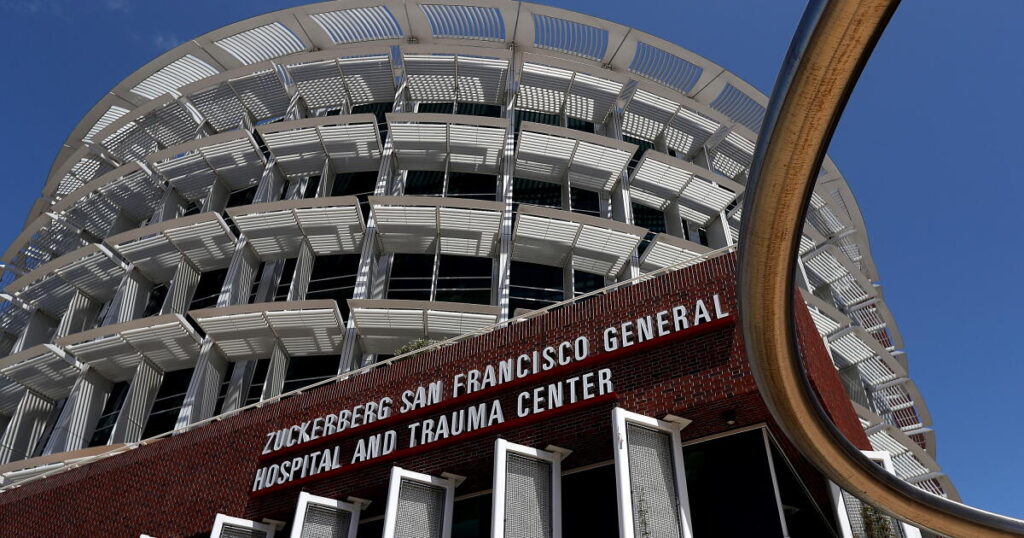
Ever since Steven Deeks began treating HIV and AIDS patients at San Francisco General Hospital in 1993, he was drawn into their community and became especially interested in those whose illness didn’t behave as expected.
Why did some deteriorate more slowly than others? Was their virus different, or was there something unusual about their immune systems?
More than three decades later, Deeks is one of the field’s leading researchers and still sees patients at San Francisco General’s Ward 86, one of the world’s leading AIDS clinics. In that time, AIDS has killed more than 40 million people worldwide, even as HIV medicine has been transformed. Deeks watched combination antiretroviral therapy turn a routinely fatal infection into a manageable chronic disease, and prevention drugs make it possible to stop infections before and after exposure.
But antiretroviral drugs suppress HIV rather than eliminate it. Stop treatment, and the virus almost always returns. That has kept alive the question those early patients first prompted for Deeks: Can the immune system itself be trained to control HIV?
Now Deeks and his colleagues have evidence that it can.
Starting in 2020, 10 people with HIV each made about 50 visits to what is known today as Zuckerberg San Francisco General Hospital for an unusually intensive study Deeks designed and led. They received a series of experimental treatments designed to strengthen different parts of their immune response. Then, under close medical supervision, they stopped taking the daily antiretroviral drugs that kept the virus suppressed.
Normally, HIV rebounds within weeks. Seven of the 10 kept the virus under control without treatment. Six maintained low levels for months. In one participant, HIV still hadn’t rebounded to detectable levels more than 18 months later, Deeks and his colleagues reported in the journal Nature in December.
A follow-up analysis released in June found signs that the immune system was being mobilized weeks before HIV became detectable again, offering clues to how the treatment may have primed some participants to contain the returning virus. The study was small and lacked a control group, and the treatment remains far too complex for routine use. But the result provides evidence that something Deeks has pursued for decades actually works.
“For the first time ever, we and others are showing that we can meaningfully reshape the immune response to HIV so that it leads to partial control, at least in some people,” Deeks says.
The hope is to turn that proof of concept into something far simpler: a treatment that could give people with HIV lasting control of the virus without continuous antiretroviral therapy. The next challenge is to understand which parts of Deeks’ elaborate regimen produced that control, then find simpler ways to reproduce it in far more people.
That could take years. And the advance comes at a precarious moment for HIV research as the U.S. government cuts funding for some programs and leaves the future of others uncertain. Deeks’ decades-long path shows how long it can take to reach a breakthrough — and the importance of not interrupting such research.
Conventional thinking
Deeks was 30 when he joined Ward 86, with little research experience.
To some established staff, he was initially something of a mystery.
“Who is this guy? Why is he here?” Dr. Paul Volberding, who hired Deeks, recalls people wondering. The skepticism didn’t last long. Deeks was “totally dedicated and brighter than [heck],” says Volberding, who treated San Francisco General’s first AIDS patient on his own first day at the hospital in 1981.
What distinguished Deeks was a willingness to follow unexpected findings in his patients, even when conventional thinking couldn’t readily explain them. One of his earliest lessons came from Jeff Getty, a prominent AIDS activist who was running out of options. Getty and Deeks began pursuing an extraordinary idea: transplanting bone marrow cells from a baboon, a primate naturally resistant to HIV, in the hope the cells might establish an immune system the virus couldn’t destroy.
The audacious 1995 experiment attracted worldwide attention, but the transplant failed. Within two months, researchers could find no baboon cells in Getty’s immune system, and he wasn’t cured.
Nevertheless, Getty’s health improved significantly. Deeks believed the unexpected result was related not to the transplant itself but to the radiation and chemotherapy used to suppress his immune system in preparation for the donor marrow.
The experiment also pushed Deeks toward another emerging approach: genetically reprogramming a patient’s own immune cells to attack HIV using an early form of CAR T-cell therapy, which engineers immune cells to recognize and attack specific targets.
“I learned very early on in my career that if I just got blood from my interesting patients” and studied it, “things that we never thought could happen were happening in real time,” says Deeks.
It became Deeks’ way of doing science, and Ward 86 was particularly fertile ground, with patients participating in studies of new HIV treatments and everyday clinical care continually raising new questions about the disease. Over time, Deeks’ approach grew into Scope, a long-running UC San Francisco study that turned the clinic into what he calls a “living laboratory.”
A major breakthrough in HIV treatment came in the mid-1990s, when powerful combinations of antiretroviral drugs began suppressing the virus in people who had seemed destined to die. Doctors initially struggled to trust what they were seeing.
“At first, I’m not sure we really believed it,” Volberding recalls.
In San Francisco, annual AIDS deaths fell from more than 1,000 in 1995 to fewer than 200 three years later. Over the decades that followed, treatment continued to improve. Modern drugs can suppress HIV so effectively that people can live for decades and not sexually transmit the virus when viral levels remain undetectable.
Yet the drugs don’t eliminate HIV, which can hide for years inside long-living immune cells. Eliminating every one of those cells has proved extraordinarily difficult. Deeks pondered a different possibility: Perhaps the immune system could instead be taught to control whatever virus remained.
Rare patients known as elite controllers offered evidence that such management was possible naturally. In the mid-1990s, infectious diseases physician Bruce Walker, now director of the Ragon Institute in Cambridge, Mass., met a man who’d been infected since 1978 without treatment or signs of disease.
“I just felt this chill go down my spine,” Walker recalls. “I thought, ‘Oh, my God, maybe not everybody dies of this disease. Maybe the immune system can actually combat it.’”
Walker went on to spend decades studying such patients and discovered that so-called killer T cells helped keep HIV in check. Early experiments suggested that immune control could be strengthened, but making that last proved far harder.
Then came even more promising evidence. In 2011 a man who’d recently moved to San Francisco came to Deeks looking for a new doctor. It was Timothy Ray Brown, the so-called Berlin patient — the first person widely believed to have been cured of HIV.
Brown had undergone a stem-cell transplant in Germany in 2007 to treat leukemia. The donor cells carried a rare genetic mutation that prevents HIV from entering its usual target cells — and when Brown stopped taking antiretroviral drugs, the virus didn’t come back.
“Timothy, we have so many questions,” Deeks recalls telling him. “We can only answer them if we just torture you. Are you willing to be tortured?”
Brown agreed. The “torture” included spinal taps, biopsies and repeated blood draws as researchers searched for traces of HIV and tried to understand what had happened to him.
“That was our first cure study,” Deeks says.
Brown’s treatment was far too dangerous to offer people who didn’t need a stem-cell transplant for another disease. But his case established something profound: HIV persistence wasn’t necessarily irreversible.
Deeks and his colleagues set out to turn the exceptional immune control seen in patients like Brown into something that could be induced in others.
Cat and mouse
With the 10 volunteers, they tried several approaches at once, including a therapeutic vaccine to boost HIV-fighting T cells and laboratory-made antibodies intended to restrain the virus and help rally the immune system against it.
Rachel Rutishauser, a UC San Francisco immunologist who co-led the study, says some of the immune cells they tracked appeared primed to react quickly when HIV reemerged — like a cat waiting to pounce on a mouse. The result resembled the kind of natural control scientists had observed decades earlier in elite controllers.
Deeks’ group is also seeing encouraging signs from CAR T-cell therapy, and three decades after he tested an early version, researchers are again using the approach. The technology has also transformed treatment for some blood cancers and is now showing promise in severe autoimmune diseases such as lupus.
An update on a separate nine-person study presented in Ghent, Belgium, in September showed Deeks and his colleagues had genetically engineered patients’ own T cells to recognize HIV before infusing them back into the body. Two participants have kept the virus suppressed for extended periods without antiretroviral treatment — one of them for more than two years.
David Collins, who led a separate study at the Ragon Institute, says multiple research groups are beginning to identify mechanisms associated with control after treatment stops. “We’re finding pieces and putting them together,” he says.
The vaccine field is trying to solve a related immune puzzle. In work published in Nature in June, researchers led by Shane Crotty and William Schief showed that sequential vaccinations could guide the immune systems of monkeys through a series of steps needed to generate broadly neutralizing antibodies against HIV.
That achievement took 14 years. The National Institutes of Health funding that supported the work ended on the same day the paper was published, a coincidence Crotty called “quite bittersweet.”
Other parts of the HIV research infrastructure are also being wound down or face an uncertain future. Grants to long-running NIH research groups that helped develop vaccine and antibody strategies aren’t being renewed, while the future of clinical-trial networks supporting vaccine, prevention and treatment research remains unresolved after next year. NIH-funded collaborations established to pursue a cure — including one led by Deeks — face funding decisions after 2027.
The impact could extend well beyond HIV. Decades of AIDS research helped lay the groundwork for advances in cancer treatment and the rapid development of COVID-19 tests, drugs and vaccines, says Deborah Birx, who served as White House coronavirus response coordinator in 2020-21. “This fundamental work that everybody toiled on created the ability to move at light speed across all of these areas,” she says.
Walking through Ward 86, Deeks points out the rooms where Volberding and Donald Abrams, another pioneering AIDS physician, began seeing patients with Kaposi sarcoma, a type of cancer that develops when the immune system is weak, in the early 1980s. Farther down the hall was a room where gurneys would be lined up for people needing pain medication and fluids.
“Those days are long gone,” he says.
Deeks still spends half a day every week at Ward 86 providing primary care to people with HIV. Some have been his patients since the 1990s. “We’ve grown old together,” Deeks says.
The clinic has evolved with them. It offers a broad range of HIV services, including a walk-in program for patients struggling with homelessness and unstable housing. Ward 86 is still cramped in its aging building, though it feels clean and fresh.
Through all that change, one rule of HIV medicine remained remarkably stubborn: Stop treatment, and the virus comes back.
The exceptions kept telling Deeks something else. Now researchers are trying to turn the exceptions into the rule.
Gale writes for Bloomberg.
The post At San Francisco General, researchers are learning how to control HIV without drugs appeared first on Los Angeles Times.