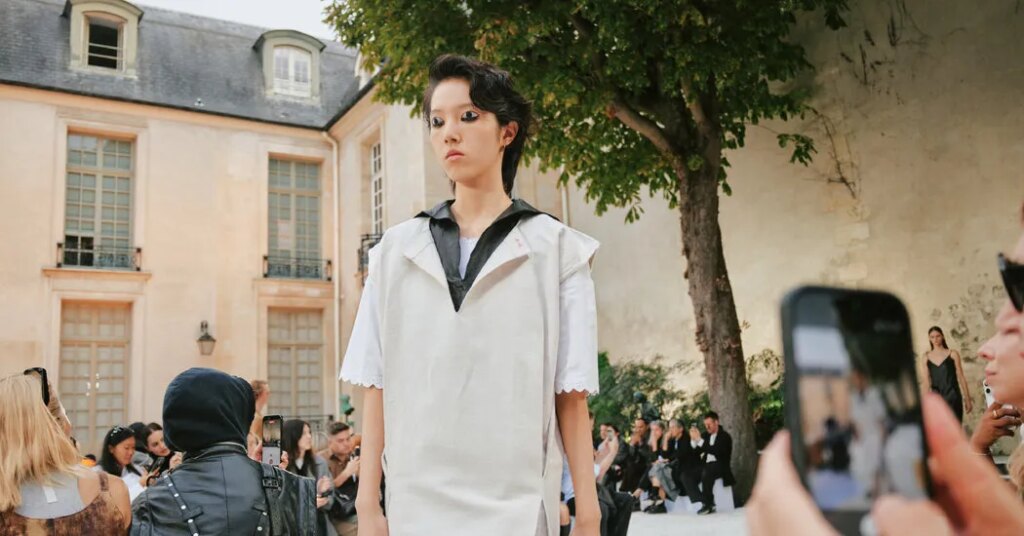
“I was thinking, you know, we can’t put this on a hanger and sell it in a store,” said Rick Owens backstage before his show of Puritan goddess vestments and romantic Martian explorer gear.
He was looking at some finale — well, it was hard to know what to call them exactly. Constructions? Cages? Fashion STEM toys? Whatever they were, they were made of tubes of fuzzy tulle that encased the body and were held together by tensile elastic bands. They seemed … impractical.
But then, Owens said, “I tried them on. I sat down in them. I was fine. The elastic just moves everything around, and then when you get up, it all snaps back into place. It’s kind of a great thing.”
Sometimes, in fashion, you can’t believe your eyes. Not just because you are looking at clothes that seem extreme, or don’t qualify as clothes by any traditional definition of the term, but increasingly because what you think you see no longer applies.
The fabric you recognize isn’t actually that fabric; the layers of garments are not layers; the dress is actually pants and so on. It’s both destabilizing and strangely familiar, given the rise of deepfakes, and how much we have learned to doubt what we now see. Designers aren’t challenging that development; they are reflecting it — and maybe, offering a proposal for how to live with it. Sometimes the results can be a little gimmicky, like fashion sleight-of-hand, but they can also be surprisingly effective.
The crunchy-looking papery pastel slip dresses and car coats that began Ellen Hodakova Larsson’s Hodakova show, for example? Actually deadstock lining fabric covered in beeswax, to make the normcore something altogether more perverse.
Those lumberjack shirts and houndstooth jackets wafting suspiciously lightly around the body at Dior? Not flannel or tweed at all, but silk chiffon printed to look like much heavier fabric. That pinstripe double-breasted jacket? Same. The long tweed trousers? Same.
At first glance, Jonathan Anderson’s latest collection for the French heritage house didn’t seem to cover any new ground: He’s still over-indexing on flowers and a somewhat fussy approach to femininity. This works fantastically in the bags and shoes, which increasingly resemble little jewel-like collectibles, but can overcomplicate the clothes, as in the pseudo-panniers built into micro-pleated cocktail frocks. Many women do not want extra material on their thighs.
By messing with the materials in his suits and separates, on the other hand, he transformed them from prissy Avenue Montaigne into easy and unexpectedly modern. They were the best part of the show.
Similarly, at Maison Margiela, where Glenn Martens still seems to be feeling his way through a maze of old Margiela-isms (“second skin” inserts made to match different shades of flesh so tops seemed to be revealing, but weren’t; a breast plate pieced together from kitchenware hammered flat), the most appealing pieces were the varnished floral silks.
The ones that looked as though they were two garments — a dress and a matching overcoat, a shirt and a vest or a sweater — but turned out to be a single item that could be worn multiple ways.
They worked because they took what could be an unsettling idea and turned it into a solution, unlike the weird pants play at Givenchy. There, strength-through-curves leather dresses and suits that began the show as perfectly tailored boardroom boss women gear soon devolved into something else entirely.
Jackets lost their sleeves, which migrated to the front of the garment and were pressed flat to form a sort of heart. Others, rather than buttoning up neatly, crisscrossed their two front sections one atop the other, like a hug. Pants were barely pants at all, but had been blown up to enormous proportions, so they turned into, effectively, skirts, the extra fabric left to drape into deep folds on the sides. One pair became a strapless jumpsuit-cum-gown, the waistband raised to just under the armpits.
That’s not a new approach. Designers from Margiela to Galliano have been messing around with pants for decades (designers seem to love to play around with pants; Hodakova Larsson also deconstructed them into sailor tops and dresses in her show).
But though it was clear where Sarah Burton, Givenchy’s creative director, was going with the pants thing — trying to take the classic masculine power ‘fit and co-opt it by feminizing it — the result was ultimately more meme-worthy than convincing.
The post When It Comes to Fashion, You Can’t Always Believe Your Eyes appeared first on New York Times.