A landmark study tracked smartphone locations of 10 million Americans over Thanksgiving 2016, soon after President Trump’s election victory. When people shared a meal with family members who voted for the opposing party, they cut their visits short by 30 to 50 minutes.
If you believe that your cousin or uncle across the table is not just misinformed, but also a morally corrupt monster, you don’t stick around for pie and coffee. But what if people stayed, not for the company, but for the afternoon’s football game?
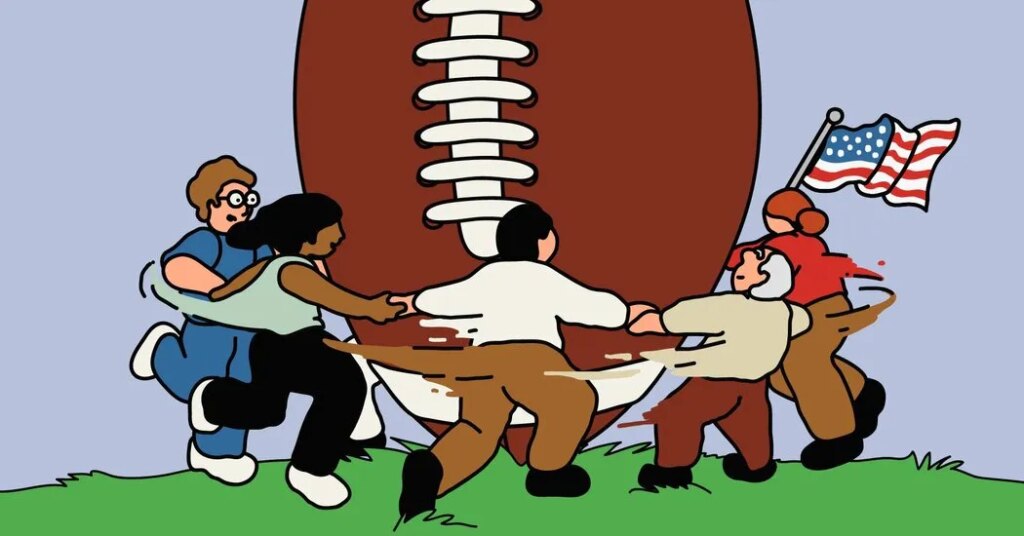
Many dismiss sports fandom as a trivial, tribal distraction: knuckle-dragging adults yelling at televisions while watching elite athletes throw, bat, kick or catch balls. Our research highlights how important this seeming triviality is to civil society: Sports might be the last remaining American cultural institution that spans our political divides.
Across a series of national surveys of 50,674 Americans, we found that every fan base in Major League Baseball, the National Football League and top college football programs remains politically diverse. Our team allegiances bring us into contact with people from “the other side” to cheer together in common cause. We high-five each other along the way. Ohio State versus Michigan? Packers versus Bears? Yankees versus Red Sox? For fans following these longtime rivals, passion for their team often dwarfs that their political passion.
The most conservative fan bases in the N.F.L. — those of the Tennessee Titans and the Jacksonville Jaguars — still count one Democrat for every two Republicans. Conversely, the most progressive fan bases — those of the Los Angeles Chargers and the New York Giants — display that exact ratio in reverse. The same is true of fan bases of M.L.B. clubs and leading college football teams. Another study analyzing geolocated mobile phone traffic uncovered that with the exception of airports, the most politically integrated public spaces in modern American life are sports stadiums.
We cheer in mixed company, whether we realize it or not. But can high-fiving a stranger over a Notre Dame touchdown against Penn State actually translate into improved civic health?
To find out, we ran a series of experiments pairing political adversaries. In a survey environment, we introduced participants to someone who voted for the opposite party and varied what else they knew about that person. The depolarizing impact of shared fandom was startling.
Learning that a political opponent cheered for the same team increased personal warmth. Knowing you are both Cubs or Astros fans, say, is more important, on average, than discovering the other guy shared the same race, educational background or home region. In fact, shared fandom was consistently as powerful a positive force as shared religion. (Red Sox Nation is a religion, right?) Perhaps most crucial, shared fandom made participants more willing to interact with political rivals in real life.
When you learn that someone celebrates or commiserates over the same walk-off home run, you can’t help perceiving that person as more similar to you than before. A subtle, often imperceptible shift occurs: They care about what I care about. They aren’t a single-dimensional, immoral caricature.
Social scientists attribute our deeper animosities to the rise of the “mega-identity.” Decades ago, our identities were an eclectic tapestry: You might have been a Presbyterian, a proud Philadelphian, a union carpenter and an occasional Republican voter. Today, partisan politics increasingly consume those distinctions. Partisan mega-identities influence where we live, whom we date, what we watch, how we use social media, what brands we consume. Our political affiliation is blinding us from seeing each other.
Not long ago, a friend was at a bar in Washington, D.C., and noticed two acquaintances strike up a spirited conversation. She feared trouble: One was wearing a red MAGA hat; the other was a staffer at a progressive think tank. When she listened, she learned they were commiserating over the agony of being Washington Commanders fans. In that moment, they weren’t partisans locked in an existential culture war — they were two fans who lived for the same team, bemoaned the same losses and had the same posters on their walls growing up.
Bipartisan fandom is not a reform that needs to be concocted or imposed or funded or mandated by legislation. Rooting for your team is widespread, persistent and naturally embedded in everyday life. We enter into it voluntarily and enthusiastically.
Seventy-six percent of American adults are sports fans, and about two-thirds of them say their fandom is central to their identities. This helps explain why 96 of the 100 most-watched television broadcasts last year in America were live sports. Fandom cuts across partisan mega-identities.
Sports can’t solve systemic political dysfunction. Nor are we making the case that fans are inherently noble or that teams or leagues are innately virtuous. Rooting for the Crimson Tide won’t convert any fan from blue to red or resolve policy disagreements. Nor should it. Because the danger isn’t so much that we disagree, but that we become irreparably estranged from and contemptuous of one another.
To resist this pull, we have to lean into our many diverse identities, and fandom is a promising one. Especially this fall: As midterm campaigns try to pull us apart, it’s also peak sports season, with the M.L.B. postseason and the World Series, the N.F.L. and college football on the schedule.
Watching a game with a neighbor who votes for the other team won’t fix Washington, and it won’t change your politics. But instead of turning and walking away from each other, you might just do what our civic life actually requires: Stay in the room a little longer.
Todd Rogers is the founder of Harvard’s Fandom and Social Connection Initiative. Ben Valenta is a co-author (with David Sikorjak) of “Fans Have More Friends.”
The Times is committed to publishing a diversity of letters to the editor. We’d like to hear what you think about this or any of our articles. Here are some tips. And here’s our email: [email protected].
Follow the New York Times Opinion section on Facebook, Instagram, TikTok, Bluesky, WhatsApp and Threads.
The post We Surveyed 50,674 Americans. This Is What Brings Them Together. appeared first on New York Times.