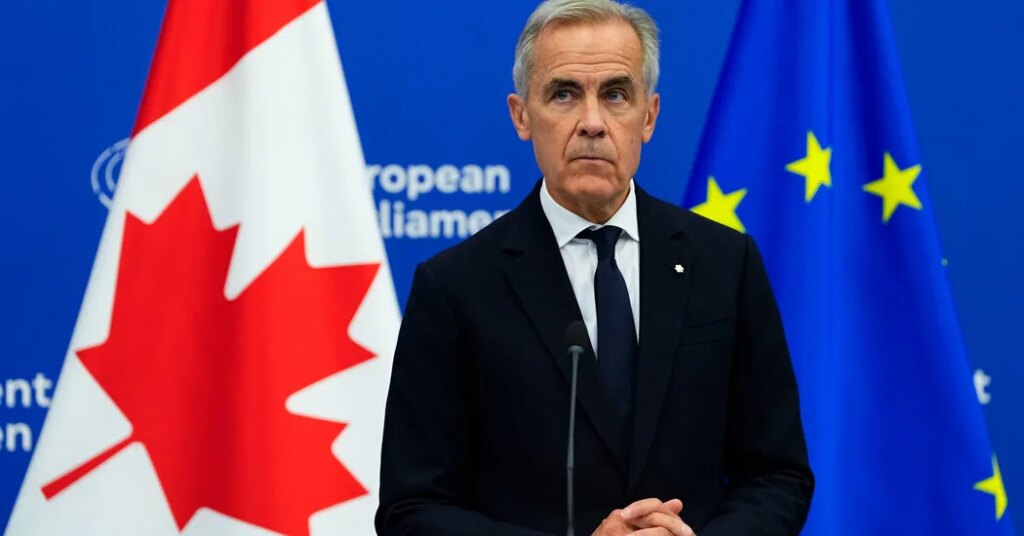
Last month, after Prime Minister Mark Carney visited the European Parliament in Strasbourg, France, and announced that Canada and the European Union would pursue a closer relationship, we asked for your questions about the topic.
In our recent one-hour interview with Mr. Carney, he spoke extensively about his vision for this new relationship. And Jeanna Smialek, our Brussels bureau chief, obtained a copy of the draft statement being prepared ahead of a summit in Montreal at the end of this month between the European Union and Canada.
So we return to the question of the European Union — one I’m excited to tackle as a former Brussels correspondent who dedicated nearly a decade to covering the bloc.
What exactly does it mean to be an “associate member” of the European Union? Will it change Canadian taxes?
“Associate membership” is not a formal designation, and Mr. Carney and European officials walked back the term after announcing it in Strasbourg, concerned that the label was causing confusion and distracting from the substance. The title doesn’t mean much right now, but what you should read into it is a strong desire from both sides to formalize a close relationship that goes well beyond trade. Such a relationship should not change taxes or other clear domestic policies in Canada; Mr. Carney has said he has no interest in giving up sovereignty to the European Union, and tax policy is a deeply sovereign matter. It’s also worth knowing that tax policy is set nationally for E.U. members, but they all contribute jointly to a shared budget. Canada would not be expected to do so under the current terms of negotiation. But, for example, Canada would contribute financially to the cherry-picked programs it wants to be part of. Canada already contributes financially to Horizon, the European Union’s research and innovation program, in order for Canadian institutions to be eligible for grants under the program.
Will this change antitrust and privacy laws in Canada?
This is complex, given how little we know about the future shape of this relationship. It is plausible that Canada and the European Union will seek to coordinate and make these policy areas compatible, as they do affect parts of the relationship they want to deepen.
Looking for evidence of this, I examined the leaked draft of the statement being prepared by Canadian and European officials, set to be delivered at the end of the Montreal summit. Changes could be made to it over the next few weeks, but it says, “We have concluded negotiations on a second-generation competition agreement that strengthens cooperation between competition authorities, to effectively address anticompetitive conduct and foster a more open, innovative and competitive marketplace for businesses and consumers.”
Privacy is a key area where the two might coordinate. While the word itself is not mentioned in the draft document, we know that Canada and the European Union are planning to cooperate on digital and data sovereignty and an array of online elements — including payments systems — that would require common privacy rules to function cross-border.
It is worth noting that Mr. Carney told us, during his interview at The New York Times last week, that he was not interested in importing overregulation from the European Union into Canada.
Will Canada keep its currency or adopt the euro?
There is virtually no chance that Canada will adopt the euro, the common currency shared by most members of the European Union. The euro is not available to non-E.U. nations, and Canada will not become an E.U. member, however deep the future association with the bloc is. The level of coordination and financial, macroeconomic integration required to become a member of the common currency is unfathomable for Canada given current and future conditions.
What does this mean for E.U.-Canada immigration links?
It seems likely that expansions of immigration benefits would be focused on youth and highly skilled professionals. Mr. Carney spoke about Canada’s joining Erasmus, the wildly popular E.U. student-exchange program. Canada would need to pay into a budget to participate in that program, but Mr. Carney has shown interest in doing so, and the draft statement specifies that talks about this are going to begin in earnest. If successful, it would mean that Canadian students could study at European universities, and European youth could come to Canada to study.
Additionally, the E.U. and Canada have a special protocol for architects, whose qualifications are mutually recognized. The draft statement mentions a willingness to expand that model to other professions. It says: “Canada and the European Union will also launch discussions on enhancing labor mobility, with a focus on reducing barriers for young people and highly skilled workers and promoting greater recognition of professional qualifications.”
Will Canada become a member of Schengen? Will the “three-months-in, three-months-out” rule change?
Canada will not be a member of the Schengen Treaty. Conceptually, the answer is similar to the one about the euro. Schengen is the area that includes most E.U. members and some European nations that are not members, where people can move freely without being required to show their passports. It is also not likely that Canadians will be able to jump in that faster “E.U. citizens” queue at European airports anytime soon.
E.U. and Canadian citizens already enjoy time-limited visa-free travel to each other’s jurisdictions. Mr. Carney and E.U. officials have said they’d like to see that expanded. However, as far as we know, there is currently no discussion of changing the time limits on that access (three months out of every six months).
Canada already has a free-trade agreement with the European Union, although it is not officially ratified by all E.U. members. What more can this new relationship mean for Canadian exports?
In his interview with The Times, Mr. Carney enumerated areas beyond trade in which he thinks Canada can pull the European Union much closer. Those include joint development of secure and sovereign defense infrastructure such as satellite solutions that would bypass Elon Musk’s Starlink; Arctic defense, where Canada works most closely with European powers; joint investment in development of sovereign cloud and A.I. policies. He also identified the European Union as a major market for key Canadian exports, primarily critical minerals and liquefied natural gas. The draft statement notes both.
A crucial, immediate area of cooperation that is very advanced is that, as we reported last month in The Times, Canada is about to finalize an agreement to receive investments from the European Union’s financial institution, the European Investment Bank, which will open offices in Canada and is seeking to invest in critical mineral opportunities.
Mr. Carney also mentioned his interest in the pharmaceutical industry — where the bloc is a global leader and Canada fares well — as an area for deepening cooperation, which could look like mutual investment. In this area, too, the draft statement mentions the prospect of a “special cooperation status” between Health Canada and the European Center for Disease Prevention and Control.
What does this mean for Canada’s relationship with the United States? Will the European Union move anger the White House?
Mr. Carney defended his European Union policy as a positive thing, intended to expand and improve Canada’s standing in the world rather than pit it against any other power. In his Times interview, he said he wanted to strengthen the relationship with the United States and the European Union, as well as other powers. He said that his drive to bring Canada closer to a number of other powers was good for the United States. “We will be a better partner for the United States because of what we’re doing,” he said.
As yet, the White House has not reacted to the announced deepening of Canada-E.U. ties. While that does not mean it won’t do so in future, the muted reaction does indicate that for now, it is not seen as hugely or directly antagonistic to U.S. interests.
However, a deeper look could reveal flash points where the United States would practically be sidelined or de-prioritized as a partner in a way that would not make President Trump or perhaps future administrations happy. For example, Mr. Carney’s push for E.U. collaboration on sovereign cloud could be seen as antagonistic to the United States; Canadian critical minerals are desirable south of the border, and the U.S. government has a direct stake in some Canadian rare-earth mines. A preferential deal with the European Union could run counter to those interests. A more immediate crunch point will be whether Canada decides to buy some Saab Gripen fighters, made in Sweden, over filling a full order of 88 F-35s from the American behemoth Lockheed Martin, as part of a military spending and capabilities diversification.
Matina Stevis-Gridneff is the Canada bureau chief at The Times. She lives in Toronto.
A fast-tracked pipeline, our interview with Mark Carney, and the trade war
-
Ian Austen, our Ottawa correspondent, reported on how an oil pipeline advanced by Prime Minister Carney this week could help him weather the economic turmoil caused by President Trump’s trade war and ease a separatist threat to national unity in Alberta.
-
Ten New York Times reporters and editors, including the Canada bureau chief, Matina Stevis-Gridneff, interviewed Mr. Carney for an hour on Sept. 16 at The Times’s office in Midtown Manhattan. It was the first interview Mr. Carney had given to The Times since becoming prime minister last spring. Here’s a transcript of their conversation.
-
Shaken by tariffs and threats from the Trump administration, Canadian businesses are seeking markets and suppliers beyond the United States.
-
On Monday, U.S. officials released a notice saying Canadian products including whey protein, molasses, nonalcoholic beer, wine, vermouth and a variety of liquors would be “unconditionally rejected” by U.S. Customs and Border Protection starting at 12:01 a.m. Tuesday.
Trans Canada
-
A number of the beluga whales that were moved as part of a large rescue mission this summer from Marineland in Ontario have died over the past few weeks, according to aquarium officials.
-
Two people were killed and two others were injured in British Columbia when a driver lost control of a pickup truck, crashing into pedestrians outside a shopping mall on tribal lands.
-
A judge in Nova Scotia has dismissed a sexual assault charge against Mike Smith, the Canadian actor best known for playing the character Bubbles in the cult comedy television series “Trailer Park Boys,” after prosecutors did not present evidence in court.
-
Choose your favorite home in Toronto: a duplex near Chinatown, a two-bedroom in a former factory or a modern loft close to a bustling market.
-
Travel’s Tripped Up column features a traveler who flew Air Canada to Europe, only to be stranded by the airline.
-
A Newfoundland bridal shop owner will not face conviction for hanging a 7-year-old boy by a coat hook until his face turned purple, after a judge ruled that the shopkeeper posed no threat to the public.
How are we doing? We’re eager to have your thoughts about this newsletter and events in Canada in general. Please send them to [email protected].
Like this email? Forward it to your friends, and let them know they can sign up here.
The post Understanding Canada’s Europe Pivot appeared first on New York Times.