The Trump administration’s talks with Russia about ending the war in Ukraine have expanded to include a multibillion-dollar oil deal that would benefit Middle Eastern business executives with ties to the two main U.S. negotiators, Steve Witkoff and Jared Kushner.
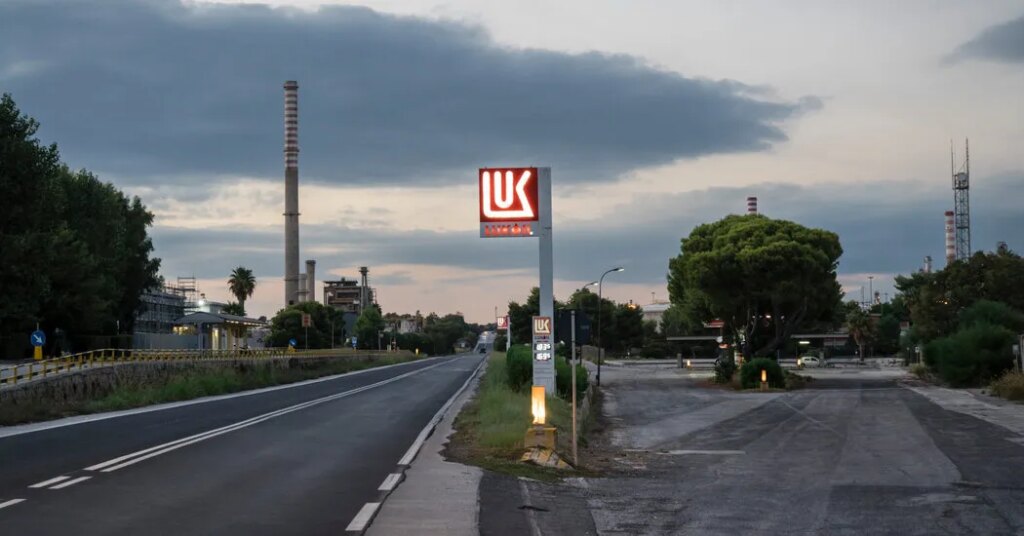
The deal, which is contingent on approval from the U.S. government and the Kremlin, is for a sprawling set of oil fields, refineries and gas stations around the world owned by Lukoil, one of Russia’s biggest energy companies.
The leading group seeking the deal includes an American investor, Todd Boehly, who has donated $2 million to President Trump’s political causes; two Middle Eastern groups that have done business with Mr. Kushner or Mr. Witkoff’s family; and an arm of the U.S. government itself.
The monthslong negotiations, which were described by eight people familiar with them, shed new light on Mr. Trump’s latest approach to settling a four-year war that has killed hundreds of thousands. The people spoke on condition of anonymity because of the sensitivity of the negotiations.
There is no indication that Mr. Kushner or Mr. Witkoff themselves stand to profit. But the pending deal represents a striking intermingling of personal business ties with geopolitics, even for an administration that has regularly dismissed concerns about potential conflicts of interest.
President Vladimir V. Putin of Russia brought up the deal when he met with Mr. Witkoff and Mr. Kushner at the Kremlin on Sept. 5, according to three people familiar with the meeting. Mr. Putin proposed it get done as a way of showing Russians that they can do business with the United States, according to one of the people.
The Americans responded that they would work on it, the person said, seeing it as a way to build good will with the Kremlin while also lowering global energy prices. But the deal is also a lucrative one for the buyers: U.S. approval for the sale would release the assets from American sanctions, instantly increasing their value.
In Moscow, the decision on the deal is widely seen as Mr. Putin’s to make, even though Lukoil is technically a private company. The upshot is that the giant transaction, involving assets as varied as oil fields in Cameroon, refineries in Europe and gas stations in New Jersey, comes down to Mr. Putin and Mr. Trump.
Mr. Trump has been promoting the promise of business deals with Russia since early last year, describing the country as a “tremendous opportunity.” The deal again brings Mr. Trump’s World Liberty Financial cryptocurrency company — co-founded by Mr. Witkoff — into focus. One of the investors in the Lukoil deal is a part owner of World Liberty.
Mr. Witkoff and Mr. Kushner, who have traveled repeatedly to Russia for meetings with Mr. Putin, have argued that the potential to rebuild economic ties with the West could convince the Russian president to compromise in Ukraine. The administration has recently signaled it is open to deals with Russia even before the war ends, as a way of showing it is serious about resetting the United States’ relationship with Moscow.
The Lukoil sale, people familiar with the matter say, is one of those deals.
In a statement, a senior administration official confirmed that Mr. Witkoff and Mr. Kushner played a direct role in helping negotiate the financial terms of the investment by the federal government in the deal to ensure that it included “a substantial upfront payment and profits interest for the United States.”
A spokeswoman for Mr. Witkoff said that he “takes no salary and travels the world on his own plane, at his own expense, working on behalf of President Trump to negotiate peace and bring hostages home to their families.” She added that Mr. Witkoff “has no conflict of interest and no financial stake in this matter.”
A Stalled Bid, and a New Contender
Numerous potential bidders expressed interest in at least part of Lukoil’s international holdings when the assets went on the market last fall, including U.S. energy giants like Chevron.
The Washington private equity firm Carlyle reached a tentative agreement in January to buy a large share of the assets, after making the pitch that bringing Lukoil’s international portfolio under U.S. ownership would further the Trump administration’s goal of “energy dominance.”
But in recent months, as U.S. approval for Carlyle’s bid stalled, a different group emerged as the leading bidder: one led by Mr. Boehly, a billionaire supporter of Mr. Trump’s, alongside well-connected figures in the Middle East and the U.S. government itself. The members of the partnership were reported last week by The Financial Times.
Mr. Boehly is a co-owner of the Los Angeles Dodgers and donated $1 million to MAGA Inc., the Trump-aligned political committee, in December 2025. He gave another $1 million through his investment firm, Eldridge Industries, to Mr. Trump’s inauguration.
The U.S. government is taking a stake in the deal through the U.S. International Development Finance Corporation, an agency that invests in and lends to projects overseas. A D.F.C. official said in a statement that the potential Lukoil deal “would advance the Trump administration’s commitment to strengthen U.S. economic security, advance U.S. foreign policy and lower energy prices for everyday Americans.”
But it would not be an all-American purchase.
A major equity holder would be the Qatar-based conglomerate controlled by Moutaz Al-Khayyat and his brother Ramez Al-Khayyat, both of whom attended Mr. Trump’s inauguration in 2025 and have since formed a partnership with Mr. Kushner and his wife, Ivanka Trump, one of Mr. Trump’s daughters, to help finance a multibillion-dollar luxury hotel resort project in southern Albania.
Another major stakeholder would be an Abu Dhabi-based investment fund controlled by Sheikh Tahnoon bin Zayed Al Nahyan, the United Arab Emirates’s top national security adviser, who controls another fund that purchased a large stake in the Trump family’s cryptocurrency company, World Liberty, run in part by Mr. Witkoff’s son.
Steve Witkoff was a co-founder of World Liberty, and Mr. Trump’s sons are also involved in the company, which generated $799 million for Mr. Trump last year, in part because of an additional cryptocurrency purchase worth $2 billion that Sheikh Tahnoon’s affiliate made in 2025. Mr. Witkoff himself has sold off his stake in World Liberty, a person close to him said.
Sheikh Tahnoon also helps oversee an Abu Dhabi investment fund called Lunate, which is among the largest stakeholders in the private equity firm Mr. Kushner set up after he left the White House at the end of Mr. Trump’s first term. This means Sheikh Tahnoon is effectively a business partner of Mr. Kushner’s as well.
An ‘Alarming’ Set of Entanglements
Hui Chen, a former Justice Department prosecutor and a white collar crime and ethics adviser who served until the start of Mr. Trump’s first term, said the connections between Mr. Witkoff and Mr. Kushner to players in the Lukoil deal illustrated why friends and family members of Mr. Trump’s should not be top foreign policy advisers.
“This is an alarming and very concerning set of entanglements,” said Ms. Chen, who has also worked as a corporate compliance lawyer. “And it means you have to question how the Trump administration is evaluating the different bidders involved here. Are the personal interests involved going to wrongly influence the outcome?”
Lukoil’s international division, which is based in Austria, hired its own Washington-based consultant who is close to Mr. Trump, Bryan Lanza, who served as a senior adviser to Mr. Trump’s 2024 election campaign and now works at Mercury Public Affairs. He is no longer working for Lukoil, a person familiar with the matter said.
The deal is not yet final, and would need to be approved by the Treasury Department, which oversees sanctions enforcement.
But in the case of Lukoil, people involved said, the key decisions are being made at the White House. Asked about its approach to the Lukoil decision, a Treasury Department spokeswoman said that the agency’s Office of Foreign Assets Control “implements foreign policy as determined by the White House.”
The Sept. 5 meeting with Mr. Putin was the first time that Lukoil came up in the Russian president’s conversations with Mr. Witkoff and Mr. Kushner, one person familiar with the matter said.
But Kirill Dmitriev, Mr. Putin’s economic envoy, has been closely involved, people familiar with the sale process said. He traveled to New York and Washington for meetings last month, and told reporters that “dialogue” with the United States was “continuing across many areas, including energy.”
Lukoil’s refineries in the Netherlands, Bulgaria and Romania play an important role. They produce diesel and jet fuel, which have been in short supply since the start of the Iran war, which has driven up prices and given Mr. Trump an incentive to support a deal that could provide more access to energy.
Lukoil valued its international assets at $20 billion earlier this year, but the price and structure of the proposed deal are not clear.
An official with the D.F.C., the U.S. agency investing in the deal, described participation in the purchase as a way to strengthen the energy security of U.S. allies. The official also said the deal would produce significant profits for the American taxpayer and keep strategic infrastructure away from adversaries.
Scramble for Assets
The Trump administration imposed sanctions on Lukoil a year ago, describing the move as new pressure on Mr. Putin to “stop the killing.” It also created a lucrative opportunity: Lukoil was forced to sell off its sprawling portfolio of international holdings.
Investors around the world scrambled to bid on the assets, but the U.S. government held veto power because it controlled how to enforce its sanctions. Because of Russia’s autocratic system, Mr. Putin was seen as the final decision maker in Moscow .
The bidding frenzy accelerated last November, when the Treasury Department rejected an initial offer by Gunvor, a Swiss-based energy trading company with past ties to Russia, which had moved to buy Lukoil’s foreign assets. The Treasury Department said in a statement that “as long as Putin continues the senseless killings, the Kremlin’s puppet, Gunvor, will never get a license to operation and profit.”
Carlyle secured a “nonexclusive” agreement in January with Lukoil to sell its international assets. It was up to the Treasury Department to then sign off on the deal. As months passed with no final deal, other bidders intensified their efforts to step in.
Mr. Boehly has little experience in the oil and gas industry. He has made most of his money through investment firms such as Guggenheim Partners and Eldridge Industries, as well as sports team and entertainment industry investments, including Bruce Springsteen’s music catalog.
But over the last several years, the billionaire Khayyat brothers, who were born in Syria before moving to Qatar during the Syrian civil war, have begun to amass a collection of oil industry assets and planned projects in Syria, Libya and Iraq.
Even while the Lukoil negotiations were underway, the Khayyats were continuing to work with Mr. Kushner and Ivanka Trump over plans to build the luxury resort in Albania, an effort that included a meeting involving Ramez Al-Khayyat and Ms. Trump earlier this year in Albania, The Times reported.
The decision over Lukoil’s fate has taken so long that the Treasury Department has had to repeatedly issue extensions to its sanctions action, so that Lukoil gas stations in the United States and other businesses around the world could continue to engage with other financial partners. The most recent extension lasts until Oct. 29.
The post U.S.-Russia Talks on Ukraine Now Involve an Oil Deal Tied to Trump Allies appeared first on New York Times.