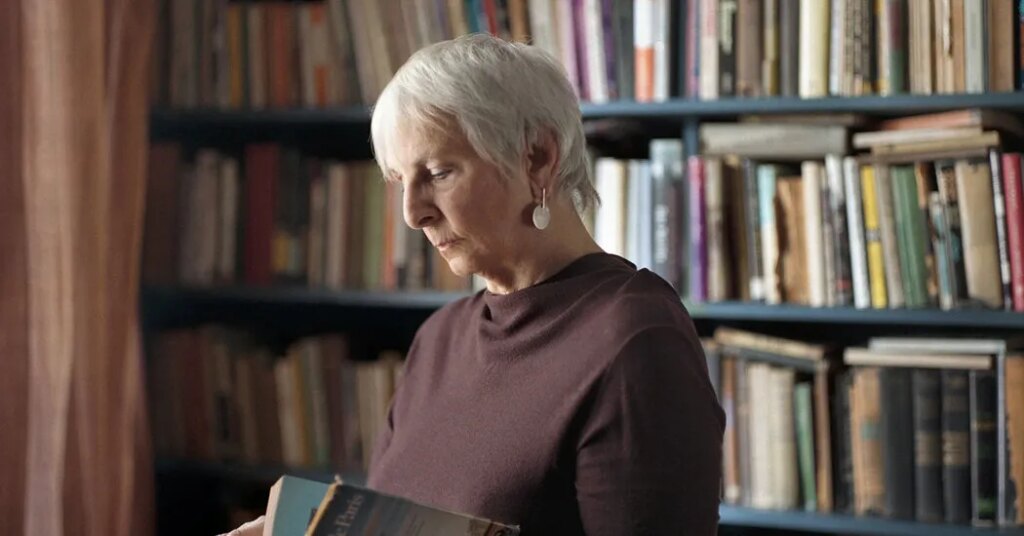
Linda Asher, who in nearly two decades at The New Yorker edited the stories of literary luminaries like Haruki Murakami, Louise Erdrich and A.S. Byatt and who was also a prominent translator of fiction from the French, including of novels by Milan Kundera, Yasmina Reza and Georges Simenon, died on Sept. 15 in Manhattan. She was 93.
Her death, in a hospital, was confirmed by her daughter Rachel Asher.
Ms. Asher “broadened the horizons of our fiction department,” Charles McGrath, a former deputy editor of The New Yorker who later oversaw The New York Times Book Review, said in an interview. “She was a genuine intellectual in a way the rest of us weren’t. And she introduced writers to the magazine that only she could have — the biggest one was Murakami.”
In her 18 years as a fiction editor at The New Yorker, Ms. Asher edited stories — some of them, like Mr. Murakami’s, translated by others into English — and translated writers like Mr. Kundera for the magazine. After she left the magazine in 1997, she continued to translate for books and articles.
“Linda’s enthusiasm and excitement about the writing that interested her was an inspiration,” Deborah Treisman, the fiction editor of The New Yorker, said in an email, “and her translations of Kundera, among others, show her enormous sensitivity to the writer’s intent.”
Her first task as a translator was to understand the nature of a book. As she told the fine arts magazine Works That Work in 2013, she set out by determining “whether the text is gloomy or lilting, sharp-tongued or exuberant” and then looked “for the meaning, the sound of the text, the song, which is to say the style, and my goal would be to find the English to answer in kind.”
She added, “I ask the question: Do I have the voice to meet this?” and she assessed whether she had “an answering style to represent it in English.”
Mr. Kundera was a powerful international literary figure who wrote about life under Communist rule in his native Czechoslovakia in novels like “The Joke” (1967) and “The Unbearable Lightness of Being” (1984). In 1975, he left Czechoslovakia — which had banned his books — and settled in Paris, where he eventually wrote in French.
Mr. Kundera was also an essayist. His collection “The Art of the Novel,” published in French in 1986, was one of the first of his books that Ms. Asher translated, in a 1988 edition. In it, he dissects how Kafka, Joyce, Cervantes and other novelists crafted their works.
“Linda Asher’s translation from the French deftly conveys the lucidity of Mr. Kundera’s prose,” Perry Meisel wrote in The New York Times Book Review.
In his review in The Times of another book of essays, “Encounter” (2010) — Mr. Kundera’s celebration of novelists, poets, composers and painters — the critic John Simon praised Ms. Asher’s “apt translation,” which “makes for fluent reading.”
In 2020, she received the Thornton Wilder Prize for Translation from the American Academy of Arts and Letters for lifetime achievement.
“Asher is singular in her ability and plasticity of language to convey what the original intent of the writer had in mind,” Terry Tempest Williams, a member of the literature committee, said on the prize’s website. “She makes ‘reading between the lines’ synonymous with ‘translating between the lines.’”
Ms. Asher was not the only Kundera translator in her family. Her husband, Aaron Asher, a prominent editor at several publishing houses — whom she married in 1956 and who died in 2008 — translated several of his books, including “The Book of Laughter and Forgetting” (1979) from French in 1996 and “Life Is Elsewhere” (1973) in 2000.
At their apartment in Manhattan, the Ashers hosted dinners and parties attended by literary lions like Philip Roth and Arthur Miller; musicians like Pinchas and Eugenia Zukerman; and many other figures including Brian Urquhart, a British diplomat who was a top aide to five secretaries general of the United Nations.
Linda Wofsey was born on Nov. 27, 1932, in Stamford, Conn. Her father, Michael, was a lawyer, and her mother, Freda (Nemoitin) Wofsey, worked in a thrift shop run by Hadassah, the Jewish women’s organization. While attending Smith College, Linda spent her junior year studying in Paris. In 1954, she graduated with a bachelor’s degree in history.
Before joining The New Yorker in 1979, Ms. Asher was a researcher at Life magazine; worked at Time-Life Books; was managing editor of the journal of the Institute of Society, Ethics and the Life Sciences (now the Hastings Center for Bioethics); and an editor at Psychology Today.
She was hired at The New Yorker by the editor William Shawn and established herself as a modest, smart and thorough editor, Mr. McGrath recalled.
“We had this system of exchanging opinions so when a story was up for consideration, it got passed around to different editors,” he said. “Each editor would write a paragraph or two, but hers were incredibly deep, like miniature term papers.”
Like other editors, she was always hunting for new voices and interesting stories.
“I would not only read the reams of fiction which publishers proposed for publication in the magazine,” she told Works That Work, “but I also spent long hours in libraries and bookstores reading or scanning dozens of works a month.”
She read widely for her translation work, which included sitting on the award jury for the French-American Foundation, for which she annually read at least a hundred new translations from current and classic French writing.
Ms. Asher won the organization’s award in 2000 for her translation of “The Case of Doctor Sachs,” by Martin Winckler, and in 2008 for “The Curtain: An Essay in Seven Parts,” by Mr. Kundera.
In his review of “The Curtain,” another meditation on writing, the novelist Russell Banks wrote in The Times that Ms. Asher translated it with “precision and grace.”
Ms. Asher’s other translations over the years include “Babylon” (2018), Ms. Reza’s 2016 novel about a dinner party that turns into a catastrophe; “The Yellow Dog” (1987), one of Georges Simenon’s early Inspector Maigret novels in the 1930s; “Memoirs of a Breton Peasant” (2004), by Jean-Marie Déguignet, the autobiography of a man born into poverty in Brittany in 1834; and “The Human Comedy: Selected Stories,” by Honoré de Balzac, which she translated in 2014 with Carol Cosman and Jordan Stump.
In addition to her daughter Rachel, Ms. Asher is survived by another daughter, Abigail Asher, and four grandchildren.
Ms. Erdrich, author of the 2021 Pulitzer Prize-winning novel, “The Night Watchman,” said that “A Wedge of Shade,” her first story published in The New Yorker, was accepted and edited by Ms. Asher.
“I remember the thrill it gave me and the even greater sense of gratification when, after many rejections, she’d write, ‘Of course we’ll take this one,’” Ms. Erdrich wrote in an email. “It was as if we both knew the outcome, and with the others I’d been throwing wide on purpose.”
The post Linda Asher, Who Widened The New Yorker’s Taste in Fiction, Dies at 93 appeared first on New York Times.