The night before she was scheduled to die, Christa Pike did not choose a last meal. She had asked that the money for that indulgence — $20, according to Tennessee prison rules — be used to buy pizza for homeless people in downtown Nashville.
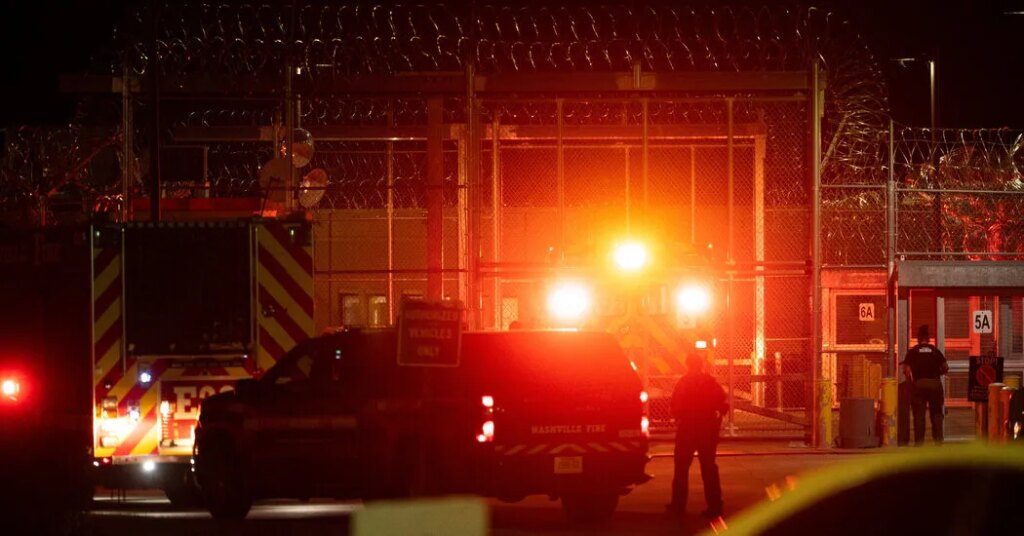
The next morning, journalists gathered in a tent in the parking lot of the Riverbend Maximum Security Institution, along the Cumberland River on the outskirts of Nashville, to monitor the first execution of a woman in Tennessee in more than 200 years. Demonstrators, most of them opposed to the death penalty, amassed in a field on the prison grounds.
The execution was set for 10 a.m. on Wednesday. But the careful choreography of the day almost immediately went off track. By evening, Ms. Pike would survive two separate attempts to inject her with execution drugs, bringing horrified reactions, renewed scrutiny of the death penalty and the second moratorium on executions in Tennessee in the past five years.
Many questions remain about exactly what went wrong. The Tennessee Department of Correction has said that it followed its lethal injection protocol to the letter. But the protocol does not lay out what should happen if two attempts to kill a condemned prisoner fail.
Ms. Pike remains unconscious and on a ventilator at a Nashville hospital, her fate still an open question. This account of her failed execution has been pieced together from the witnesses and lawyer who were at Riverbend.
Ms. Pike, 50, was condemned to death for torturing and murdering a classmate, Colleen Slemmer, with her boyfriend and a friend when she was 18. Ms. Pike has acknowledged that she initially did not have remorse for the crime, but that she grew to regret her actions over decades of physical isolation in prison.
Her lawyers said that a history of extreme trauma and sexual abuse that began when she was a toddler had not been considered at her trial.
Just 90 minutes before Ms. Pike was set to die on Wednesday, a federal appeals court issued a stay, saying that it needed more time to consider new arguments in the case. For Tennessee, that set off a race against the clock. The execution warrant would expire just before midnight.
Nine hours elapsed as everyone waited. Outside, flowers that had been placed near enlarged portraits of Ms. Slemmer drooped in the heat.
Inside, Ms. Pike was in a cell next to the execution chamber with one of her lawyers, Randy Spivey, and her Buddhist spiritual adviser. Finally, just after 5:45 p.m., the U.S. Supreme Court vacated the stay, and the execution resumed.
Ms. Pike was strapped to a gurney and taken to the execution chamber, where an IV team was to insert a catheter into each of her arms. The process is supposed to take 10 minutes, according to state protocol. Instead, Mr. Spivey said, it took an hour.
“I counted at least seven needles used in her left arm alone, one of which appeared to be bent when it was pulled from her arm after an unsuccessful attempt,” he said.
At a hearing last month, Ms. Pike’s legal team had warned of this very possibility, saying that their client had small veins and a blood disorder. In the execution chamber, Ms. Pike tried to help. “Over and over again she said, ‘Please try up on my shoulder higher, please try here, please try here,’” Mr. Spivey said.
Witnesses including the victim’s mother, who had driven from Florida, and seven journalists had been allowed into the viewing rooms, but the curtain was still drawn to block their view. With the microphone off, they heard muted sounds of paper rustling, Velcro fastening, groaning and whimpering.
“If you imagine what it sounds like when you open up a Band-Aid, that’s what I heard on multiple occasions,” said Will Puckett, a TV reporter in Knoxville, Tenn. By 7:15, he said, journalists who had attended executions before began to comment on the unusually long process.
Around 7:30, the curtains opened, the microphone was turned on and Ms. Pike was given a chance to say her final words. She spoke of leaving the world with love even for those who hated her. “I’m ready to be free,” she said. “This is a happy day.”
The catheters were connected to tubing that ran outside the chamber, to an out-of-view location where a “special operations team” would administer two syringes of the drug pentobarbital. At 7:34, Ms. Pike began experiencing obvious pain, witnesses said.
“The vein in my arm feels like it’s about to bust,” Ms. Pike said, though she was smiling and laughing. Moments later, Mr. Puckett said, “I saw a tear roll down her right eye, and then she said, ‘One spot is really throbbing.’”
At 7:41, a hand wearing a purple latex glove appeared and placed a small rock on a ledge, an apparent signal that the drugs had been administered and a five-minute waiting period should begin.
As that time neared its end, Ms. Pike gave a big yawn, the curtains closed and the spiritual adviser was removed from the room. But Ms. Pike was still audibly breathing, making a noise witnesses described as snoring or choking.
At this point, the protocol says that a physician is supposed to verify that the condemned person has died. If the person has not, a second round of injections is administered.
The curtain again opened, and the spiritual adviser returned. Ms. Pike continued to make the snoring noise, punctuated at one point by a grunt, and at another by her body lifting into a V-shape.
At 8:01, the rock appeared for a second time, and five minutes later the curtain was drawn. But Ms. Pike was still obviously alive.
This time the curtain remained closed, leaving the journalists literally and figuratively in the dark. When they protested, they said, it appeared that the correction staff members present were at a loss.
“They were in the same boat as us, to be fair,” said Steven Hale, a reporter for The Nashville Banner. “They didn’t seem to know more than we did.”
In a later interview, he added that the botched execution was “an extreme example of what every execution is, which is the grim reality of what is being done colliding with that sort of anesthetic planning.”
Mr. Spivey, the lawyer, was similarly in the dark. He did not know what was happening to his client, because after the IVs were inserted he was required to move to the witness room. Cellphones were not allowed, and he had no way to notify his colleagues on the outside of the situation.
“It took approximately seven minutes and passage through six locked doors to finally get me to a phone,” he said.
After the call, Ms. Pike’s legal team on the outside tried to get her medical attention. The governor’s office did not respond, they said. The emergency number they had been given for the State Supreme Court went straight to voice mail. Finally, they filed two separate emergency motions and were able to have a hearing, where they learned from the state attorney general’s office that an ambulance had been called.
At almost 9 p.m., all the witnesses were instructed to leave. The reporters walked out of the prison to give a news conference, their faces pale and stricken. “When they told us to leave at 8:53, Christa Pike was still breathing,” said Catherine Sweeney, a reporter with the local public radio station.
While they spoke, an ambulance could be seen pulling up to the prison, lights flashing. Everyone turned to watch.
The post How a Failed Execution Left Christa Pike Hovering Between Life and Death appeared first on New York Times.