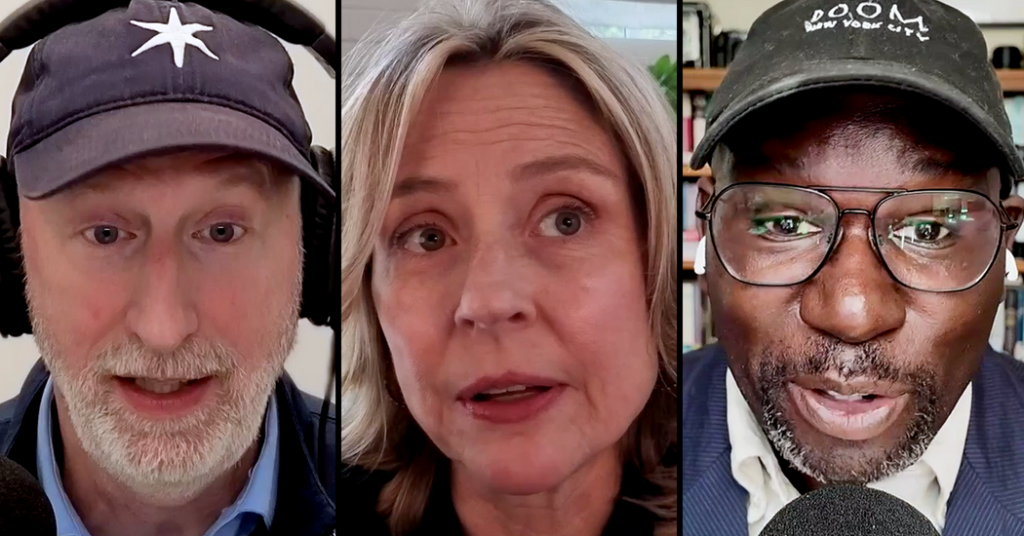
Disturbing details from an investigation of a rape allegation at Cornell University continue to be revealed. In this week’s episode, the Times Opinion politics correspondent Michelle Cottle joins the columnists Jamelle Bouie and David French to talk about the cultural implications and the legal complexities surrounding the case. Then the trio discuss the people they’re keeping an eye on in the upcoming midterms.
Below is a transcript of an episode of “The Opinions.” We recommend listening to it in its original form for the full effect. You can do so using the player above or on the NYTimes app, Apple, Spotify, Amazon Music, YouTube, iHeartRadio or wherever you get your podcasts.
The transcript has been lightly edited for length and clarity.
Michelle Cottle: This week, we are going to talk about the midterms, which are now just a month out. But first, I feel like we need to discuss the Cornell rape investigation, which captured national attention this week, after a former student filed a lawsuit against the university and seven members of the Chi Phi fraternity. The woman, who is identified as Jane Doe in the filings, says that frat members drugged and raped her in October of 2024. According to the legal filings, after the initial investigation, the university expelled only two of the accused students, and the local district attorney declined to prosecute.
So for all this and more, I am joined by my brilliant colleagues, columnists Jamelle Bouie and David French. Guys, good to see you, as always.
Jamelle Bouie: Good to see you all as well.
David French: Hi, Michelle.
Cottle: Before we get into the details of this horrible case and the legal issues that are at play, I was thinking about why this story struck such a nerve. I mean, obviously, the allegations are terrible — just horrific — and it took place at an elite institution, one that parents are always fighting to get their kids into. But I’m wondering if maybe there’s also something to the fact that we are now almost a decade past the #MeToo viral movement, and some days, it feels as though vanishingly little progress was made. So Jamelle, what struck you about this case and how it fits into our cultural moment?
Bouie: I think that you can’t separate the interest and outrage, with regards to this case, from the fact that, at the highest reaches of government, it appears that many key figures are, at the very least, people who have been accused of sexual assault, accused of mistreating women. And in at least one case, namely, the president of the United States has been found at least civilly liable for sexual abuse. Not even appears — it is simply the case that this administration is indifferent to concerns around sexual violence against women, that the movement around it glorifies a kind of aggressive and predatory and domineering masculinity.
Last year, an administration figure whose name I cannot recall intervened to help Andrew Tate and his brother out. Andrew Tate being the manosphere influencer who is currently being prosecuted, charged with basically pimping out women. I mean, a really awful and terrible and degenerate human being, if I’m going to really say how I feel about it. And
That’s not just the cultural context, but the political context in which all this is happening. Simply a powerful political movement, which doesn’t just seem to hold the notion that there’s pervasive sexual violence and contempt, but in some cases celebrates the people who abuse women for entertainment and profit.
And so then, when you have an example like this — have a case like this — where it really does appear at this elite university, these young men who may go on to elite spaces, and who may have escaped any kind of real accountability for engaging in sexual violence. Many people are angry and upset, and do feel as if there hasn’t been any meaningful progress since the #MeToo movement. And I don’t blame them for feeling that way, because it feels to me as well that it doesn’t really seem like there’s been much meaningful progress since #MeToo.
Cottle: David?
French: I agree with that, and I think I might even be more bleak than Jamelle, if that’s possible. Because I actually think it’s not that there’s been no progress since #MeToo — I think there’s been regress since #MeToo. And I think the arc of events is kind of like this: That if you go back to when Jodi Kantor and Megan Twohey, our remarkable newsroom colleagues, broke the Harvey Weinstein story and really launched this #MeToo wave and we began to see story after story that was genuinely appalling — and especially in the media world, just genuinely appalling. And many of these stories were very well documented with multiple people coming forward with dates, times, details. And you also had some stories that were too much, that it was too far.
There was an excess, where people went too far in the height of the #MeToo movement. So where you went from an age of accountability, where sometimes accountability went too far, to using the excesses of the age of accountability to justify what we’re in now, which is an age of impunity. And it’s that age of impunity that, when Jamelle talks about Donald Trump and the civil judgment, what’s so notable about the way in which the entire right side of the spectrum ignored that civil judgment is that for years, the right had constantly said: We hate sexual assault, we hate sexual abuse, but we also really love due process, and what needs to happen is more due process on campus.
And I agreed with that. We cannot skip due process to leap to liability. Well, Trump got due process. He got a jury trial. He got appeals. He got all of the process that could potentially conceivably be due, and he was still found liable, and it didn’t matter. It didn’t matter.
And so you now begin to see this world in which people glory in their transgression. And I want to just say, by condemning what these guys did — which I think is reprehensible, the way they behaved — that’s not reaching a legal conclusion about the criminality. We’ll get into that, but I think it’s really important that we at least be able to say that this is not how a human being should have been treated under any circumstances. And to say that loudly and clearly, before we get into the legal situation, which, Michelle and Jamelle, is complicated and also betrays, I think, some fundamental problems in the way we approach the issue generally.
Cottle: That does not surprise me. The thing that I found unusual about this — and I can remember, when I was in college, these types of situations would arise. Way too much drinking, way too many hormones, way too much entitlement among certain corners of the university community. But what seems to be new with this is the part about how in the middle of the alleged assault, these guys allegedly sent out a group message to other people, to come get some free sex from this poor woman. And this, to me, seems to be social media on steroids; where it extends the circle of culpability and raises questions about the kind of responsibility that, even if they’re not legal questions, there are certainly moral questions. And it just makes this whole thing that much more horrific and complicated.
But I guess we should go back. One of the big questions here is how the university responded and how the fraternity responded. So David, why don’t you walk us through some of the specifics about how it was originally handled?
French: Well, we’re still learning a lot and our newsroom colleagues did a really excellent job on this. Whenever something like this occurs, there’s multiple processes that can unfold simultaneously. So you have really, for lack of a better term, three legal systems that are potentially involved. One is the criminal justice system — this is the district attorney who investigates. Another one is the civil litigation system — this is when she ultimately filed a lawsuit seeking damages. The civil justice system is liability, and its preponderance of the evidence.
And then you have a university system — that is a Title IX system involving sex discrimination investigations, and sex abuse is a form of sex discrimination. And that is much more informal and also has that lower standard of proof, usually proof beyond a reasonable doubt. So you had, unfolding pretty soon after the alleged assault, a criminal investigation and a university Title IX investigation. And these university investigations tend to happen behind closed doors. The participants are protected by privacy laws, for example. But they resulted in a degree of punishment for some young men involved. The district attorney took a look at the case, and at least as of the initial investigation, declined to prosecute.
Now, a number of people are questioning that decision, and questioning whether the district attorney’s investigation was comprehensive enough — whether he dotted all the I’s, crossed all the T’s. It did not appear, for example, that the district attorney had the Snapchat messages, had the free access message — which really doesn’t exactly communicate a whole lot of consent to say, essentially, free you-know-what. So the D.A. has since reopened the investigation, and also the individual has — the way this hit the media is that the young woman filed a lawsuit, so civil justice. So all three of the systems have now been activated to some extent.
And so there is no such thing here, so far as we’re able to know or see, as anything that looks like a comprehensive adjudicated outcome that provides us with a body of facts that we can sit and clearly analyze. We’re, right now, in this process of basically learning something new almost every day.
Cottle: So combining Jamelle’s observation with your legal observations here, do you think, on any level, Cornell is being or has been extra cautious about this? In part because the Trump administration has been hammering schools on anything that smells of erring on the side that would be seen as unfair to men, or wokeness, or this sort of thing? Or do you think that this is just what happens in these cases, period?
French: It’s really tough to say. These cases are extremely difficult, especially for universities to adjudicate. I mean, we’ve been going through years and years and years of litigation over Title IX. The pendulum has sort of swung back and forth. If you go back to the Barack Obama years, there was a “Dear Colleague” letter sent out to universities that unfortunately paid short shrift to due process in some ways, and there were a lot of campus tribunals and campus disciplinary proceedings against accused students, without very much due process at all — like, no ability to cross-examine a witness, often not really able to see the evidence against them.
And there were tons of lawsuits filed, and many, many of them came out against the universities. So now the pendulum has come around to, in a different direction, we need lots of due process here — which, I think, is completely fair and correct to see that there has to be due process in a government-mandated disciplinary proceeding.
Cottle: So Jamelle, here’s a kind of nonlegal question, but from what you’ve read and what you’ve looked at, how do you find the balance between not railroading the accused men, but also making sure you’re not putting undue burdens on the woman who’s the victim? Where do you go with this?
Bouie: I suppose my starting premise here — where I begin is that we don’t live in a society where sexual violence is prosecuted to the fullest extent of the law, investigated to the fullest extent, taken seriously to the fullest extent. We don’t live in that society. We just don’t.
And the evidence suggests that the rate of sexual violence against women is considerably more pervasive than what is charged and prosecuted. The fact that these young men engage in this behavior, talked about it the way they did, treated it as some big fun game, is, to my mind, evidence enough. The thing I’m trying to say is, these aren’t exceptional young men, right?
In a lot of ways, they’re just ordinary young men. And the fact that this didn’t seem to be remarkable to these ordinary young men is, I think, evidence of the actual state of American culture as it relates to the treatment and dignity of women, and as it relates to how serious we take sexual assault and sexual violence.
I guess from my view, my starting point would be: I would want the criminal legal system and I would want universities to take this extremely seriously, to really dedicate themselves to serious investigations. My sense, reading the various accounts of how this has unfolded, is that there was a real reluctance on the part of the various authorities to really want to press further.
And that seems to be generally the case when it comes to these incidents. A real unwillingness to want to press further, investigate further, take serious action in response. And so for me, it’s that. It’s really treating this like the incredibly serious problem that it is.
I was in college 20 years ago, and I was involved somewhat in sexual assault education for other men, and we were having this conversation then about the importance of respecting consent, of understanding that consent is a process, not just a binary thing. That women face — especially in the context of, say, fraternities and alcohol and drinking and drugs — there are real and serious safety concerns, and that it’s the responsibility of men in these situations to police each other. Police each other, keep people safe. I mean, these were the conversations we were having 20 years ago, and these are the conversations that were happening 10 years ago, and they’re happening now.
Cottle: OK, so let me grab that piece, because I think one of the people named in this suit was then president of the fraternity, named because he didn’t appropriately oversee his members. Now, that sounds great, but that, from my experience of college fraternity parties, is a really unrealistic idea. I mean, when you’re talking about facts on the ground, I’m wondering if this is part of what throws institutions like Cornell into a swivet. They don’t really want people looking into how much partying goes on in these schools. There’s so much insanity that I have a hard time wondering how you expect anybody to police other members in that situation.
French: You know, there are two huge problems I want to emphasize: cultural and legal. So here’s the cultural problem — and I think we have confused the minimum legal standard, which is consent, for the moral standard. And I do not agree that the moral standard for sexual activity should be consent. I think it should be care. Now, I’m not going to ask that people agree with my conservative, evangelical Christian sexual ethics, that sex is for marriage between a man and a woman. Look, I know lots of people disagree with that, obviously, but at the minimum — at the minimum — is this the kind of thing, if these young men actually cared for her, rather than just asked if she agreed with it in the moment — is this how they would treat her?
And that’s the problem I have with a lot of these arguments, culturally, is we almost treat it like, well, everybody was consenting, and then that makes it morally OK. I want everyone to be caring, and if you’re caring, you’re going to be preventing an awful lot of this stuff, where years later — and even days later or hours later — people look back at what they did when — Michelle, as you’re talking about, the combination of alcohol and hormones does not always make us our best selves — and then we look back at that and go, “I didn’t want to do that. I didn’t want to be that.”
Now, legally, what we have done is we have privileged getting wasted over taking care of people. And here’s what I mean: If you look at New York law, the crime — second-degree rape, where someone is incapacitated, say, through intoxication — if you are voluntarily intoxicated, that’s not going to count. It has to be involuntary; in other words, being drugged. But Michelle and Jamelle, whether you’re voluntarily or involuntarily intoxicated, what are you? You’re still intoxicated. The level of intoxication doesn’t depend on the voluntary or involuntariness of it. And then you start to get into the really difficult question of, OK, which line of ketamine that was snorted was coerced versus which line of ketamine that was snorted was voluntary? And you begin to see why these prosecutions get really difficult.
So here’s what I would think, morally and legally. We need to flip the ethic here, toward the ethic of care over consent, morally and legally. When people are intoxicated to the point of incapacitation, we need to privilege safety and bodily security over: Well, this is college. People are going to get wasted, right? That’s not the way the law should be operating.
Cottle: I want to ask about the cultural guardrails that we have put up, because I do think I agree, that in recent years, we fetishized consent just by itself. Like, that’s the only question people ask. So Jamelle, this has been, I think, my theory, that especially with progressives and the whole kind of sex-positive, you know — it’s like the extreme version of no slut-shaming. You’re not supposed to call anything out of bounds as long as everybody has said, “Oh, no, I’m OK with this.” Jamelle, where do you stand on this? Should there be another piece to this, or is that just kind of what we have to work with?
Bouie: My own inclination is not far from David’s, frankly. It is that consent is fine, as far as a broad minimum, but that when it comes to having sex, engaging in sexual activity, I’m not sure that minimums are what you should be aiming for.
Or I’ll put it this way. My kids are quite young. Both my children, but my son especially, when we have these conversations, it’s not going to be, “Oh, as long as you get the minimum approval, then everything’s cool.” It’s going to be, “Take this person seriously as a full person. They’re not merely an object for your own satisfaction. They are a full human being who feels and thinks just the way you do, and think about how you would want to be treated in this situation. Think about how you would want someone to take account of your feelings, and think about what, how you would feel if you felt that you were being violated in some way.”
Like, that’s the minimum, right? The absolute minimum is to put yourself in that other person’s place, and make your decision, and make your choices with that in mind. I don’t know, as far as thinking of cultural standards, I don’t know how you make that a cultural standard.
But I do think that part of what we’re witnessing is the extent to which many young men have both internalized the consent requirement, and also the quite vicious and aggressive misogyny that has, maybe not re-emerged, really, but kind of taken a more prominent place in American cultural life. You put those things together and you get a situation where young men basically think that they look at someone incapacitated, saying “Yes,” put quotes around that yes, and go forward with it as if that’s the only thing they need to account for. And the idea that no, you need to account for the fact that this is another human being, that women are people, and you need to take that seriously — that doesn’t enter the picture.
Cottle: Yeah, I spend my days, as you know, dealing with political candidates and politicians; and it is depressing to me that what we’re talking about on college campuses is also what we’ve seen — certainly this last year — re-emerge with a vengeance among members of Congress. I mean, we’ve had members have to resign. We have members who have declined to resign over accusations of mistreating spouses or, in some cases, taking sexual advantage of young staffers. So I have to think that this is just, as role models go or as cultural signifiers, it’s just a terrible swamp that people are being subjected to.
And so I am worried about where this goes. Where do we think this case is going? I mean, is there any chance that we think it’s going to lead to reforms, either in how schools handle these things — or one piece that we haven’t gotten into a lot, and David, you probably know more about this than I could ever imagine, it’s just that fraternities are big players in these situations.
I know Caitlin Flanagan, years ago for The Atlantic, did a big piece about when members get into trouble, like fraternities, their national organizations have a lot of power, and then they sometimes come marching in to make sure their members get handled delicately. But where does this go, do we think?
French: Can I be, I want to say, bleakly realistic? I do think that there will be, and has been, a renewed burst of concern. And not just a burst of concern about the state of the law, and should the law say that voluntary intoxication is this zone of privilege, versus reforming it to where intoxication is intoxication. OK, that’s sort of a low-hanging-fruit legal reform that I think could be undertaken. Is there a burst of interest in maybe reforming and rethinking moral norms? Yeah. But what we’ve seen is just relentless impunity. And we haven’t even raised the name Jeffrey Epstein yet, right?
And Michelle, we had both been watching this show called “Furious” on Hulu, and what was so powerful about that was how it really accurately portrayed how very difficult it is to bring powerful people to account, hold powerful people accountable, especially when it comes to sexual misconduct.
And then we’ve had some cases where prosecutors and the public went crazy — like the Duke lacrosse situation, where people leaned way in ahead of the evidence. And so we shouldn’t be doing that. We shouldn’t be leaning in and making judgments on evidence before adjudication. So it’s hard, but one thing that I also think is in play here is that prosecutors don’t like hard cases. They want a case that’s going to be like, I walk in, and they’re going to plead it out because it’s so open-and-shut, or if they are stupid enough to take it to jury, it’s going to be a quick jury deliberation because it’s open-and-shut.
And this is a case where there’s a lot of different text messages. Some of them are really, really bad. Some of them clutter the picture and cloud the picture. And that’s the classic case that a lot of prosecutors will try to kind of lean away from, or do what this prosecutor said they’re going to do — essentially punt it to the grand jury, sort of say, “We’re going to see what the grand jury says.” But that’s not really the role. If they believe the case is prosecutable, tell that to the grand jury.
Cottle: Jamelle, are you feeling bleakly realistic as well?
Bouie: Yeah, I mean, just based on what I said earlier, we seem to be stuck in a bit of an eternal recurrence. I am afraid that I’m quite pessimistic about all of this. My hope is that some accountability is found, that the young woman finds some peace and justice in her life, and that, I hope, we can use this to build better systems. But I’m really not going to hold my breath about that.
Cottle: Yeah. All right, now I’m going to have us do a hard pivot to a topic that has been a repeat favorite among our conversations but now is getting down to the wire: the very high-stakes political midterms, where — I don’t want to say the soul of the nation is on the ballot, but we can do that if you like. We’re about a month away from Election Day. Early voting has already started in some places. It has been quite the journey thus far. As we are heading into the homestretch, what is one isolated story or nugget that has stuck in your head as telling us a lot about what’s going on and where we’re headed?
Bouie: So our newspaper ran this story about Kansas Senator Roger Marshall not long ago, about how he was apparently having people from his medical practice arrested for basically small bills; $50 here, $200 here — a pittance, relatively — but siccing the law on them for not having paid on time. And this has become a big issue in the Kansas Senate race. And Marshall, who faces a surprisingly tough challenge from a Democrat — I believe his name is Adam Hamilton — appears basically unable to really figure out how to deal with this controversy, these attacks. He really is flailing.
He’s like: Well, actually, I had them arrested for not showing up for a court date. That doesn’t really capture what people are upset about when it comes to this story. And you see something similar, this sort of flailing about in the face of a strong challenge, from Ken Paxton. Ken Paxton is, I would say, like a sub-replacement-level Republican candidate; he is an experienced one, at the very least. He’s run plenty of races, but he’s never really run a competitive one against a Democrat for statewide office in this way.
And one of the stories of these midterms — and this is how you get waves, right? — is that when national conditions make more seats competitive, make more candidates viable in challenging whoever the incumbent party is, you find that there are all these incumbents who just have never had to run a truly competitive race, and just don’t know how to do it. And if they lose, it’ll be as much because of a lack of being able to deftly respond to attacks and criticism and the like, as it will be national conditions.
You can outperform national conditions. Part of the reason Susan Collins is still in the Senate is that she has consistently outperformed national conditions, in part by being a very effective Maine politician, who knows the state, who knows its voters, and who knows what they want to hear — and who knows what she has to do to get ahead of criticism from Democrats. And I think what you’re seeing in both House races and Senate races are Republican candidates who, if they ever had the ability, lost the ability to do that. And now they’re up against challengers who don’t just have the wind at their back, but are genuinely hungry to win.
Cottle: David, what story have you got?
French: I’m glad Jamelle brought up the Paxton-Talarico race. And one thing that really stood out to me was, if you move past the grass tips of MAGA — like the somebody who follows Trump and says, “Ken Paxton’s our greatest attorney general,” which is usually entirely related to the fact that he absolutely will carry water for Donald Trump no matter what.
But outside of that core MAGA that upholds him as sort of Trump’s A-No. 1 water carrier, there just isn’t an affirmative case for Ken Paxton. And so everything depends on tearing down James Talarico. And after spending years hearing from MAGA that we’re electing a president, not a pastor, why are we asking about what Donald Trump believes theologically, why are we diving too much into his character, because policy is all that matters, etc. — now, all of a sudden, James Talarico’s theology matters. The theology of James Talarico’s pastor matters. So which is it? Are we electing a president, not a pastor; but when it comes to the Texas Senate race, we’re electing a pastor, not a senator? All of this doesn’t make a lot of sense. And so it’s so muddled, and a lot of the attacks on Talarico, or 90 percent of them, don’t have anything to do with his conduct in office. They’re all about this other stuff — like, how many paths to Jesus are there, and all of this stuff.
Cottle: Well, they can’t do the conduct in office, and they can’t do personal morality, because if you open those cans of worms, then Ken Paxton goes down. The defense that I’ve been hearing from his supporters in the state is: Oh, personal morality doesn’t matter anymore. Eh, you know, why do we care if he’s had affairs or been, you know, indicted or impeached or whatever?
French: And it wasn’t just personal morality. I mean, members of his own team resigned and blew the whistle on official misconduct, including allegations of bribery that got him impeached by the Republican-dominated Texas House. It really is this interesting microcosm of the moment, where it’s very hard at this point, given the sentiment in the country, to make the positive case that we should have united, all-Republican government for two more years. It’s very hard to make that positive case when public sentiment is this low, so what is all that’s left?
All that’s left is “Talafreako this, Talafreako that,” and I’m just not sure it’s going to work. And Michelle, I’m also not sure it’s going to work because I honestly think that people are getting a little bit tired of the constant catastrophism. Just the constant: Vote for me or the world ends. And so, I don’t know. It’s going to be interesting. Talarico’s taking a very different approach. He’s trying to be a more ecumenical, welcoming, upbeat kind of politician, motivation ——
Cottle: Happy warrior.
French: And so it’s almost like a perfect storm kind of case, and we’ll see how it goes.
Cottle: I’m going to take Texas as well. So I did some following around of Bobby Pulido, who is the Democratic House candidate in Texas 15, which is in the Rio Grande Valley, which is one of my favorite places to go report. It’s just the most fascinating cultural experience. And he’s running against Monica De La Cruz, who took this blue district and flipped it a few years ago, and the Democrats want it back.
And of course, Republicans have redistricted. It’s a hard thing to claw back. But while I was down there, following around Pulido — this is a hugely Latino district. It’s a good test case for whether or not Trump’s inroads into the Latino voting community are going to hold. And I was just talking to this woman. She runs a restaurant down there. She and her husband voted for Trump in 2024 because they liked his economic message, and they just feel burned. And she’s like: Never again. She is out. She’s all in for Pulido. She’s changed her mind and decided that she was sold a bill of goods.
And from what we’ve seen from other reporting and other polling, this is potentially a real problem for the Republicans broadly, if they can’t hold these Hispanic inroads, but especially in places like Texas, where they redistricted on the assumption that they would get a certain percentage of the Hispanic vote. So it could turn their gerrymandering into dummymandering — one of Jamelle’s favorite things. And so I am just waiting to see how all of that plays out. And that will affect them going forward well beyond this particular cycle.
French: Jamelle, I can’t tell you how much I’ve used the term “dummymandering,” but I always credit you. I always give the right attribution.
Cottle: It’s a fantastic possibility, and it would be divine justice, I really think, if, after all of the game-playing that Trump did, pressuring all these states to redistrict, if a lot of dummymandering came back and bit him on the butt. I would be so pleased about that. Not going to lie. With that, I feel like we’ve got to change. Time for recommendations. What you got for me?
Bouie: I saw the new Robert Pattinson movie, “Primetime,” about “To Catch a Predator.” It’s been sort of a controversial movie, because there are a lot of people who quite like the show “To Catch a Predator,” and the movie is very clearly critical of the television show. But I think it’s worth watching. I’m still working through what I think about the film. Pattinson gives a great performance. Merritt Wever is excellent. Also Skyler Gisondo. Like, the whole cast is really working at the absolute height of their powers. But the most interesting thing, to me, about the movie is that it really feels like a “Moby-Dick” kind of story — a movie about the dangers of fanaticism first.
But the film is very much about post-9/11 America. It begins in 2004. It’s very much the height of the war on terror, and it draws an analogy between the kind of fanaticism and yearning for clarity that characterizes a show like “To Catch a Predator” and the war on terror and the war on Iraq, and the desire to have something clear and black-and-white, where the moral stakes are exactly as they appear. So it’s an interesting movie. I’m not going to say it’s, like, the best movie I’ve seen this year, but it’s a very interesting movie, and I really recommend it.
Cottle: OK. David?
French: All right, Michelle. Two words: “Last Seen.” OK, this is an Apple TV drama, Australian. You know, normally I’m British crime. Let’s go Australian crime. These Anglo countries and their horrific crime problems. And so, this one is a 911 — or in Australia, a triple zero — dispatcher, and his daughter had disappeared at age 3, 11 years ago, written off as deceased. Gets a call from somebody he believes is his daughter 11 years later. So it’s hard to watch, but it is so well done. And the end of Episode 4 — I think it’s only about six episodes — was one of the most gripping and intense 45 minutes of television that I have seen in a long time. And after it was over, my wife and I just looked at each other and just said, “Wow.” Because it went in a way we didn’t fully expect — and, wow.
Cottle: OK, so it’s that time of the election cycle where I turn into a hideous nag about people getting involved. So I’m going to take this moment, one month out from Election Day, to recommend that people figure out a way to get involved. I have, for instance, a lovely friend who has started, every Sunday, holding postcard writing parties. Now, she’s not doing it in a particular partisan vein. She actually got voter lists from Reclaim Our Vote that are registered but not regular voters. And so she has people over to her house every Sunday to sit and just write. I think they’re targeting Texas. Just little notes that say: “Remember, you have the right to this, that, the other. Make your vote count.” And then they send those out every week, and there you have it. They’re going to do that through the end of the election.
So that may not be your cup of tea. Maybe you want to go knock doors, maybe you want to call, maybe you just want to donate. But we can sit here and complain all day long about how horrible this administration is, how pathetic the Republican-led Congress is, in terms of letting Trump run all over everybody, but if you don’t get out there and get involved, get your early ballots, whatever, it’s all for nothing. Just saying. And with that, we’re going to end this and land this plane. Guys, always a pleasure.
Thoughts? Email us at [email protected].
This episode of “The Opinions” was produced by Vishakha Darbha. It was edited by Alison Bruzek and Kaari Pitkin. Mixing by Pat McCusker. Video editing by Steph Khoury and Mahdokht Mahmoudabadi. The postproduction manager is Mike Puretz. Original music by Pat McCusker. Fact-checking by Mary Marge Locker. Audience strategy by Shannon Busta, Kristina Samulewski and Ali Baluch. The director of Opinion Video is Jonah M. Kessel. The director of audio engineering is Isaac Jones. The deputy director of Opinion Shows is Alison Bruzek. The director of Opinion Shows is Annie-Rose Strasser.
The Times is committed to publishing a diversity of letters to the editor. We’d like to hear what you think about this or any of our articles. Here are some tips. And here’s our email: [email protected].
Follow the New York Times Opinion section on Facebook, Instagram, TikTok, Bluesky, WhatsApp and Threads.
The post Cornell and the Age of Impunity appeared first on New York Times.