Six months ago, Deborah VanTrece, the chef and owner of Twisted Soul Cookhouse & Pours in Atlanta, noticed she was running out of containers for diners to take leftovers home.
“It wasn’t a few bites left over. It was half a plate.” Ms. VanTrece recalled. “I was like, ‘Did our portions change?’”
No. It was that more customers were on GLP-1 weight-loss medications. Restaurants, from cozy, upscale establishments to national fast-food chains, are figuring out how to adapt menus for the 11 percent of adults, or roughly 30 million Americans, using drugs like Wegovy, Ozempic and Zepbound. People on these medications are eating out less and spending less when they do.
“We always ask guests about meals that aren’t fully consumed, and they are very forthcoming in letting you know it’s ‘the shots,’” Ms. VanTrece said.
The number of people taking these medications is expected to rise, and as consumers seek more protein to protect muscles (GLP-1s can reduce muscle mass), the response would seem fairly straightforward: Put more protein on the menu, and cut portion sizes.
But adding protein to a plate can be expensive; beef prices, for one, remain at a record high. Businesses have to determine whether consumers would be willing to pay $5 or $7 more for a few additional grams of chicken or beef in their meal.
And does half a sandwich or a half-size portion of Barbecue Duck Confit mean it will cost 50 percent less? Not likely, as restaurants must still cover their rent, their labor and their own rising food expenses, said Darren Tristano, the chief executive of Foodservice Results, a research and consulting firm in Chicago.
“If you’re serving half the portions, you’re likely going to charge 75 percent of the price” of the full portion, Mr. Tristano said. “There’s going to be a premium for the consumer for that.”
But meeting the evolving needs of diners on weight-loss medications isn’t easy for restaurants, which have spent decades selling bigger burgers, larger orders of fries and giant containers of soda.
Higher food prices in grocery stores and at gas pumps from the war with Iran were already being felt at restaurants as some consumers started eating out less frequently or skipping appetizers or dessert to save money.
But the reality for many restaurants is that their own expenses have soared since the Covid pandemic. Average hourly earnings of restaurant employees and wholesale food prices have risen more than 35 percent since early 2020.
And while restaurants have raised menu prices, sometimes quite sharply, one-third of restaurants said they were unprofitable in the first half of this year, according to a survey by the National Restaurant Association.
Fast-food chains are facing significant challenges as their calorie-dense foods — burgers and fried foods — are not what people on weight-loss medications are seeking, according to a report by analysts at the investment bank William Blair.
Still, McDonald’s, which has seen customer visits slow down this year, is treading carefully in introducing new menu items for customers on GLP-1s.
In an interview last month, Chris Kempczinski, the chief executive of McDonald’s, reiterated that the restaurant chain had not seen any effect from consumers on GLP-1 medications.
Still, the company is testing options. During its investor day meeting in Chicago, it served analysts a salad topped with McCrispy chicken strips and offered a grilled chicken wrap. McDonald’s discontinued salad bowls and grilled chicken offerings in 2020 when it simplified its menu during the pandemic.
But Mr. Kempczinski said it was unclear if those test items would be added to the menu.
“The challenge is making sure that there’s sufficient demand to justify putting those items on the menu,” he said. “I think sometimes in the past, you know, when we’ve done some things similar to this, the risk or the mistake was maybe putting it on before there was sufficient demand to do it.”
Restaurant Brands International, which owns Burger King, listed weight-loss medications as a risk to its business in financial filings this year. Burger King is testing smaller portions, like Whopper Bites, but a spokeswoman for the chain said the smaller portions weren’t specifically for consumers on GLP-1 medications.
Late last year, Shake Shack introduced a “Good Fit” menu, which features burgers and chicken (mostly without buns) and highlights the grams of protein. The price of its SmokeShack Lettuce Wrap and the SmokeShack burger, bun included, is the same. The company declined to comment.
Maddy Hague said she wished more restaurants offered smaller portions of meals.
The creative director for a tech start-up, Ms. Hague said she had lost 80 pounds since she started taking Zepbound in the spring of 2025. She has developed an aversion to large plates of food put in front of her and often doesn’t eat the leftovers that she takes home.
“I know I’m paying more to eat out than I need to and I’m wasting food, which doesn’t sit super well with me,” said Ms. Hague, who lives in Plymouth, Minn., just northwest of Minneapolis.
If restaurants offered a half-size portion of meals, she said, she would be willing to pay about 80 percent of what she would be charged for a full entree.
“I wouldn’t expect it to be 50 percent of the price of a regular meal,” Ms. Hague said. “I’m still going out and having that experience, and I want to make sure that the restaurant is successful.”
Adapting menus for consumers on weight-loss medications and still making a profit means restaurants have to become creative, said Neil Doherty, the head of global culinary and strategy at food service giant Sysco, who works with restaurants to develop menus.
Using less expensive ingredients like lentils, eggs and cottage cheese is one way restaurants could boost the amount of protein offered, Mr. Doherty said.
“If you’re a steak restaurant, instead of an eight-ounce tenderloin, pair a four-ounce tenderloin with shrimp,” Mr. Doherty said. “Shrimp is a great value right now.”
Restaurants should consider offering more smaller-plate options for diners, he said and noted the smaller portions served in many European countries.
About a year and a half ago, Dennis Turcinovic, the owner of Tucci, an upscale Italian restaurant in New York’s NoHo neighborhood, saw plates of Fettuccini Fra Diavolo and Veal Chop Marsala being removed at the end of meals with very little eaten.
So he created smaller versions of some menu items. Instead of the typical appetizer of three balls of Arancini and Caviar for $34, Tucci offers a plate with one for $12.
Mr. Turcinovic said there was a discussion around cutting overall portions of food. But members of the restaurant staff said that was likely to anger diners not on the weight-loss medications who could still eat the full entrees.
“I thought, what if we made the pasta dishes a little bit smaller?” Mr. Turcinovic said. “But if you charge more and give less, then you’re going to look like the bad guy when you’re just trying to stay in business in the smallest-margin business there is.”
Ms. VanTrece, the Atlanta restaurateur, who is on the weight-loss medications herself, said she saw more diners order only appetizers or share entrees. That has led to a drop of more than 25 percent in the average check size at the restaurant over the last few months.
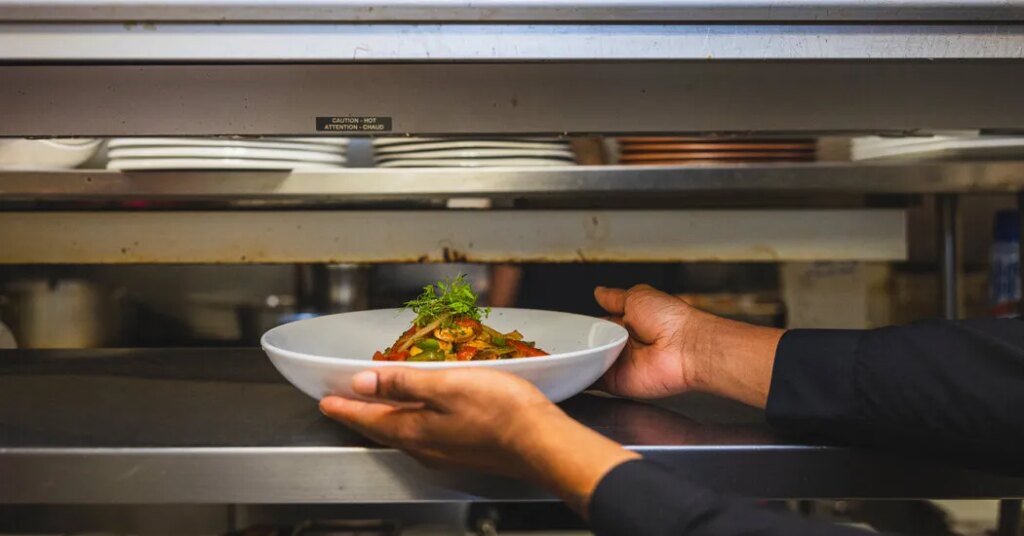
To keep the check size up, she is experimenting with offering smaller portions. An entree of Hoisin Glazed Oxtails at Twisted Soul Cookhouse is $46. Last week, the restaurant featured a special set menu of an appetizer, a half-portion of the oxtails and a dessert for $50.
“People loved it,” she said. “Moving forward, I think we’ll start to offer specials like that more often. Diners still like the idea of trying different things, but they don’t want to be wasteful. I know I can’t eat all of that food anymore.”
The post America’s Restaurants Face a Dilemma: How to Sell Food in the GLP-1 Era appeared first on New York Times.