They are too young to buy a beer and barely old enough to drive, yet these four teenage boys have already found their way into the criminal underworld.
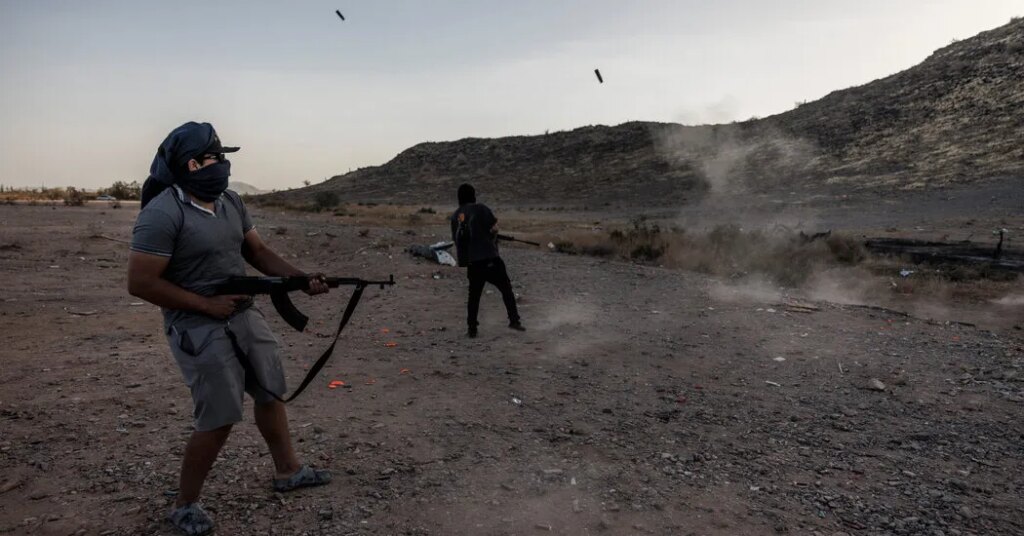
On weekends, they drive into the Sonoran Desert outside Phoenix. I watched them line up AR-15s and AK-style rifles against their cars, pose for photos and spend the afternoon shooting targets. At night, they head to parties, smoke pot and scroll endlessly through their social media feeds.
These teenagers are part of a growing network of American high school students and young adults that are helping to arm some of Mexico’s most powerful and violent cartels, according to U.S. officials and trafficking experts who are tracking the trend. They source weapons ranging like handguns and high-caliber rifles, and sell them almost exclusively to cartel operatives based in the United States, the teenagers said.
In repeated interviews, four weapons traffickers ages 16 to 19 — all current or former high school students in west Phoenix — allowed me to observe how they buy firearms and sell them to the highest bidder. Sometimes, they said, they steal the guns and then resell them. They aren’t loyal to one criminal group or another; instead, they say, they are motivated by making money, gaining status and having a sense of belonging.
The American teenagers spoke on the condition of anonymity because of the illegal nature of their activities. Their identities were corroborated through their official identification documents. I observed gun transactions unfold in real time through encrypted WhatsApp group chats and Telegram channels. Other elements of their accounts were corroborated by current and former U.S. law enforcement agents and trafficking experts.
“After my first gun sale I thought, this is it, I am set,” said one 18-year-old trafficker who goes by El Flaco, Spanish for “Skinny.” “I don’t want to be poor, and why would I if I found a way not to be?”
While the numbers are hard to track, the U.S. authorities say Mexican criminal groups are increasingly relying on teenagers and young adults in border states like Arizona. The proximity to Mexico, a large presence of U.S.-based cartel operatives and the promise of easy money have helped such networks flourish, according to current and former law enforcement officials.
“For the youth, sadly, this is an opportunity to make quick money, just like it would be to commit other types of crimes,” said A.J. Gibes, special agent in charge of the Bureau of Alcohol, Tobacco, Firearms and Explosives’ Phoenix field division.
New technologies, including encrypted messaging apps, have only accelerated the process, he added.
“The criminal organizations will prey on those that they can influence the most,” Mr. Gibes said. “And then I think the youth fall into that.”
Federal data show that young people make up a significant share of gun traffickers. Of more than 11,000 traffickers whose ages were identified in A.T.F. investigations from 2017 through 2021, about one-third were under 25. About 5 percent were under 17. The data cover investigations nationwide and do not specify how many were involved in supplying weapons to Mexico.
Jason Red, a former Homeland Security Investigations agent who investigated Arizona arms trafficking networks with the A.T.F. from 2015 to 2020, said every multi-person trafficking case he had handled involved at least one teenager, often a high school student.
Mr. Red noted that while agents initially caught teenagers smuggling weapons to Mexico, deeper investigations showed young people were also sourcing guns online, through social media, or buying them legally at 18.
“Cartels use anyone they can,” Mr. Red said. “To them, these are disposable buyers. Teenagers don’t put a lot of thought into it. They don’t think about the big-picture consequences.”
Fueled by America’s expansive gun rights and the permissive firearms laws of border states like Arizona, a relentless surge of weapons has flowed south to feed a bloody internal war within the Sinaloa cartel and counter an intensifying crackdown by the Mexican government. The scale of the illicit pipeline is staggering: The Mexican authorities estimate that as many as 500,000 firearms are smuggled from the United States into Mexico each year. Those arms fuel some of the country’s most violent crimes, contributing to the bloodshed that has devastated entire communities and claimed tens of thousands of lives.
Meta, the owner of Facebook and WhatsApp, says it does not allow the purchase, sale or trade of weapons on any of its platforms, though the boys demonstrated just how easily those rules can be bypassed. Arizona allows private gun sales without background checks or record-keeping, which makes it even easier for traffickers to source weapons without getting caught.
To avoid detection by both the authorities and companies like Meta, the smugglers said, they routinely create and delete group chats, avoid sharing personal information during conversations or gun transactions and admit new members only through referrals.
“If we become aware of this type of activity on WhatsApp we ban the accounts involved and we respond to valid law enforcement requests,” Meta said in a statement.
‘Who They Kill Is Not My Problem’
As J.M., one of the teenage arms dealers, tells it, he and two friends met in a school bathroom between classes two years ago to discuss a plan: Pool $700 and buy a gun.
To raise the money, one would sells snacks. Another worked at a restaurant. The third boy was 18 and could legally buy the gun at a licensed dealer.
The three friends purchased a Kalashnikov-style rifle, sold it for $1,200 and split the profits. They immediately invested in more guns, over and over again.
Now, 18, J.M. says he coordinates dozens of students from at least 20 Phoenix high schools who acquire weapons through a variety of legal and illegal means. Most of those firearms, he said, eventually make their way south to Mexican cartel operatives.
I met J.M. last fall through an Arizona-based cartel operative who told me that J.M. and his networks of high school students had become some of his main gun suppliers because of their ability to source high-caliber weapons.
Current and former law enforcement officials say cartels often use teenagers for trafficking because they usually face shorter sentences if caught, tend to have clean records and can be easily lured by the promise of easy money. The boys rarely dwell on what happens once the guns cross the border.
“What they do and who they kill is not my problem as long as I make my money. I am sure they are not innocent,” said El Flaco, 18, referring to the cartels. He described himself as part of J.M.’s crew.
The teenagers speak about gun trafficking like seasoned entrepreneurs, focusing on margins, suppliers and logistics. They rattle off the names of pistols and rifles with the same enthusiasm they do about sneakers or sports cars they hope to one day own.
J.M. insists his network is not aligned with any one criminal group, though he acknowledged that most of the weapons he supplies ultimately go to the Sinaloa cartel, which, according to the U.S. authorities, largely controls the Arizona-Sonora gun and drug-trafficking pipeline.
He and his friends acquire the weapons through a range of sources.
Students who are old enough to buy firearms purchase some from licensed dealers, the teenage traffickers said. They said others stole guns by breaking into homes and vehicles, and, at times, stealing them from their own parents. Many scour WhatsApp and Telegram gun trading groups, El Flaco said, arranging meetings and at times purchasing weapons with counterfeit cash. When they obtain firearms, the traffickers said, they often remove the serial numbers with nail drills, making the weapons harder to trace.
The teenage traffickers said they typically kept the weapons in stash houses, storage units or even their own apartments until cartel operatives pick them up. Sometimes they pay other students to drive the guns across the border and deliver them to designated locations in Mexico, they said.
J.M., a Phoenix native who lives alone while his parents in Sinaloa state in Mexico, said that until recently. gun stores were among the most important sources of supply. He described under-the-table arrangements in which store owners, managers and employees inflated prices to pocket a share of the profits.
One trusted supplier, he said, was Laurence Gray, owner of Grips By Larry, in Hereford, Ariz. Mr. Gray was indicted in March under the Anti-Terrorism Act on charges that he attempted to provide firearms to the Sinaloa cartel and the Jalisco New Generation Cartel. He pleaded not guilty to all charges.
Mr. Gray declined to comment through his lawyer.
As J.M. took on larger deals, seasoned traffickers taught him the tricks of the trade, including how to avoid liability if a firearm he had legally purchased was later recovered at a crime scene. The simplest trick, he said, was to report the weapon stolen soon after buying it.
“All you have to do is call 911, say it was stolen, give a location, give the serial number and that’s it,” he said. “Legally, that gun was no longer under your possession.”
The more guns he moved, the more trusted he became, J.M. said. Before long, cartel-connected contacts were offering him access to higher-end weapons and bigger deals.
Cartels rarely buy firearms directly. Instead, they rely on layers of U.S.-based intermediaries, recruiters and buyers to create distance between their operatives and the weapons.
The profits can be substantial: A Beretta 9-millimeter pistol purchased legally for about $700 can be resold for as much as $1,500. A Colt .38 Super handgun, long favored by Mexican cartels, retails for about $1,200 in the United States but can fetch as much as $2,500 from cartel buyers in Mexico.
In Mexico, J.M. said, his group has acquired a nickname among their clientele: The Phoenix Boys.
“We are here for whatever any group needs,” he said.
Counterfeit Cash and Lavish Gifts
On a recent afternoon, a tall, lanky teenager known among his friends as El Güero, Spanish for Blondie, pulled a $20 bill from his wallet and slid it across the table.
“Could you tell if this is false or true money?” he asked me with a goofy smile lined with braces.
The bill looked entirely genuine, but it was a fake. He later showed me that when held up to the light, the watermark clearly read “FOR MOTION PICTURE PURPOSES.”
The 19-year-old said he had used stacks of counterfeit cash of various kinds to buy firearms across Phoenix — a tactic the law enforcement authorities say is common among Arizona gun traffickers. He spends his days scrolling through Telegram groups looking for people selling guns, he said. Once he finds a target, he negotiates a price, arranges a meeting in a parking lot somewhere in the city and shows up carrying fake money.
The weapons eventually make their way to J.M. and El Flaco. Or to whomever needs it.
For El Flaco, 18, the path to gun dealing began shortly after he started high school. He was 14.
Owning a gun, he said, was extremely common among fellow students at his high school. Boys posted photographs of themselves posing with pistols on Instagram and TikTok. Some brought the firearms to school, leaving them locked inside their cars during class and flaunting them after school, he said. Sometimes they brought them into school, he said.
El Flaco said he bought his first firearm — a Glock 19X handgun — at 14, using money he had saved while working as a restaurant cook. He said he then sold it through a WhatsApp group, used the proceeds to buy a rifle and then sold that for nearly double what he had paid.
“I knew I was set,” he said.
He’s been in business ever since. By last November, shortly after turning 18, he dropped out of high school.
He is particularly fond of using his cash to spoil his girlfriends with expensive gifts and clothes. One of his most prized purchases was a French bulldog puppy that cost roughly $5,000, he said. He spent about $1,000 on an enormous bouquet of roses for a different girlfriend, he said.
El Flaco said he often recruited friends who had recently turned 18 to make legal purchases on his behalf from licensed dealers or at gun shows to avoid being flagged by the authorities. He also goes to online marketplaces like Armslist, WhatsApp groups and personal contacts to source the guns himself.
One afternoon, J.M. and El Flaco showed up at my hotel carrying a black backpack. Inside were a disassembled AR-15-style rifle and a hand grenade. J.M. said he had bought the grenade because he thought it was cool.
Later that day, as I sat beside El Flaco, he scrolled through a gun-trading WhatsApp group and stopped at a photo of two AR-15-style rifles and six handguns. In the foreground, a cellphone displayed a fresh time stamp — a standard digital safeguard used by sellers and buyers to weed out scammers and undercover police. Within minutes, El Flaco was in the seller’s direct messages haggling over a rifle. The seller offered it for $530, but El Flaco ultimately passed, betting he could find a better price elsewhere.
The use of messaging apps such as WhatsApp, Telegram and Signal to buy and sell firearms has surged over the past five to 10 years, according to Mr. Gibes, the special agent in charge of the A.T.F.’s Phoenix field division.
The technology has made it easier for traffickers to connect with buyers and suppliers, replacing the need for word-of-mouth networks, Mr. Gibes said.
“By simply getting on a messaging app, you can solicit people to acquire firearms directly or on behalf of someone else,” he said. Yet even when traffickers use encrypted group chats or apps like Signal, Mr. Gibes said, investigators have developed ways to identify those involved and dismantle the networks.
For the teenagers, however, the money is too lucrative to stop. El Flaco said that even in a bad month he earned $4,000 to $5,000. So far, the teenagers say, they have not been arrested.
A little more than a month after I left Phoenix, I met up with J.M. in Sinaloa state in Mexico, where his mother lives.
He said demand for guns had surged, but so had law enforcement scrutiny. He believed the police were closing in on him, so he had decided to hide out in Sinaloa, “until things cool down,” he said.
“There will still be work when I come back,” he added.
The post American High School Students Are Selling Guns Bound for Cartels appeared first on New York Times.