When the Trump administration started dismantling a $368 million ocean monitoring system earlier this year, scientists fought back. So did fishermen. And Congress. On Saturday, a 238-foot ship set sail to reinstall the first batch of monitors in the waters of the Pacific.
The equipment was part of a network of 900 deep-sea instruments that had been anchored off Oregon, Washington State, Alaska, North Carolina, and an area between Greenland and Iceland known as the Irminger Sea. It included seismic instruments, and robotic gliders placed near underwater seamounts and volcanoes off the northwest coast.
For a decade, the instruments had monitored coastal environments, marine ecosystems and powerful currents that affect the global climate, transmitting data that helped meteorologists, oceanographers, climate scientists and the fishing industry.
That data has become even more vital as a powerful El Niño builds in the Pacific Ocean, affecting weather and fisheries.
In late 2025, the National Science Foundation began the lengthy process of removing the system, even though it had been designed to operate for another 15 years. Three moorings in Oregon and Washington were pulled from the water and stored in a warehouse. Additional equipment was removed from off the coasts of North Carolina and Alaska and from the Irminger Sea station. Dozens of other instruments were simply turned off.
21wq
The National Science Foundation had said the move was part of its “wider strategy to have a nimbler approach to prioritizing support for evolving scientific priorities and emerging technologies as well as a deliberate approach to smart life cycle management within its portfolio of research infrastructure.”
After The New York Times reported the federal science agency’s decision in June, a bipartisan outcry led by Senator Jeff Merkley, Democrat of Oregon, and Senator Lisa Murkowski, Republican of Alaska, prompted the administration to reverse course.
Now, the agency is soliciting feedback about whether the system still provides relevant information, given the advances made in more mobile instrumentation.
Scientists use data from the system to understand how the ocean is turning more acidic as it absorbs carbon dioxide from the atmosphere; how marine heat waves are changing the underwater ecosystem; and whether a vital Atlantic Ocean current might collapse.
Fishermen from Oregon to Alaska have come to rely on the hourly data postings to track potential feeding grounds, check for oxygen-poor dead zones that affect the $100 million Dungeness crab industry and track El Niño’s approaching warm water. They also depend on wave height measurements to avoid treacherous conditions.
“There’s a lot of information that the guys use, and they weren’t happy when they were taken out,” said Gary Ripka, who fishes for crabs off Newport, Oregon.
To reach commercial fishing grounds, Ripka and others have to navigate through the Yaquina Bay bar, where the Yaquina River meets the Pacific Ocean. It is one of the most dangerous spots along the Pacific Northwest coast, with tidal currents and shifting sand that create steep, breaking waves that challenge even Coast Guard rescue boats.
“We count on those buoys, and if you don’t know what the swell is doing, it’s catastrophic,” Mr. Ripka said as he stood on Newport’s busy waterfront.
Kurt Cochran and his family own three trawlers that operate from Northern California to Kodiak, Alaska. He hasn’t been able to get the ocean observation data for the past few months as El Niño has brought warm ocean water along the coast, making it more difficult to decide where to set his nets and what kind of gear to use.
“We use the data all the time,” said Mr. Cochran, who had stopped at a marine hardware store near the port earlier this week. He said the data help him avoid schools of salmon, which his boats are not permitted to take but congregate around plankton and can be detected by optical instruments in the moorings.
The battle over the scientific buoys represents the second time that fishermen’s groups along the Oregon coast have clashed with the Trump administration. Last year, residents fought the removal of a Coast Guard rescue helicopter stationed at Newport.
“We didn’t expect it, and it left without our knowledge,” said Taunette Dixon, a spokeswoman for Newport Fishermen’s Wives, which represents several hundred coastal fishing boats. A federal judge issued an injunction to keep the helicopter in Newport while a lawsuit is pending, Ms. Dixon said.
Administration cuts and funding delays to the National Oceanic and Atmospheric Administration have also meant fewer of the surveys used to collect data used by fishery managers to set catch limits and quotas for commercial fishermen.
“The government seems to be reducing what they do for us,” Mr. Cochran said.
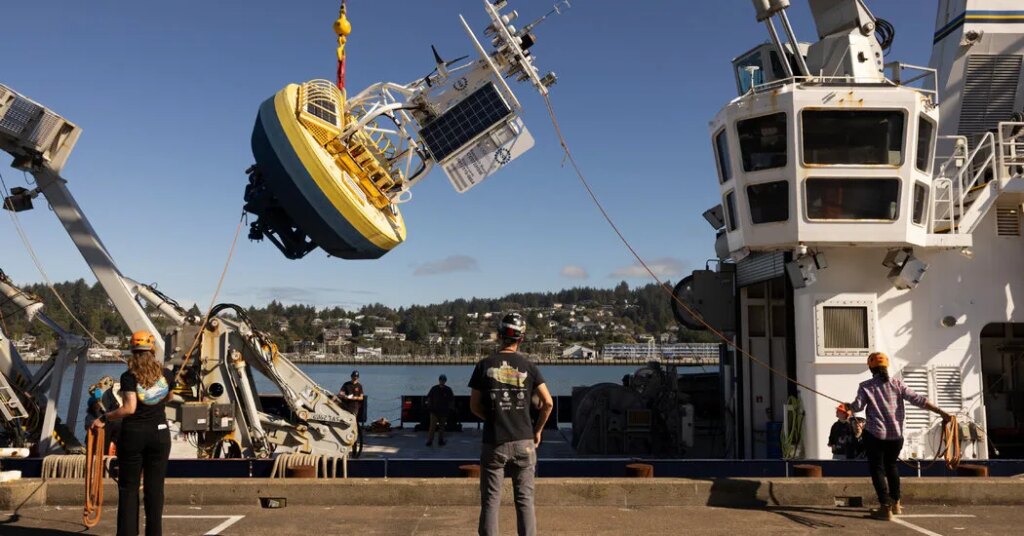
This week crews in Newport loaded a pair of 10,000-pound mooring buoys onto the oceanographic research vessel Sally Ride, named for the astronaut. Each mooring houses more than 20 ocean instruments. A third, smaller mooring contains five instruments.
On Saturday morning, the ship, operated by the Scripps Institution of Oceanography at the University of California, San Diego, left Newport on a three-day trip to return the devices to the ocean. They were to be positioned at three locations off the Oregon and Washington coasts, between the seafloor and the surface, to check water temperature, carbon dioxide, and other readings. Free-swimming robotic gliders circle the moorings to expand the sensors’ footprint. A weather station on top of the buoy transmits hourly temperature, wind and wave data to an onshore station, and then to NOAA.
‘It’s good to have them back in the water,” said Ed Dever, professor of earth, ocean and atmospheric sciences at Oregon State University and the principal scientist for the Endurance array, the name of three moorings off the Oregon and Washington coasts that together house more than 60 instruments.
If all goes well, the fishermen will start receiving their data again in a few days. But some researchers wonder whether the National Science Foundation is still committed to studying the ocean.
Though the arrays are being put back in the waters off Oregon and Washington this weekend, four moorings off North Carolina and three robotic gliders in both Alaska and the Irminger Sea are not scheduled to be returned to the sea this year.
Michael England, a spokesman for the National Science Foundation, said in an email that it was because of “both financial constraints and operational efficiency. Due to inflationary pressures, deployment costs have increased significantly, while the facility budget has remained at the 2024 funding levels.”
The Trump administration has cut funding to ocean and climate studies, including an international program to understand climate-related changes at the Atlantic Meridional Ocean Circulation in the North Atlantic, an underwater system of currents that act like a conveyor belt, affecting weather patterns across the U.S., Canada, and Europe.
In addition, the Global Ocean Biogeochemistry Array, a $53 million network of 500 floats that collects data on the chemistry and biology of oceans around the globe, is being phased out this month.
Other governments have watched warily as the Trump administration has reduced the nation’s ocean monitoring capabilities. Right now, the United States provides more than half the data that goes into the world’s network for collecting and sharing ocean observations.
At an event in New York last week, the European Union and Canada announced a new alliance to strengthen ocean monitoring. The E.U. and the 30 countries that have joined the alliance so far have pledged almost $240 million, to maintain and expand infrastructure.
The nations in the alliance include Brazil, Britain, Madagascar, Mexico and South Korea, but not the United States.
“The U.S. represents 54 percent of the global ocean observation infrastructure,” said Vidar Helgesen, the executive secretary of the Intergovernmental Oceanographic Commission, the United Nations agency that helps coordinate the world’s systems for tracking ocean physics, chemistry and ecosystems. “So the need for others to compensate if and when the U.S. pulls back is obviously massive.”
Raymond Zhong contributed reporting from London.
The post After Outcry, Monitors the Trump Administration Tried to Scrap Return to Sea appeared first on New York Times.