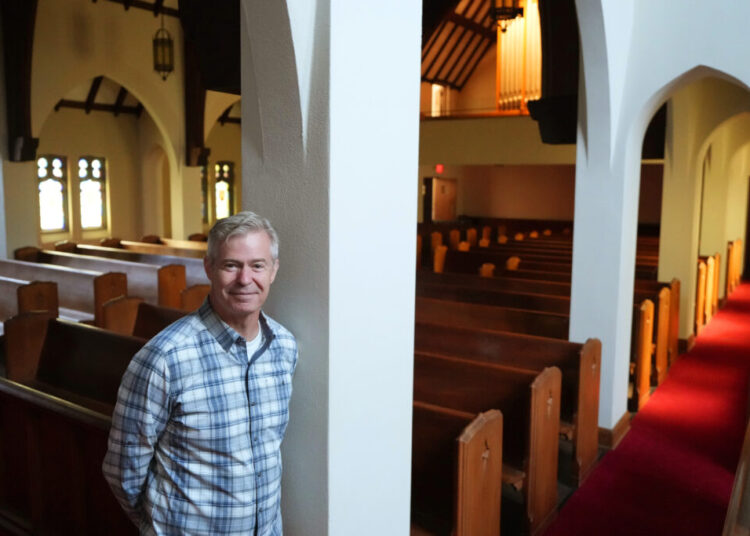
Jeff Lipscomb, a high school orchestra director in Kanawha County, W.Va., has been doing a lot of math.
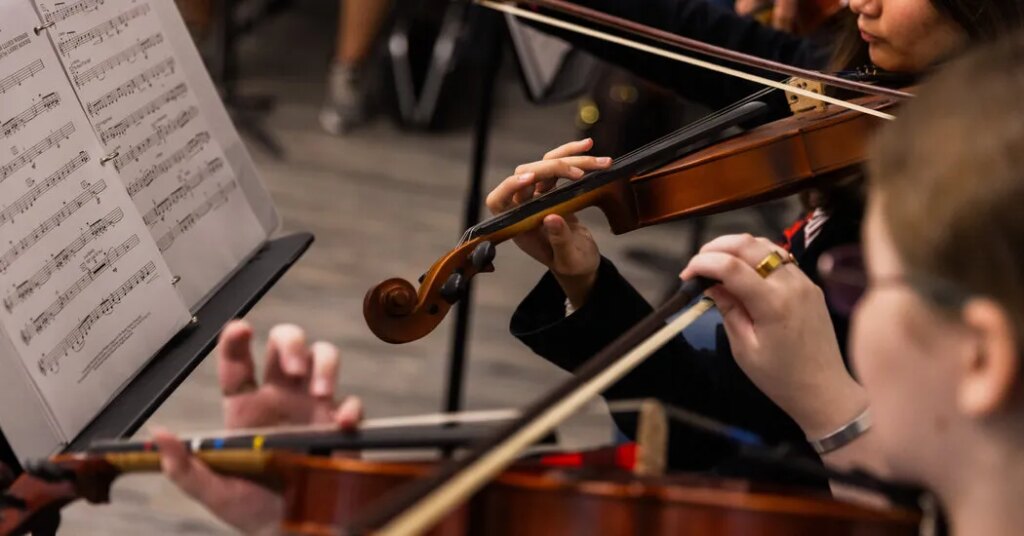
For example, he has 12 cellists but only 10 cellos. If the school district gives him a total budget of $500 to $600 for the year, but one new cello costs more than $1,000, what should Mr. Lipscomb do? What if he needs some new violins and violas, too?
“I’ve actually had to buy instruments out of my own pocket,” Mr. Lipscomb said from his classroom at South Charleston High School on the first Monday of the school year. “I just kind of have to.”
Like many music teachers, Mr. Lipscomb has become attuned to tight budgets. Lately, though, the cost of instruments has ballooned beyond his ability to make do.
Pandemic-era supply chain snarls lifted prices for goods across the board. President Trump’s global tariffs further swelled the cost of foreign-made instruments. Then in August, the Trump administration proposed additional 25 percent tariffs on trumpets, tubas and other brass instruments, citing “national security threats” under a provision it has used to impose duties on foreign metals.
The consequences have reverberated across the country. Higher instrument prices are a particular threat to lower-income districts where enrollment and budgets are shrinking.
An elementary school music teacher in Beaverton, Ore., has considered 3-D printing ukuleles because she cannot afford them. In Passaic, N.J., an arts administrator is doubling down on encouraging students to clean and care for their instruments so they last longer. The superintendent of a small district in Washington County, Pa., has taken to scouring eBay and Facebook Marketplace for used instruments.
Proponents of musical education say the tariffs are endangering school music programs and threatening to push the extracurricular activity out of reach for many families. John Mlynczak, the chief executive of the National Association of Music Merchants, a trade group, warned that higher instrument prices could lead to “empty music classrooms.”
“The camaraderie that happens in a community when everyone goes and supports the Friday night football game?” he said. “Imagine that without a marching band.”
Some instruments, such as higher-end Fender and Gibson guitars, are made in the United States. But most elementary, middle and high schools rely on less expensive beginner instruments that are largely made in China. Many school districts own or rent instruments they lend to students at no or little cost.
As Mr. Trump escalated his trade war with China last year, music teachers grew wary.
Schools were already dealing with a confluence of challenges, including the end of federal pandemic aid, budget cuts and declining enrollment. Inflation was driving up costs.
“It’s kind of like a perfect storm of all these different things happening at once that can cause a bigger mess,” said Annamarie Bollino, a seasoned public school arts administrator who sits on the executive board of the National Association for Music Education, an advocacy group.
She said she expected that the proposed tariffs on brass instruments would further push up prices.
The effective tariff rate on instruments in June was about 13 percent, said Cullen Hendrix, a senior fellow at the Peterson Institute for International Economics. That was down from a peak of nearly 24 percent last September but more than twice as high as before Mr. Trump’s second term.
Band and orchestral instruments have been hit the hardest, he said. In the second quarter of this year, imports of instruments were down nearly 20 percent from the same period in 2024. Imports of orchestral string instruments, including violins, violas and cellos, dropped 50 percent. Brass instruments fell 43 percent.
“It’s hitting the horns, it’s hitting the strings, it’s hitting the percussion,” Mr. Hendrix said. “All of those things combined are kind of sapping the available pool of tools that we can provide these children to begin their journey.”
Carolynn Langston has been teaching music at low-income elementary schools in Oregon for two decades. Her room this year, at a school in Beaverton, has a colorful rug surrounded by a rainbow of paw prints to indicate where her students should stand. In one corner are patterned drums and other percussion instruments. She described her musical philosophy as “sing, dance, play.”
Schools like hers will feel the higher instrument prices most.
“I don’t even have a budget,” Ms. Langston said. “Zero money.”
When she wants to buy instruments — or a carpet, for that matter — she applies for grants, including from a local educational foundation. Sometimes she requests money from people directly. She considered using a 3-D printer to make plastic ukuleles. At least they would be more durable.
In May 2025, Ms. Langston asked the local foundation for $700 to replace a large bar on one of her xylophones. “It’s one note you can play — it’s very loud and very low,” she said.
By the time she went to buy the part that fall, the cost had jumped to $750. The foundation agreed to pay the extra, but the increase stung.
“Instruments are more expensive, which then squeezes even tighter on somebody like me,” she said.
Latasha Casterlow-Lalla, the supervisor of visual and performing arts for Passaic Public Schools in northern New Jersey, said many instruments had doubled or tripled in price since the pandemic. A student saxophone that used to be $420 is more than $900. Tubas are at least $9,000, and the high school band wants four. If the proposed brass tariffs go into effect, she said, buying all of them would probably take her five or six years. By then, the would-be tuba players would have graduated.
Students are hard on their instruments, and Ms. Casterlow-Lalla estimated that each one lasted 10 years at most, and often less. Anticipating that costs will continue to rise, she is pushing principals for better storage to keep instruments functioning longer. She is also emphasizing proper cleaning and care to students and parents.
She worries above all that she will not have enough instruments for all the students who want to play. If registration in school music programs falls as a result, it could create a domino effect where the district pulls funding.
“We’re going to eventually hit our rubber-meets-the-road moment,” she said.
When Mr. Lipscomb was growing up, he variously wanted to be a paleontologist, an astronaut or a computer programmer. But from the moment he graduated from high school, he dreamed of teaching music. He got a college degree, a teaching degree and a master’s degree and then a doctorate in music composition from Louisiana State University.
“I like how it sounds — I like how it makes me feel,” he said. “I’m normally an introverted person, but it’s one of the few times that I actually enjoy being around people.”
For 15 years, Mr. Lipscomb has taught orchestra classes in Kanawha County’s high schools, including Capital High School, his alma mater. The only full-time orchestra director in the district, he spends a lot of time driving from one school to the other.
His music program is small, typically around 60 students. When he has a particularly strong class, he teaches it a challenging repertoire. Otherwise, he focuses on scales and technique.
The district provides instruments for some students who cannot afford to buy or rent them, but Mr. Lipscomb’s $500-to-$600 annual budget is not enough. He spent all of the money he was allocated last year and this year on two cellos.
One student, a freshman viola player, told him shortly after the school year began that she had to drop his class because her family could not afford to rent her instrument. He said he could lend her one free of charge, but she declined.
Mr. Lipscomb worries that rising instrument prices mean the students who stay will be stuck playing old instruments. He knows that when children play on instruments that sound bad, they do not blame the instruments. They blame themselves.
But the district is in a budget crunch, in part because it is losing students. He wishes he had thought to buy more instruments earlier in his career, before prices rose so much.
“It’s tough for me to say, but you got to work with what you’ve got,” Mr. Lipscomb said. “Unfortunately a lot of these old instruments, it’s what I got.”
The post Soaring Instrument Prices Could Stop the Music at Many Schools appeared first on New York Times.