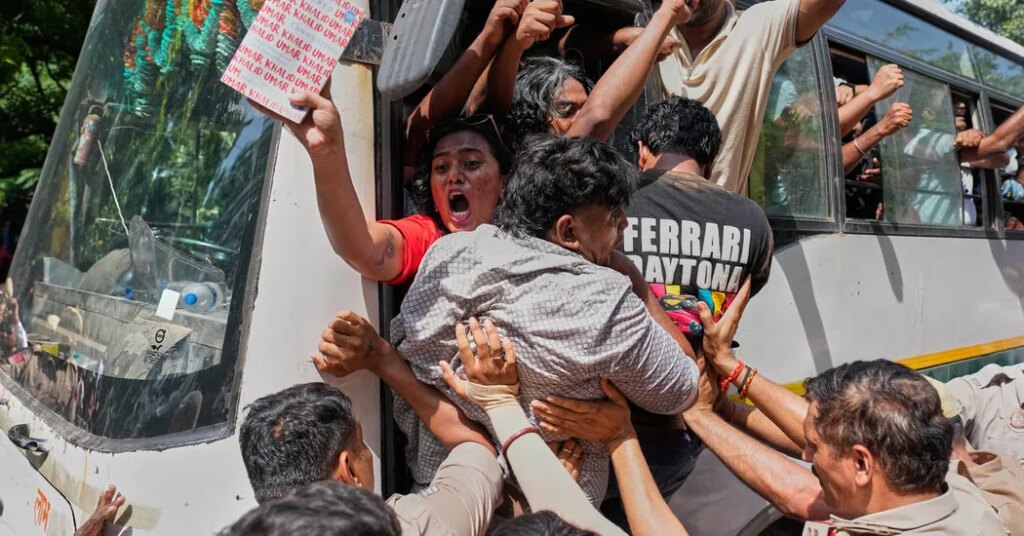
Police in India’s capital city on Friday detained hundreds of protesters calling for the resignation of the country’s election chief, with authorities barricading roads and restricting mobile internet access.
The protest in New Delhi was one of several planned against a contentious revision of the country’s voter rolls that have led to more than 130 million names being dropped across the country. Opposition groups accuse Prime Minister Narendra Modi of ‘vote theft’ — claiming that his party is using the election commission to try and rig the rolls in its favor.
Officials from Mr. Modi’s ruling Bharatiya Janata Party have denied the allegations, saying the election commission is an independent institution and the rolls are being updated to weed out what they call “infiltrators.”
India’s largest opposition coalition, called the I.N.D.I.A. bloc, announced nationwide protests starting on Friday, and said they would march on the election commission next Tuesday. The Cockroach Janta Party, a youth pressure group whose earlier protests forced the education minister to quit over an exam leak scandal, led demonstrations in Mumbai later in the day.
In Mumbai, the scenes were more joyful as thousands of people, clapping, singing and waving Indian flags, gathered near Shivaji Park, the city’s largest.
Smaller groups and student unions have also joined in the calls for action, with protests expected around the country on Friday, a national holiday.
The resignation of Dharmendra Pradhan, the education minister, in July was a rare concession by Mr. Modi, who has established an uncompromising grip on power over his 12 years as India’s leader. The success of the young activists has emboldened more protesters since and the showdown over the election chief will test the government’s resolve.
On Friday in New Delhi, the police began detaining people after saying earlier that the protest was not allowed. In statements, the police said “gatherings, public speeches, shouting of slogans, processions, demonstrations” were prohibited, along with the “carrying of firearms, banners, placards.”
The government deployed around 5,000 security personal to prevent people from reaching Jantar Mantar, the only spot in New Delhi in recent years where protests have been authorized. Nearly a dozen metro stations around the site were locked up, and roads were closed to prevent vehicles from reaching the area.
Those who managed to get close to the site faced large ranks of police and security forces in riot gear, who took them away on buses.
“Who doesn’t allow protest? Those who know they have done something wrong,” said Banishree Das, 70, a retired educator who was among the protesters. “They have done something wrong — depriving so many people of their votes. A vote is not just a piece of paper for us.”
Opposition and civil society groups have ratcheted up pressure in recent weeks, demanding the resignation of Gyanesh Kumar, the chief election commissioner, and the cancellation of the voter roll exercise, which is called the Special Intensive Revision, or S.I.R.
An explosive investigation by The Indian Express showed that concerns about the legality and transparency of the exercise that the opposition had long raised were also echoed inside the commission, by two of its three commissioners. Mr. Kumar, the lead commissioner, made decisions unilaterally, according to the investigation, even though the body’s decisions are required by law to be made by majority.
In a statement after the investigation was published, the election commission suggested the newspaper drew only on internal deliberations, and that final decisions on any voter roll revision moves were made unanimously. The commission has not responded to requests for comment on the specifics of the allegations.
Some areas like Delhi have seen their voter rolls shrink by as much as 30 percent after the revision. Crucial battleground states like West Bengal carried on with elections for the local government this year, despite millions of people who were expunged from the lists still trying to appeal those decisions. Mr. Modi’s party won the state for the first time.
In Mumbai, the protesters were not granted permission by the police to use Shivaji Park. But after they threatened to turn their protest into a “Fill the Jails” strike, indicating that the threat of mass arrests wouldn’t stop them, the protesters and the police appeared to compromise. A stage was erected outside the park, and the streets nearby had the air of a neighborhood festival.
Aishani Aindri, 26, called the Cockroach movement the motivation Indians like her needed.
“A lot of people in India needed a platform,” she said.
Protesters expressed broad dissatisfaction and frustration with Mr. Modi’s government beyond the election issue.
“For the past 12 years we were losing hope slowly,” said Meena Karnik, 66. “This has given us hope.”
The post Police in India Detain Hundreds Rallying Against ‘Vote Theft’ appeared first on New York Times.