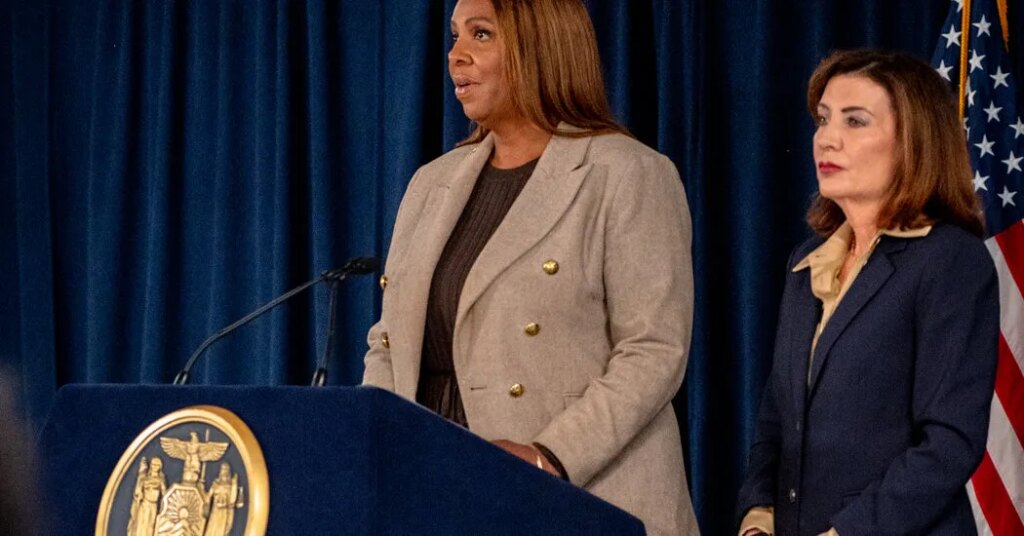
Gov. Kathy Hochul of New York has appointed the state’s attorney general, Letitia James, as a special prosecutor to investigate a woman’s allegations that she was raped at Cornell University in 2024, in a case that has led to widespread public outrage.
As special prosecutor, Ms. James has wide latitude in her investigation of the case and what steps, if any, she takes.
In a lawsuit filed last month, the woman, identified in court documents as Jane Doe, accused several men of rape while coercing her to take drugs. None of the seven men named in the suit have been charged with a crime, and all have denied wrongdoing. Four said that they had consensual sexual contact at the fraternity house with the woman, and the others have denied participating.
How Ms. James handles the investigation will shape the trajectory of a case that has renewed conversations nationally about fraternities and sexual assault on college campuses.
Ms. James has frequently waded into politically fraught matters as attorney general, accusing President Trump of exaggerating his net worth by billions of dollars and winning a civil judgment against him in 2024. Mr. Trump’s Justice Department has repeatedly sought to indict her on federal charges.
Ms. James, at a news conference on Friday, said she would “review the facts, gather evidence, interview witnesses and, if warranted, pursue prosecutions” over the coming months.
Legal experts who spoke with The New York Times say that the case could present some obstacles. These include the evolution of Jane Doe’s account, first reported by the woman to the Cornell Police Department nearly two years ago, as well as a New York law that makes it difficult to bring a rape conviction if a person was willingly intoxicated.
Here’s what lies ahead for Ms. James’s investigation.
Ms. James has broad investigative powers.
As special prosecutor, Ms. James has broad discretion to investigate the allegations that Jane Doe was raped on Oct. 19, 2024, at a Cornell fraternity.
In appointing Ms. James, Ms. Hochul said that she had lost faith in the ability of Matthew Van Houten, the local Tompkins County district attorney, to properly investigate the encounter. The governor said that Ms. James “shall exercise all the powers and perform all the duties in respect of such actions or proceedings” that Mr. Van Houten would have otherwise been authorized to do.
Mr. Van Houten has defended the work of the district attorney’s office. In a statement released on Friday, he said that he welcomed the appointment of Ms. James and that his office was “not provided the full picture by the university.”
If Ms. James determines that there is sufficient evidence that a crime has been committed, she will bring the case before a grand jury, which may decide to indict potential defendants.
Ms. James has previously dealt with special counsel appointments in politically charged cases. In 2021, Gov. Andrew M. Cuomo asked Ms. James to appoint an independent counsel to investigate allegations of sexual misconduct against him, which he denied. Mr. Cuomo resigned after the publication of an ensuing report.
Ms. James’s office, because of New York State law, also investigates civilian deaths during encounters with law enforcement officers. Those inquiries have at times led to criminal charges.
State law makes proving rape difficult in some cases.
Bringing prosecutions for rape cases where a person is intoxicated can be difficult. A New York State law makes it difficult for a person who was willingly under the influence of drugs or alcohol to prove they did not consent to sex.
Jane Doe, in the account provided in a lawsuit filed last month, said she had been plied with alcohol and a powerful anesthetic known as ketamine — leaving her unable to consent — before she was raped by several men.
On Friday, Ms. Hochul said the case had exposed a major flaw in the law, and that she supported changing it.
“If someone is too intoxicated to consent, it should not matter whether they chose to use drugs or alcohol,” she said in a news conference. “Voluntary intoxication is not a license for sexual assault or gang rape.”
Defense lawyers may seize on Jane Doe’s testimony.
An accuser’s willingness to testify before a jury often determines whether charges are brought in sexual assault cases. And were Jane Doe to testify in a potential criminal case, shifts in her account could be a prime target for defense lawyers.
A key variable, some experts say, is that Jane Doe’s account and understanding of what happened changed in the time between the alleged assault and when she reported it to the police.
In the days immediately after the encounter, Jane Doe assured one of the men she would later accuse of rape that nothing illegal had happened during that night, according to documents reviewed by The Times.
In November 2024, weeks after the alleged assault, she told the Cornell Police Department that she was “pretty OK” with the initial sexual encounter, which was with two men. As more men showed up for sex, she came to understand that she was being raped, she told the police.
In her lawsuit, however, Jane Doe said she had been so intoxicated that she could not have consented to the initial sexual encounter.
An evolving story is typical for a survivor of sexual assault, legal experts say. A victim may have difficultly grappling with the effects of the assault and coming to terms with what happened.
But a potential criminal defense would nonetheless hinge on the evolution of her allegations, and Ms. James could decide that the changes are too stark to justify bringing charges.
The post Letitia James Is in Charge of the Cornell Rape Inquiry. What Comes Next? appeared first on New York Times.