“Friday Night Lights” was a show about a blue team and a red team.
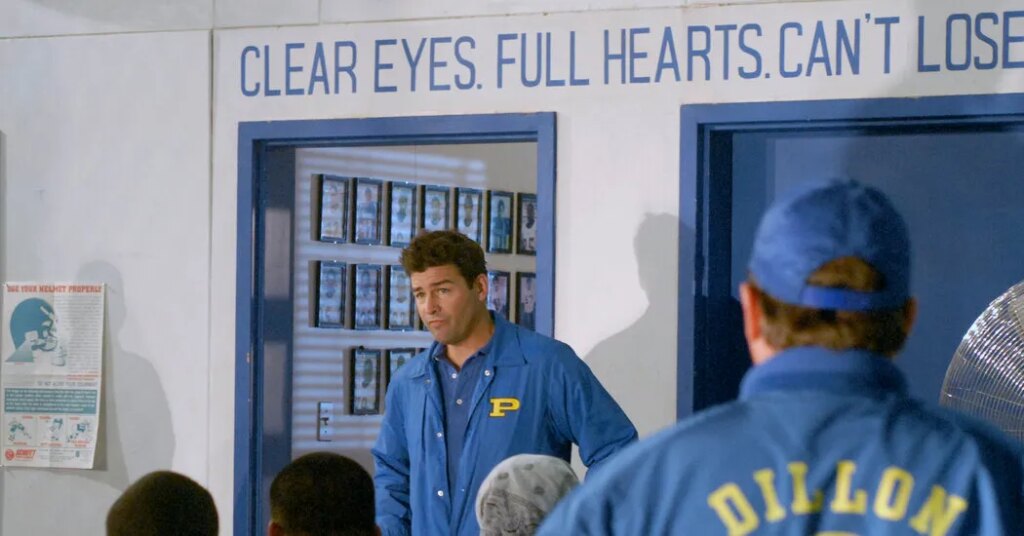
The color choice was not a political statement. These were, respectively, the colors of the Dillon Panthers and the East Dillon Lions, the high school football teams whose wins and losses meant everything to the small town in Texas where the show was set.
Over five seasons, the series, whose first episode aired 20 years ago this month, involved blessedly little politics of the elections-and-legislation type. Yet it captured America and its struggles better than more ham-handedly topical shows do, because — with heart and nuance and generosity — it was about the business of everyday life.
It was about how very different people can share a community and a goal. It was about hope and limitations, despair and perseverance, shared dreams and shared pain. It was about how a hometown can be sustaining and suffocating. It was about individual triumphs and about how no individual triumphs without help.
All these things made “Friday Night Lights” special. And they make it a little heartbreaking to watch now.
THE FIRST EPISODE AIRED Oct. 3, 2006, on NBC. I don’t know if it is the greatest pilot in TV history, but it’s certainly a Hall of Famer.
It takes place over the week leading up to the first game of the season for the Panthers, under their new head coach, Eric Taylor (Kyle Chandler). The job of coach, in a place like Dillon, is a combination of five-star general and dunk-tank clown. You live on a pedestal, but you can plummet in an instant. “You got that deer in the headlights look,” someone tells Eric at a booster party.
It is a week of nerves, preparation and relentless pressure, which the pilot conveys with cinéma-vérité camerawork and kinetic energy. An achey, echoey soundtrack by Explosions in the Sky evokes a lonesome sense of place. The high school misfit Landry Clarke (Jesse Plemons) calls Dillon “a big old out-of-tune guitar.” But in the right hands, boy, can it sing.
In a brief network-TV hour, the pilot creates a world. We meet Eric’s wife, Tami (Connie Britton), the school counselor doing thankless double duty as coach’s spouse. We meet the players: the ne’er-do-well heartbreaker Tim Riggins (Taylor Kitsch); the swaggery Smash Williams (Gaius Charles); the all-American quarterback Jason Street (Scott Porter); and his anxious backup, Matt Saracen (Zach Gilford), stretched thin caring for his ailing grandmother (Louanne Stephens). We meet Lyla Garrity (Minka Kelly), Jason’s cheerleader girlfriend; and smart, rebellious Tyra Collette (Adrianne Palicki), who can take football or leave it.
In the big game, Jason suffers a spinal injury that paralyzes him. Matt comes off the sidelines and, after a few punishing hits and a quick, tough-love talk from Coach Taylor, leads the team to the first in what will be a long string of last-second victories.
It’s unrepentant sports-movie melodrama. But the themes are transcendent, even spiritual. Football is a big game in Dillon, but it is also a way of reaching for something higher. (“Do you think God loves football?” a young child asks Jason during the pilot. “I think everybody loves football,” he says.) Football is the promise that hard work and talent can pay off more reliably than they do in the rest of life.
The closing words of the pilot could be carved on a monument. As the gravity of Jason’s injury sinks in, Coach Taylor delivers a monologue about the fragility of life. “We will all, at some point in our lives, fall,” he says, and you can bet I am choking up all over again just typing that.
In my memory, Coach Taylor gives the speech to a shaken, subdued locker room. But in fact, we never see him speak the words. It’s all voice-over. We see the family, the friends, the classmates gathered anxiously at the hospital, because on “Friday Night Lights,” everyone — players, spectators, parents, every car dealer and strip-club dancer in Dillon — is part of a team.
Just as a team needs the contribution of the lowliest third-stringer, so every person in the town has obligations to others. No one, not even the shiniest star on the field, does anything alone. Everybody plays; everybody matters.
OVER THREE SEASONS of wins and losses, setbacks and crises with the Dillon Panthers, “Friday Night Lights” lived out these ideas. And then things changed.
In the middle of its run, the show deployed one of those pocket universes that high school series sometimes discover when their original characters graduate. There was another part of town we hadn’t visited — East Dillon, poorer, less white, on the other side of the tracks. After a redistricting and a coup among the team’s rich boosters, Coach Taylor is sent packing to the underfunded school to build a football program from scratch.
It’s an astonishing reinvigoration and reimagining. Suddenly Dillon, the team we cheered on for three seasons, is the crosstown enemy, the overdogs, run by arrogant, affluent cronies. And suddenly the series’s themes of neighborly coexistence become richly complicated. By the end of the fourth season, you are rooting for the down-and-out Lions to beat the same team that broke your heart at the end of the pilot.
“Friday Night Lights” appealed to the ideal that people of different values and cultures could live together and even work toward a common goal. But it was never naïve about the limits of coexistence. Even struggling Dillon has haves and have-nots.
However convenient the discovery of the town’s other half is plot-wise, it’s perfect as a statement. East Dillon, it says, is the sort of place that people can, and do, ignore as if it doesn’t exist.
The final two seasons center on Coach Taylor’s work to transform a troubled East Dillon student, Vince Howard (Michael B. Jordan), into a star quarterback. The final episode ends (of course) with a state championship game that depends (of course) on a last-minute Hail Mary.
As the seconds tick off the scoreboard, Vince fades back and heaves a long bomb. We see the receivers jostling for position in the end zone, the expectant faces of the fans and family in the stands. The ball arcs up, up, up …
And it never comes down. We cut to the future, with Coach Taylor training a new team on a field in Philadelphia. We learn the results in a closing montage, as the banner celebrating East Dillon’s state championship win is unceremoniously pulled down from the scoreboard, the football program having been shut down in yet another reorganization.
You could see that last sequence, denying us the thrill of the winning catch, as saying the game doesn’t matter. Of course, the game matters! But what really matters is the crowd watching, their hopes and fears and prayers.
And winning, these final scenes tell us, isn’t the end. There is always another contest, on the field or off it.
I SAID THAT “Friday Night Lights” is not about politics. It’s not, the way we usually think about them. Nor did it have a single knee-jerk worldview. You could see it equally as a show about the values of hard work, faith and tradition or as a testament to diversity, equal opportunity and collective dependence. It was all that. It was complicated, like people are.
It did, however, involve a lot of lived politics, from the characters who served (and died) in the war in Iraq to the outstanding Season 4 episode in which Tami counsels a student who decides to end her pregnancy, a rarity for TV then (and not too common now). It was about division, fairness, the allocation of resources.
Its tone resonated enough with the kinds of inspirational messages candidates like to send — or at least liked to send, once — that both 2012 presidential campaigns borrowed its slogan, “Clear eyes, full hearts, can’t lose.” In 2024, supporters of Kamala Harris made Coach Taylor comparisons with her former football-coach running mate, Tim Walz; a new super PAC supporting the Democratic candidate for Senate from Texas, James Talarico, is named “Texas Forever,” a Tim Riggins quote.
The America of 2006, in the late George W. Bush era, was hardly unpolarized; the concept of red and blue states was already well-established. But the show was dedicated to the idea, however rosy, that a town like Dillon could contain multitudes who could disagree but still abide one another.
At the end of the series, the Taylors leave Dillon, when Tami lands a great academic job out East after years of subordinating her career to her husband’s. (You would not believe how romantic the phrase “Will you take me to Philadelphia with you, please?” can be until you hear Eric Taylor speak it.) Viewed from 2026, the Taylors’ move seems like a metaphor, if unintended, for the geographic sorting of recent years, with small towns growing redder and areas like Philadelphia aggregating blue-coded professionals like Tami.
What is Dillon like today? Do the people who stayed there have anything in common with those who left? Do the Taylors ever visit? Does it still feel like home? If you grew up, like I did, in a small town somewhere in the middle of America, you have learned that the answers to these questions are not always the stuff of uplifting TV.
Maybe “Friday Night Lights” was always a bit of a beautiful dream. Maybe the Dillons of America were never like the Dillon of TV. Maybe part of the show’s appeal, then and now, was more a wish: that there might be one night each week where we could sit in the same bleachers, eyes fixed on a wobbly oval in the sky, waiting for it to come down.
The post ‘Friday Night Lights’ at 20: Can We Ever Get Back to Dillon? appeared first on New York Times.