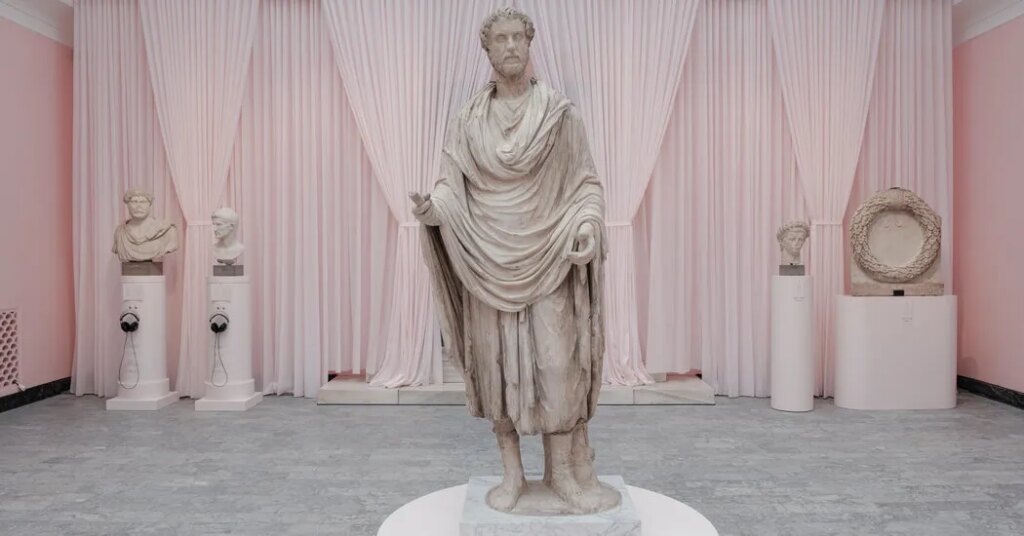
Copenhagen built its reputation as the capital of Scandinavian quiet luxury on a palette of beige and gray. But inside the city’s Ny Carlsberg Glyptotek museum, a new exhibition reveals that the power players of ancient Rome preferred a far louder aesthetic: garish garments, vibrant dyes and unapologetic display.
The show, “The Power of Fashion in the Roman Empire” running through March 29, assembles sculptures from the era to examine how imperial expansion delivered the raw materials and styles that Romans used to assert themselves in a hypercompetitive social world.
“The exhibition explores fashion as a means of expressing status and power,” said Cecilie Broens, a senior researcher at the Glyptotek who curated the show. “It also helps us understand how Roman fashion drew on the resources of its empire to express these forms of power.”
As Rome consolidated its control over the Mediterranean and beyond in the early centuries of the first millennium, a thriving trade network fueled an increasingly consumerist society. Fashion trends and materials, like silk, pearls and dyes, flowed in from encounters with other cultures and helped demarcate social hierarchies in Rome.
The more exotic or rarefied your outfit was, the more clout you carried.
Textiles decay easily, and hard evidence for Roman fashion is vanishingly rare. But Roman portrait sculpture can tell us a lot about clothing, hairstyles and jewelry — even what perfumes people used. And because these statues broadcast idealized versions of their subjects, they reveal even more about how people wanted to be seen.
Perhaps predictably, many sculptures in the exhibition feature a subject wearing a toga or a stola, a sort of pinafore for women. These garments, which telegraphed Roman citizenship, remained remarkably unchanged over the centuries. But ornaments, hairstyles and dyes offered a way of standing out.
Many of the statues were originally painted in vibrant pigments, although barely any trace is left today. The Glyptotek, a major center for research on the use of color in ancient sculpture, has used paint residue analysis to produce digital reconstructions displayed on screens in the show.
Dyes for garments were sourced from around the empire. Purple — the most prestigious — was traditionally restricted to the garments of the elite. The best purples came from the glands of Murex sea snails from the eastern Mediterranean, an exploitative practice that nearly drove the species to extinction. “The word sustainability wouldn’t make any sense to Romans,” Broens said.
Plant-based imitations provided an access point for the less affluent — “much like fake handbags of today,” Broens explained. (A discerning eye could tell the difference: In his “Epistles,” the poet Horace pities the know-nothing who can’t tell one from the other.) The exhibition displays a rare fragment of a tunic with a woad or indigo border from Egypt, on loan from the British Museum, to compare with a remnant of Murex purple from the Glyptotek’s archives.
Purple was a versatile color for Romans, covering a wide spectrum from pink to blue. Shifting trends favored different shades, and adopting new hues could give an edge. As Eve D’Ambra, an art history professor at Vassar College, writes in the exhibition catalog, “The quest to acquire the most prestigious dyes was akin to striking a moving target.”
Other dyes from imperial provinces were equally valuable and signified wealth, like kermes, a vermilion derived from insects, or saffron. These dyes were used for the clothes of wealthy citizens outside the Roman elite, including freed slaves, who were not allowed to wear purple.
The show includes a portrait sculpture of the ex-slave and actor Caius Fundilius in a toga and dress shoes like a member of the elite. His toga, however, was originally painted orange, perhaps suggesting that it was colored with saffron — an expensive dye, but still not purple.
Other fashion trends, like hairstyles, could reflect Roman conquests. When Rome was struggling to subdue Germanic territories in the first century, elite women often wore wigs made from the blonde hair of Germanic captives or tried to imitate the color with dye. In this case, Broens said, “Women’s beauty was quite literally constructed from subjugated peoples.”
Yet not all foreign influences were harvested by force. As Rome’s elite diversified, hairstyles were borrowed for cosmopolitan cachet. Julia Domna, the wife of the emperor Septimius Severus, came from a powerful Syrian family, and her distinctive coiffure appears to have been a popular style in that region. A portrait bust in the exhibition displays the look, which was widely copied.
We also know that perfume styles tracked the empire’s expansion, with popular varieties including “Egyptian” and “Assyrian.” Recent research shows that statues of the elite would even be regularly anointed with scents. Some recipes for scents survive, but we’ll never know what they really smelled like. Instead, the Glyptotek invited the Danish cosmetics brand Karmameju to create its own interpretations — bringing a touch of Scandinavian elegance to the imperial glitz.
The post Forget Quiet Luxury. In Ancient Rome, the Fashion Was Loud. appeared first on New York Times.