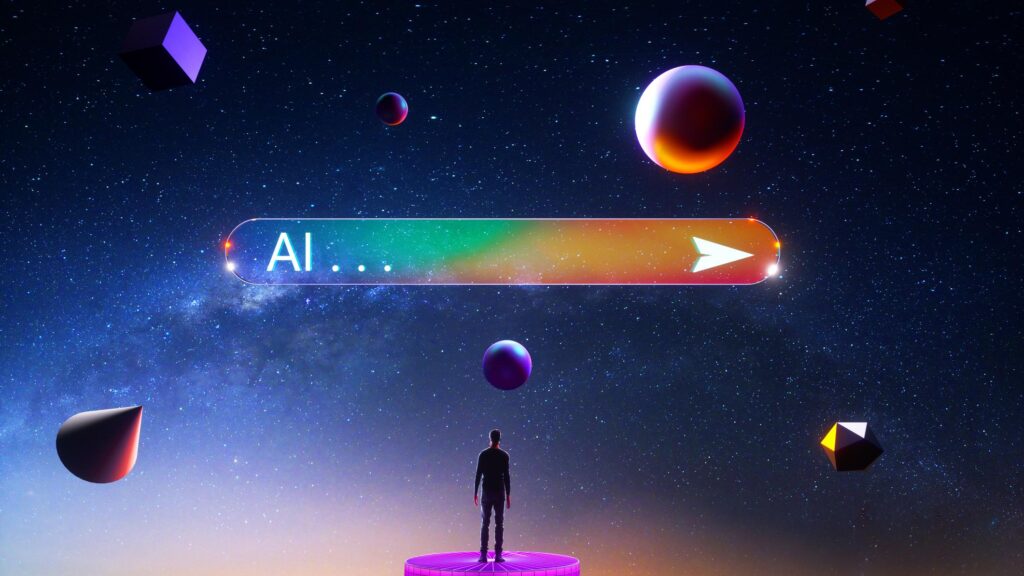
Another day, another jaw-dropping feat by AI. Just last month, OpenAI announced that it had solved one of the seven Millennium Prize Problems, a set of complex unanswered questions proposed by the Clay Mathematics Institute in 2000. Then there was Google DeepMind’s new AlphaGenome Atlas, which predicted the biological effects of all 9 billion possible single-letter changes in the human genome.
These feats are awe-inspiring. As are the countless number of milestones and accomplishments each successive AI frontier model has racked up since ChatGPT was launched in 2022. But as we marvel at the machines, what gets crowded out are the humans. While acknowledging the amazing capacity of AI, we shouldn’t lose sight of the irreplaceable value of human-generated awe.
Dacher Keltner, professor of psychology at Berkeley, studies the impact that experiences of awe have on our physical and mental health. He describes awe as “the feeling of being in the presence of something vast that transcends your current understanding of the world.”
The triumphs of AI certainly qualify. But one of Keltner’s studies, which looked at 2,600 stories of awe across 26 countries, had a very revealing finding. “What most commonly led people around the world to feel awe?” he writes. “Nature? Spiritual practice? Listening to music? In fact, it was other people’s courage, kindness, strength, or overcoming.”
The finding, Keltner says, caught his team off guard—they were expecting nature and spirituality to come out on top. Keltner called it “moral beauty,” which he defined as “witnessing the kindness, courage, strength, or selflessness of other people.” Of the moral beauty that inspired awe in the study, 95% came from witnessing actions that people took on behalf of others.
Keltner listed moral beauty as the first of his “eight wonders of life” that are everyday sources of awe. The others are collective movement, nature, music, visual design, spirituality and religion, big ideas, and life and death. Technology can play a part in many of those, but they’re mostly deeply shaped by humans and human connection.
Many of the benefits of awe have a deeply human element. Keltner cites research showing that awe quiets the regions of the brain associated with excessive ego, self-criticism and anxiety. And this can have an expansive and collective impact. “In moments of awe,” Keltner writes in Awe: The New Science of Everyday Wonder and How It Can Transform Your Life, “we shift from the sense that we are solely in charge of our own fate and striving against others to feeling we are part of a community, sharing essential qualities, interdependent and collaborating.”
But what happens when a new technology, like AI, disrupts our sense of authentic community? To be sure, the ease with which our heads can be turned by machines long predates AI and has been with us as long as machines have. The term “technological sublime” was coined by the Harvard historian Perry Miller, who found that by the early nineteenth century “technological majesty” had joined “the starry heavens above and the moral law within to form a peculiarly American trinity of the Sublime.” In 1994, historian David Nye’s American Technological Sublime explored the impact that awe inspired by achievements like automated factories, the first canal systems, and the moon landing had on national identity. Nye notes how tech-inspired awe crowded out the human element. Writing about the awe-inspiring view from the new skyscrapers, he observed that it “divorced the observer from the sense of connection with others.” From that height, the people below became “mere insects whose humanity had disappeared.”
And of course, all of us know how the awe of being connected to the entire world through our phones can simultaneously disconnect us from those around us.
Nearly a century ago, Albert Einstein was addressing the students of Caltech—many of whom would no doubt go on to create awe-inspiring technology themselves—and gave them this charge: “Concern for man himself and his fate must always form the chief interest of all technical endeavors… in order that the creations of our mind shall be a blessing and not a curse to mankind. Never forget this in the midst of your diagrams and equations.”
So sure, we will be awed by what the machines can do. But there is also so much awe to be had in our everyday lives, both in nature and in the moral beauty of humans. As Keltner notes, experiencing awe “doesn’t require money or the burning of fossil fuels.” Or tokens!
“Because we have a basic need for awe wired into our brains and bodies,” he writes, “finding awe is easy if we just take a moment and wonder. All of us, no matter what our background, can find our own meaningful path to awe.
The post Awe in the Age of AI appeared first on TIME.