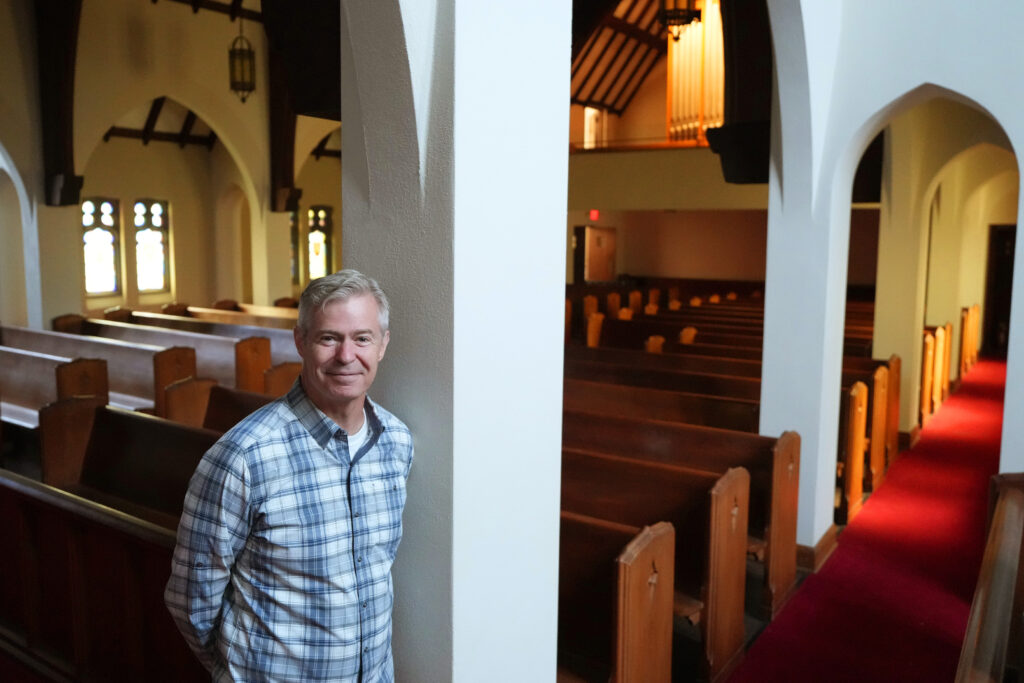
Unlike many pastors in America today, the Rev. David Lose doesn’t have a numbers problem at Mount Olivet Lutheran Church in Minneapolis. With about 16,500 baptized members, his congregation is the largest it has been in its 106-year history.
Mount Olivet has grown so much that it now qualifies as a megachurch.
“But when you’re here, we’re as different from a megachurch as you can imagine,” Lose said. “Our worship is pretty much the same as we’ve been doing since 1940.”
The setting is urban. The sanctuary is Gothic. The music is classical.
But people are lonely, with many working from home and still socially isolated after the covid pandemic shutdowns. The effects of Operation Metro Surge, the Trump administration’s immigration raids in Minnesota that led to the fatal shootings of two U.S. citizens, still linger. So does the trauma of a 2025 school shooting just a mile away that killed two children, one of them a Mount Olivet congregant.
Lose wants to turn Mount Olivet’s original chapel, which sits barely used across the street from the main church, into a community gathering space where people of all faiths — or no faith — can gather over a cup of coffee or pint of beer.
Lose said the idea builds on the community connections formed by the church’s longtime pastor, the Rev. Reuben Youngdahl, who was later succeeded by his son, Paul.
“Can we create a place where people come together and actually get to know each other and find common cause?” he said.
The proposed new space, reported on by the Minnesota Star Tribune, has been approved by local officials but still has some rezoning and other hurdles to clear. It would involve tearing down the existing chapel and replacing it with a new building that, among other things, would serve freshly roasted coffee, lunch fare and local beers.
Big open spaces and a patio would allow community groups to meet. Smaller spaces could host tutoring sessions. The church’s choirs would have a place to unwind after evening practices. Bulletin boards would connect people with neighborhood groups and volunteer opportunities. Proceeds would flow to community-oriented organizations.
“I really support their thought behind this idea,” said Linea Palmisano, a Minneapolis city councilwoman who’s represented the district for 13 years. “I get that this is a nontraditional use of a church space, and I love it. I think that they’re really listening to the community and paying attention.”
Churches get creative
Across the country, churches have experimented with ways to boost membership and attendance, both of which have declined over the past two decades. Polls show that nearly a third of Americans say they have no religious affiliation.
Those downward trends intensified during the pandemic, though some religious leaders say they’re seeing resurging interest among young people.
Church efforts to reach new people frequently involve drinks of various kinds.
“I think creating a space for coffee kind of helps with creating the community and fosters conversation,” said Nicky Reardon, whose Fruits & Roots coffee and tea company in Columbus, Ohio, counts many churches as clients. “It also feels very familiar and predictable.”
Beer pairings are common across denominations, too, going by different names: Bible n’ Brews, Theology on Tap, What Would Jesus Brew?
At Mount Olivet, a separate nonprofit would run the taphouse. The new facility would retain stained glass but be more secular than a sanctuary.
A goal is to attract patrons beyond the church’s existing membership, though Lose stresses the intent is not to attract new congregants. To that end, he has framed the project around the word “parish” — not just a church but the community that surrounds it.
“What I’ve tried to say is, ‘We’re still responsible for the well-being of the whole of our parish, whether they come to Mount Olivet or not, whether they’re Christians or not, whether they’re believers of any stripe or not,’” Lose said.
The proposed center is an example of how churches are reexamining their places in communities as some struggle to fill pews and reach new members.
“Congregations are definitely going through kind of a recalibration,” said Allison Norton, director of Hartford Institute for Religion Research at Hartford International University. “They’re asking new questions about their purpose and their mission and what does it mean to respond to crisis while also being willing to change to meet new realities.”
Loneliness, political divides
Lose said the need for a community gathering place has been on his mind for about a decade.
He cited Jennifer Haupt’s “Alone Together,” a book about the loneliness problem exacerbated by the pandemic and technological changes.
“Her analysis was that Americans simultaneously feel more connected than they ever have before and lonelier than they ever have before,” he said, “because the connections mediated by social media and the internet are just very often quite superficial.”
Minneapolis has also been at the center of national upheaval after George Floyd’s murder by police in 2020; the Annunciation Catholic School shooting; and the deaths of Renée Good and Alex Pretti during the federal immigration raids.
When some in Minneapolis were too scared to go grocery shopping during Operation Metro Surge, as thousands of federal agents flooded the city’s streets, Mount Olivet stepped in. The congregation assembled more than 3,500 emergency grocery boxes and delivered them across the region.
Lose said that response moved him. Mount Olivet includes a mixed congregation politically, drawing from the liberal area that surrounds the church and the more GOP-leaning suburbs and exurbs nearby.
“You could find a variety of people from different political points of view who would all agree people still need to be fed,” he said.
Those actions inspired the taphouse’s proposed name: The Volunteer.
“Here’s where you can make a difference,” Lose said. “Here’s where you can volunteer. Your political convictions matter, but not as much as working together with other people toward a common cause.”
The post A church’s answer to the loneliness epidemic: Turning a chapel into a taphouse appeared first on Washington Post.