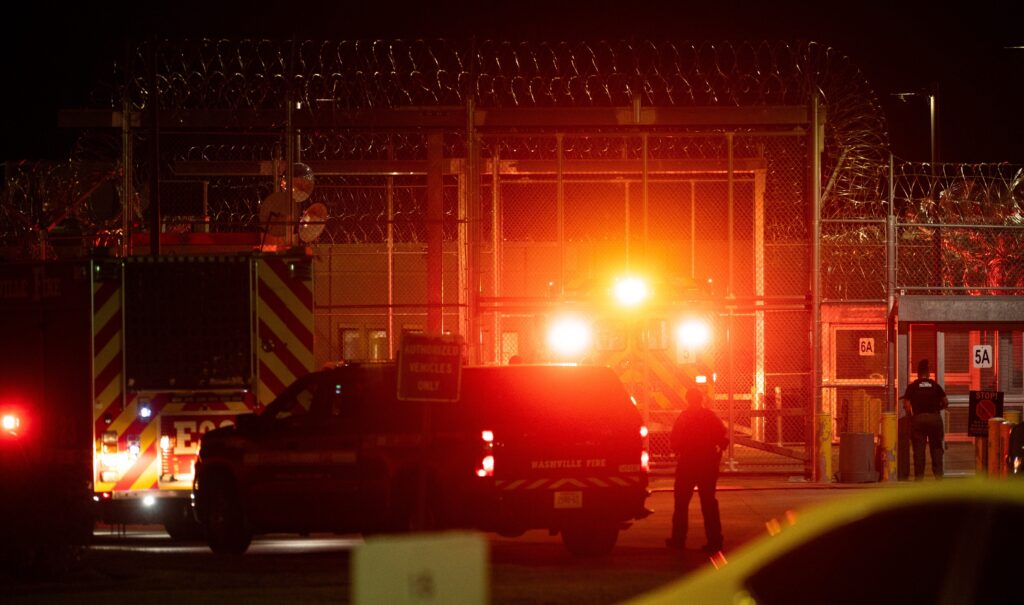
The chaotic developments that unfolded late Wednesday when the state of Tennessee sought to carry out a death penalty for Christa Pike fall under a broad category that experts call botched executions.
While there is no official definition for the term, academics have described them as executions that departed from official protocol, involved unanticipated problems or delays that caused unnecessary pain for the prisoner, or that reflected gross incompetence from the executioner.
Pike continued breathing for nearly an hour after she was administered two rounds of lethal drugs, leading the state to halt her execution and take her to a nearby hospital for treatment. Her lawyers said late Wednesday they had not been updated on her condition.
Here are some of the most recent high-profile executions that advocacy groups and observers say were botched.
Tony Carruthers, May
Convicted murderer Tony Carruthers was granted a one-year reprieve by Tennessee Gov. Bill Lee (R) after authorities botched his lethal injection in May.
Carruthers was due to be executed at the Riverbend Maximum Security Institution — the same Nashville prison where Pike’s sentence was to be carried out.
The Department of Correction said medical personnel had established a primary IV line for Carruthers but were not able to establish a backup line as required by the state’s execution protocol. A subsequent effort failed and the execution was called off.
An attorney for Carruthers, Maria DeLiberato, described how he had groaned in pain and bled.
The case also led medical professionals to urge Lee to suspend executions, saying the process does not comply with the law, protocol “or basic human decency.”
Anthony Boyd, 2025
Boyd was executed in Alabama by nitrogen gas, which is administered through a mask to cause unconsciousness and death, in October 2025.
Boyd, who was convicted for a 1993 murder, had unsuccessfully fought for a stay of execution in a lawsuit alleging that nitrogen gas is unconstitutionally “cruel and unusual” and that previous death row inmates had showed signs of “terror and pain” during the method. He offered to die by firing squad, hanging or medical aid instead.
Journalist Lee Hedgepeth, who witnessed the execution, said Boyd violently thrashed against his restraints and took deep gasping breaths for more than 15 minutes. He was declared dead nearly 40 minutes after the process began, Hedgepeth wrote.
Thomas Creech, 2024
Authorities in Idaho stopped the execution of serial killer Thomas Creech in February 2024 after medical workers were unable to insert an IV line for lethal injection.
Josh Tewalt, director of the Idaho Department of Correction, said at the time that the team attempted eight times to “establish IV access” to Creech, but he was eventually returned to his cell.
The failed attempt highlighted concerns about the use of lethal injections and the training of those carrying out the executions. Creech remains on death row.
Kenneth Eugene Smith, 2022
In 2022, Alabama officials tried and failed to execute Kenneth Eugene Smith by lethal injection for his role in a contract killing. He was ultimately executed in 2024.
During the 2022 attempt, prison staff spent “about an hour” trying to find a vein to set an IV line, trying “several locations” on the prisoner’s body, Alabama Department of Corrections Commissioner John Hamm told reporters at the time. The team gained access to one vein, Hamm said, but was unable to establish the second IV line required by protocol for executions involving lethal injection.
By 11:21 p.m., the team members decided they would not be able to complete their protocol before midnight, when the warrant expired, Hamm added.
It was the state’s second failed lethal injection in two months, and it prompted Gov. Kay Ivey (R) to temporarily pause executions for review.
Smith was later executed in January 2024, becoming the first prisoner known to be executed using the nitrogen hypoxia method.
The post What is a botched execution, and what happened in previous cases? appeared first on Washington Post.