1. The election headline that was never published
By Dean Baquet
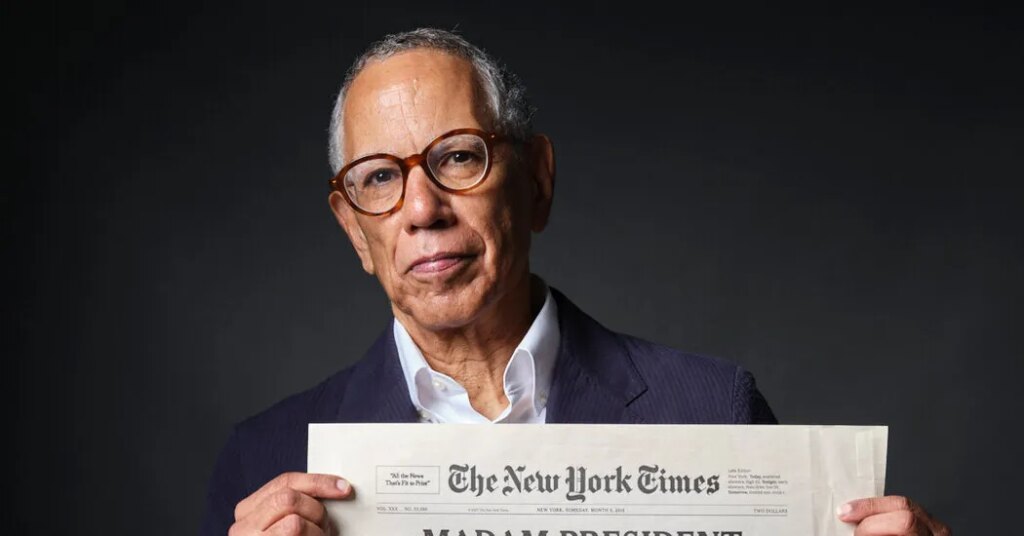
It is widely accepted that the print front page does not have the power it once did — except for historic events like the election of a new president. It is a keepsake, a memento. So there is enormous pressure to come up with the perfect headline, one that will stand up to time.
“Madam President” was just that. It didn’t have the candidate’s name. It did not have to. Those two words caught the fact that America had chosen its first female leader. It was the formal title that would be used in official settings. And the accompanying stories were designed to dwell on the moment, on the changing role of women in society, politics and power. There was even a full discussion over what to call her husband, a former president.
Except none of it was ever published, because to the surprise of most of us in the newsroom, and even to the ultimate winner, Hillary Clinton lost the 2016 election to Donald J. Trump.
That night in the newsroom — the tossing of stories and the frantic creation of new ones — was a first sign of the confusion and the chaos that would come to characterize American elections for the next decade. Chaos is the right word. The place was filled with guests, friends and spouses who assumed they would witness the election of the first woman as president.
I remember feeling conflicted, the editor’s curiosity mixed with the shock that newsrooms nationwide had missed something large. But the overall impulse was to fix the thing, to tear up the paper and start all over again — which is what we set about doing.
We almost always prepare two front pages — in fact two full packages of stories — for presidential elections. It would be hard if not impossible to ready the mix of analysis and biography right up against the deadline. American elections are usually pretty close. Mostly there are no surprises, and the perfunctory stories about the losing candidate are set aside. There was in fact a special section ready to go after George W. Bush defeated Al Gore, but the presses were stopped, and the papers were scrapped when Gore withdrew his concession.
But in the case of Clinton versus Trump, very little effort was put into the possibility that Trump would win. Most of us believed that it was highly unlikely; almost all polls and conventional political wisdom had Trump losing to Clinton.
No “Trump Wins” headline was prepared in advance. It was a lesson, one that would influence reporting in America for the next 10 years. Polls are fine, but nothing beats getting out and talking to people. There had been an enormous shift in the country, and most of the press and political pundits had missed it.
But that night started in typical fashion. Newsrooms are largely quiet as the votes come on election night. The stories are mostly written. Fast food is served to the editors and the writers waiting for results. Typical fare is pizza.
Trip Gabriel, a reporter assigned to cover voters, recalled being less certain of a Clinton victory. He had seen signs in his travels, but he, too, expected Trump to lose. Trip’s election night assignment was to talk to the mourning Trump voters, at a working-class bar in Ambridge, Pa., a struggling steel town.
The bar patrons in Ambridge were not paying much attention to the television coverage droning on. There was a ferocious dart game underway. And they certainly were not mourning, since they were convinced Trump would win.
“Everywhere you went there were nothing but Trump signs,” Trip recalled of that part of the state.
Back in the New York newsroom, we had to scramble. Reporters and senior leaders huddled around the Politics desk, staring into their phones or at computers as surprising vote tallies started to come in from Florida and elsewhere. Suddenly a race that was to end early was getting close. I called reporters to ask what they were hearing, including one who was in touch with the people around Senator Mitch McConnell. The Republicans remained certain that Trump would lose.
But then the numbers came in.
In Pennsylvania, Trip got a frantic call from an editor. “Oh my God,” the editor said. “He is going to win.”
Trip sat in his rental car in the parking lot of the bar and, in about 45 minutes, tapped out a story that would eventually make the front page under the headline “A Blue-Collar Town in Decline and in Despair Turns to Trump.”
The “Madam President” headline was scrapped for “Trump Triumphs.”
Dean Baquet was the executive editor of The New York Times from 2014 to 2022. He now leads The Times’s Local Investigations Fellowship.
2. The things I carried
By James P. Sterba
After nearly two years of war reporting, I was two days away from leaving Vietnam and cleaning out my room in the Continental Palace Hotel, half a block from The Times’s local office. I packed one bag for my next assignment, in Jakarta, Indonesia, but shipped a few other items home, including keepsakes from the war.
A light nylon and polyester poncho liner, tossed to me by a commander at an artillery base one chilly night in the highlands, is still in use; I take it with me to the couch when my snoring wakes my spouse. Several P-38 can openers, essential for eating field rations, are scattered in various drawers. A box of C rations now sits on my home office bookshelf. And I have a helmet, or “steel pot” as it was known, resting on a basement shelf. It came from a combat base near the Demilitarized Zone where incoming North Vietnamese rockets regularly killed and wounded Marines. Someone suggested I grab one from a pile of gear stripped from the dead. Written inside a fold in the canvas camouflage cover of the helmet I picked are two words I took as a dead grunt’s message to me: The first was an expletive. The second was “you.”
James P. Sterba was a reporter for The Times from 1967 to 1982.
3. A flak jacket that fit
By Somini Sengupta
In August 2003, I was covering the last days of the war to oust Charles Taylor, Liberia’s warlord turned president. A photographer took a picture of me during a firefight, crossing a bridge in Monrovia that divided the rebel-held and government-held sides of the city. The flak jacket I was wearing was clearly too big. I was swimming in it. A bullet or a piece of shrapnel could easily have slipped in.
The standard-issue flak jackets available at the time were made for bigger people — men, presumably. So I asked the International desk to have one made in my size. I chose a color that suits me, forest green, with a matching helmet. It protected me for 15 years and in 10 conflict zones.
Somini Sengupta was the West Africa bureau chief for The Times from 2003 to 2005. She is now a correspondent for the International desk.
4. To publish or not to publish
By Jonathan Mahler
The 35,000-word manuscript — a dense, philosophical indictment of technology’s effects on humanity and the natural world — arrived at the offices of The New York Times on June 28, 1995. The accompanying four-page, handwritten cover letter began: “If the enclosed manuscript is published reasonably soon and receives wide public exposure, we will permanently desist from terrorism.”
The F.B.I. suspected that the author was the Unabomber. The bureau had given the man — later discovered to be Ted Kaczynski — the moniker because the earliest recipients of his anonymous mail bombs, which dated back to 1978, were affiliated with universities. His most recent victims, though, had been an advertising executive in 1994, and the president of the California Forestry Association in 1995. He gave The Times three months to print his manuscript — in full.
Newspapers are the product of countless daily decisions, usually driven foremost by news judgment. This was one big decision involving a set of considerations that went far beyond the normal responsibilities of a news organization, and it set off a three-month debate inside the paper over what to do.
If The Times published the Unabomber’s treatise, would it create a dangerous precedent, encouraging other terrorists to undertake similar threats? But what if the paper didn’t, and the Unabomber struck again? The consensus inside the broader world of journalism was that it would be a mistake for The Times to concede to any demand from a terrorist.
The Washington Post also received a copy of the manuscript with the same demand. The publishers of both papers — Arthur Ochs Sulzberger Jr. and Donald E. Graham — agreed that they should act together.
With the September deadline looming, Sulzberger, Graham and their executive editors met with the director of the F.B.I., Louis Freeh, and the attorney general, Janet Reno. Typically, when The Times seeks input from the federal government about whether to print something, the response is: Don’t. In this case, Freeh and Reno urged The Times and The Post to publish, hoping that someone would recognize the writing and lead authorities to an arrest.
The two papers decided to copublish and agreed to share the printing costs — though the manuscript would appear in full only as a stand-alone section in The Post, on Sept. 19, 1995. The Post’s circulation was smaller; not only would the printing costs be lower, but it would give the F.B.I. fewer newsstands around the country to monitor for suspicious buyers.
A terrorist had successfully pressured the two publications into printing a manifesto with no discernible news value. But weeks later, the Unabomber’s brother, David Kaczynski, read excerpts from the manuscript on the nascent internet, and heard echoes of phrases that his brother had used in letters to him. David’s wife urged him to contact the F.B.I. The longest, most expensive manhunt in the agency’s history soon came to an end. The Unabomber was arrested.
Jonathan Mahler is a staff writer for The New York Times Magazine.
5. The ad that changed journalism
By David McCraw
On a Tuesday morning in March 1960, a legal revolution began in a most unlikely place: a full-page ad in The New York Times.
Supporters of the Rev. Dr. Martin Luther King Jr. purchased the ad, headlined “Heed Their Rising Voices,” a phrase picked up from a Times editorial that ran a few days earlier. It called on readers to stand up for civil rights protesters under attack in cities across the South. The ad claimed that, with tear gas and shotguns, the police in Montgomery, Ala., had confronted Black students who were peacefully demonstrating and singing patriotic songs and then padlocked their college dining hall “to starve them into submission.”
But the ad contained minor factual errors, and L.B. Sullivan, a white city commissioner in Montgomery and an ardent supporter of segregation, took notice. He was in charge of the local police, and he sued The Times for libel, even though his name appeared nowhere in the ad. A jury awarded him $500,000.
By the time the case reached the Supreme Court in 1964, such suits had become commonplace for Southern officials who hoped that the tactic could drive away the Northern news organizations chronicling civil rights abuses. The Times alone was facing 11 libel suits by local and state officials seeking a total of $5.6 million.
The Supreme Court was unambiguous in its response. In a unanimous decision, it held that under the First Amendment public officials could no longer prevail in libel suits unless they could prove that the publishers had acted with “actual malice.” Sullivan, who could not show any of the errors were intentional, went home empty-handed.
The ad has always struck me as an unlikely vehicle for advancing the cause of press freedom. It wasn’t journalism; it involved no reporting. The decision to publish was made by advertising executives, not editors. And rejecting Sullivan’s libel claim hardly required a deep reappraisal of constitutional law. Did any of Sullivan’s like-minded friends and neighbors really think less of him as a result of a civil rights advocacy ad that never mentioned his name? And ran in a paper that in Montgomery had a circulation of 35?
David McCraw is a senior vice president and deputy general counsel for The Times.
6. Call me Mr. Jacobs
By Pete Wells
Near the end of 2011, I made up five names to be printed on credit cards that I would use to pay for my meals as The New York Times’s restaurant critic: Glen Bradley, Lee Jacobs, Jeff Michaels, David Malone and Mark Stern traveled along with me all 12 years I worked in the job.
Though Times restaurant critics had long made reservations under assumed names to avoid special treatment, the need for fake names on cards became apparent during an early meal when I paid with one of my own. The server took it away and came back with a barely suppressed grin. The next time I arrived at that restaurant, the host didn’t even ask what name the reservation was under. She just smiled and led me to a table.
With no offense intended to the real Bradleys and Sterns of the world, the names were meant to be generic. I tried to be inconspicuous, avoiding anything that would stick in a waiter’s memory or cause a double take. As far as I know, the cards never gave me away. If I hadn’t been recognized by the time the check came, I was home free.
This system of mismatched names failed me only when I ate alone and had reserved under one of my hundreds of other aliases. Once I’d paid, a server who had been calling me “Mr. Thompson” all night would bring me the receipt and say, “Thank you and have a nice evening, Mr. Jacobs.”
Pete Wells is a reporter covering food for The Times. He was the paper’s restaurant critic from 2012 to 2024.
7. Dressing for a plague
By Sheri Fink
In 2014, I went to West Africa to write about the widespread Ebola outbreak in three affected countries.
I had bought protective gear on Amazon for reporting at a treatment unit and learned how to use it at the Center for Domestic Preparedness in Anniston, Ala., from U.S. Centers for Disease Control and Prevention staff members. We practiced in the September heat, memorizing complicated instructions for removing the gear while avoiding self-contamination.
The suits had been designed primarily for other settings, including chemical manufacturing plants and pharmaceutical factories. After we arrived in Liberia, we discovered just how challenging the suits were to use in outdoor units: They stopped the virus, which spreads by contact, but they were unbearable to wear for long periods in the high heat and humidity. Medical staff members needed to ration their time with patients to avoid becoming dehydrated and passing out on floors contaminated with infectious body fluids.
After coming out of the hot zone, one doctor would sit and pour out what seemed like a liter of sweat from his rubber boots. The sense was that better equipment needed to be produced specifically for infectious-disease workers. It was sad six years later, when Covid emerged, to see that little progress had been made.
Sheri Fink is a reporter on the investigations team at The Times whose work often focuses on medical care during crises.
8. What remained after the crossfire
By Suzanne Daley
In 1998, sheep farming was a major industry in Lesotho, a tiny, impoverished mountain kingdom surrounded by South Africa. It was not a place you expected to encounter danger. In fact, three years into a four-year stint as the South Africa bureau chief, I had yet to find a reason to go there. So, when citizens began protesting an election, I thought: Here is my chance.
But the day I set off from Johannesburg with João Silva, our photographer, and Greg Marinovich, a freelancer, South Africa staged a surprise invasion, aiming to end the unrest. The move set Lesotho’s military, numbering about 2,000 soldiers, against one of the continent’s most sophisticated armies. Tanks rolled in. Helicopters circled.
The South Africans didn’t expect much of a fight. But they got one. And we drove right into it.
Lesotho’s capital, Maseru, was on fire and looters were everywhere. Some 30 people died that day.
Our effort to reach Lesotho’s Army base outside town became a disaster. When we arrived, snipers shot at us. We crawled from the car into a ditch and waited. After a while, a South African patrol appeared, and we retreated with them, parking at some distance from the base to decide what to do next.
It was a poor choice. The engine was barely off before bullets ripped up the right side of the car, wounding Greg in the leg, flattening the tires and knocking out the brakes on that side. Still, we managed to race away, the car listing badly.
I am not much for keepsakes. But I kept a piece of that car — a reminder of how, without warning, life can go very wrong.
Suzanne Daley was the South Africa bureau chief for The Times from 1995 to 1999. She now oversees the international print edition.
9. Safety in colors
By Hiroko Tabuchi
When a tsunami in 2011 crippled the Fukushima Daiichi nuclear power plant in Japan, setting off fuel meltdowns, reporters in the field were initially in the dark. How much radiation was out there? Were we safe? Somehow, our Tokyo bureau manager procured a Russian-made Soeks Geiger counter from an obscure corner of Japan’s online marketplace. Smaller than a cellphone, it flashed radiation levels in microsieverts, the preferred international measure, along with simple color codes: green for safe, yellow for caution, red for danger.
I took it everywhere, including deep into the radioactive exclusion zone, where clocks remained stopped at 2:46 p.m. and abandoned cows peered through hedges.
At one point, behind a deserted home, the device flashed red, hitting 14 microsieverts an hour. (Background radiation levels are around 0.1 microsieverts an hour.) Yet it was hard to stay terrified of an invisible threat. Not long after the flashes subsided, an evacuee I was with peeled his hazmat suit to his waist to smoke a cigarette.
I still wonder if the elevated levels of radiation I encountered increased my risks of getting cancer. When the Soeks spiked, I did try to get the hell out of there. If I live a long, healthy life, I’ll owe it, at least in part, to this little device.
Hiroko Tabuchi was the Tokyo business correspondent for The Times from 2009 to 2014. She now covers pollution and the environment.
10. After investigating Weinstein for six months, they received this email
By Jodi Kantor and Megan Twohey
On the morning of Oct. 5, 2017, hours before we published our investigation revealing that the film producer Harvey Weinstein had harassed and abused women for decades, we received an unexpected email.
We were waiting for Weinstein’s response to our findings, and to see if he would follow through on threats to sue the paper. And while our article drew on a legal and financial trail of secret settlements and damning human resources records, only two women had been willing to share their accounts on the record.
One of them was Laura Madden, who had a terrible account of being abused by Weinstein when she worked as his assistant a quarter-century earlier. For months, she and Jodi had been speaking — over text, on the phone, on a Cornwall beach — and she had given us permission to use her name and experience.
But making allegations against powerful men could backfire, with accusers suffering public attack. Weinstein was known to be vengeful. Madden, and every other woman involved, faced the question: Why take the leap?
She was also contending with another factor. Madden had recently been treated for breast cancer, and her second mastectomy and reconstructive surgery were going to collide with the publication of our article.
As our deadline approached, we worried that she would drop out.
At 6:56 a.m., we received an email from Madden:
I feel obliged to talk about the events that happened to me at Miramax as I realise that I’m in the fortunate position of not being employed in the film business and so my livelihood won’t be affected. I’m also not one of those that have been silenced even though individuals under Harvey Weinstein have tried to persuade me to be silent. I do not have a gagging order against me either. I feel I am speaking out on behalf of women who can’t because their livelihoods or marriages may be affected. I am the mother of 3 daughters and I do not want them to have to accept this kind of bullying behaviour in any setting as ‘normal’. I have been through life changing health issues and know that time is precious and confronting bullies is important. My family are all supportive of my decision.
I am happy to go on record.
Good luck
Best wishes
Laura
Jodi Kantor and Megan Twohey are investigative reporters at The Times. Their investigation of Harvey Weinstein shared in the 2018 Pulitzer Prize for public service.
11. Tea set and sympathy
By David Rohde
Like dozens of reporters on Sept. 11, 2001, I headed to the World Trade Center after news reports that a plane had crashed into one of the towers. When I got off the subway, I saw both towers ablaze. Like thousands of others, I ran for my life as each collapsed.
Soon after, though, I headed toward 125 Cedar Street, fearing that my college friend’s mother might be trapped inside. It was the apartment where, years before, I’d spent my first night in New York. It also looked out on the World Trade Center.
I found a firefighter and asked him to help me search the apartment. After he broke down the door with an ax, we found no one inside. The towers’ collapses had blown the windows inward — not simply shattering the glass but blasting the metal frames into the apartment and hurling them to the floor.
Bits of concrete and glass blanketed the apartment, which was caked in dust. On the floor, I found a tattered sheet of paper from Cantor Fitzgerald, an investment firm in the north tower that lost 658 people that day. How the paper landed in the apartment baffled me; the home faced the south tower, not the north one.
A few days later, I visited the apartment again with Eddie Keating, a Times photographer. When we walked inside, I thought the windows, or perhaps the paper from Cantor Fitzgerald on the floor, might catch Eddie’s eye.
Instead, Eddie, saying little, crisscrossed the unit. The click of his camera intermittently broke the silence. We left, I think, after about 10 minutes, eager to capture what we could at ground zero before the police kicked us out.
Days later, a picture Eddie took in the apartment ran on the front of a section called “A Nation Challenged.” It was a close-up of a pewter tea set caked in dust, a 30-year-old wedding gift. It was an ordinary object that I had completely missed. Eddie said he walked past the tea set several times without taking a picture of it. He did so just before leaving the apartment because he felt the tea set screamed out to him to be photographed. Eddie, of course, saw something: the line between before and after.
For months, Eddie devoted himself to chronicling the search for survivors and the cleanup at ground zero — breathing noxious air, evading police, even disguising himself as a worker. He used photography to capture what was lost and the heroism of the searchers. His work helped The Times win the 2002 Pulitzer Prize for breaking news photography. But the tea set will forever be his defining image of those days.
The tea set, now cleaned, sits in the 9/11 Memorial Museum. After my friend’s mother, Elaine Williamson, passed away in 2013, her family donated it to the museum. Eddie died of cancer in 2021 at the age of 65. He attributed the disease to the months he spent at ground zero. Before his death, he called me with a simple request: Would I sign an affidavit attesting to the fact that he had worked at ground zero? I did.
David Rohde was a reporter at The Times from 1996 to 2011. He is now a senior national security reporter for MS NOW.
12. Distraction during wartime
By Sarah Lyall
Before there was Wordle, before there was Connections, before there was Spelling Bee or Strands or Sudoku, there was the O.G. of New York Times puzzles: the Crossword. And before the Crossword, the paper had no puzzles at all.
The publication of the first crossword, on Feb. 15, 1942, was a concession to popular taste and a bold leap into new territory for the staid Times. While most major American newspapers had carried crosswords for years, the paper refused to publish them and regularly inveighed against them in print. They are “a primitive sort of mental exercise,” The Times wrote, irritably, in 1924, and “a sinful waste of time.”
But then came the bombing of Pearl Harbor, on Dec. 7, 1941, and the mood in the country turned dark. Didn’t the readers deserve a diversionary activity?
“We ought to proceed with the puzzle,” The Times’s Sunday editor, Lester Markel, wrote on Dec. 18 in a memo to the publisher, Arthur Hays Sulzberger, “especially in view of the fact it is possible there will now be bleak blackout hours — or if not that then certainly a need for relaxation of some kind or other.”
Markel’s memo was attached to a note to the publisher from the pioneering crossword editor Margaret Petherbridge Farrar, who made her own case for why the paper should have the puzzle. “I don’t think I have to sell you on the increased demand for this type of pastime in an increasingly worried world,” she wrote.
She added, “You can’t think of your troubles while solving a crossword.”
The modern crossword had been brought into being by Arthur Wynne of The New York World, when he devised what he called a “Word-Cross,” which made its debut on Dec. 21, 1913.
In 1921, the editor in chief’s secretary, Margaret Petherbridge — she would become Margaret Farrar when she married John C. Farrar, a founder of Farrar, Straus and Giroux — was assigned to help Wynne.
Though at first she dismissed crosswords as “a sort of necessary nuisance in the obscurest corner of the paper,” she soon caught the bug herself.
Meanwhile, Americans were going wild for the new pastime. A book of crosswords edited by Petherbridge and others published in 1924 by the fledgling Simon & Schuster publishing company sold 350,000 copies the first year alone. Libraries were inundated by cruciverbalists, as crossword-puzzle solvers are called.
When The Times finally changed course, there was really only one person to hire to run this new feature: Farrar. In her 26 years as the paper’s founding Crossword puzzle editor, she helped begin the era of the modern crossword, establishing industrywide standards and practices. Among her rules: All the letters in the puzzle have to intersect with at least one other letter, no words can be repeated in the grid and the grid has to have rotational symmetry. (These are broken on special occasions.)
The first puzzle, written by Charles Erlenkotter, was titled “Headlines and Footnotes.” There were questions about trivia, vocabulary and current events; quotations from Shakespeare; references to Greek and Roman mythology; and lots of references to the war.
Farrar, christened the “grand dame of the American crossword puzzle” by The Washington Post, occasionally contributed puzzles she’d written herself, under the pseudonym Anna Gram. She continued editing puzzles after her retirement from The Times. When she died, in 1984, she was working on her 134th book of crossword puzzles.
Sarah Lyall is a writer at large for The Times.
13. Light in the tunnel
By Archie Tse
In late 2003, I was on assignment in Iraq for the Graphics desk when the U.S. military captured Saddam Hussein, the deposed Iraqi leader. He was found hiding in a “spider hole” at an isolated, rustic farm near Tikrit.
The day after his capture was announced, journalists were allowed to visit the site. We assembled at a temporary U.S. base, but military press officers said they had reached the limit on how many journalists they could accommodate. With the help of John Burns, our chief foreign correspondent, I pleaded with the military press officer, explaining that I was the only Graphics reporter there. John and I made it on the last Black Hawk helicopter to the farm.
At the site, we took turns going down into the spider hole, a vertical shaft just wide enough for a single person. It opened into a horizontal space that was about six feet long, 2.5 feet wide and 2.5 feet tall. An air vent was at one end and a fluorescent lightbulb was at the other. Neither was turned on, so the space felt dark and claustrophobic.
In New York, when I was preparing for the assignment, I had packed a headlamp, mainly out of being compulsively overprepared. But down in the hole, it proved useful, allowing me to quickly draw the coffin-like space in my sketchbook.
From those sketches, we published an illustrated diagram of the site, giving readers a detailed look at where Hussein had spent his last moments as a fugitive.
Archie Tse is the graphics director at The Times.
14. A special delivery
By Susanne Craig
Running for his first term as president, Donald Trump repeatedly promised voters he would release his tax returns. He never did, and I spent months trying to pull back the curtain on his finances. Then, on a Friday in September 2016, I found in my office mailbox a lone Manila envelope containing three pages of what appeared to be Trump’s 1995 tax returns. They revealed staggering losses for that year — almost $1 billion, a figure at odds with the image of the successful businessman he was presenting to voters.
After authenticating the documents, my colleagues and I began a yearslong reporting odyssey. It led to revelations that Trump had inherited hundreds of millions of dollars from his father, much of it enhanced through tax fraud, and that most of his businesses consistently lost money.
Susanne Craig is an investigative reporter for The Times. She shared the 2019 Pulitzer Prize for explanatory reporting with David Barstow and Russ Buettner.
The post The Objects Our Journalists Can’t Forget appeared first on New York Times.