Marika Holland, a climate scientist focused on sea ice, joined a call this summer in her office at the National Center for Atmospheric Research in Colorado.
Luckily, she closed her office door before it started.
She’d been told the John D. and Catherine T. MacArthur Foundation wanted to discuss a new climate program, and she assumed they would ask her to join a committee. But not long after she hopped on the line, she heard the news: She had been selected to receive one of the foundation’s “genius” grants, an $800,000, no-strings-attached stipend awarded annually to 20 artists, writers, scientists and academics who show “exceptional creativity.”
“I was completely shocked,” she said. “I got very choked up, and it took me several minutes to accept what they were saying.”
Three of the fellows this year work on climate issues. Holly Jean Buck, an associate professor at the University at Buffalo, is a sociologist who looks at emerging climate and energy policies. And Kaiyu Guan, an environmental scientist at the University of Illinois-Urbana Champaign, works on agricultural modeling to forecast outcomes under different conditions.
I caught up with Holland last night. Here’s a condensed and edited version of our conversation.
What does the grant mean for your work?
It’s still very fresh, and I don’t have specific plans for what I’ll do with this money.
I’m a physical climate scientist, so that means I study the physics of the climate system. I specifically study sea ice and the role of sea ice, which is part of the polar climate in our Earth system. But I work a lot with biologists to understand how changes in sea ice are affecting the ocean or large marine ecosystems — polar bears, penguins, things like that.
I also work with local communities in the Arctic, and I work with people who are thinking about policy and decision-making. To me, there’s a lot of need to have opportunities for more of those kinds of collaborations.
My colleagues reported in December that the Trump administration intends to dismantle the National Center for Atmospheric Research, where you work. I’m wondering how that’s affected your job.
NCAR is still there, and I am still employed there, but there have been these threats, and it’s concerning.
We’re living through the climate changes that the models have predicted, right?
We predicted these changes decades ago, honestly. And now we’re living though them. And so I think climate science is really important, understanding what’s in store, what’s to come in the future.
How we respond to that as people, as societies — those are all really important and critical questions. And we need large national centers to help us answer those questions.
At an institution like NCAR, our whole mission is around building national resilience. And doing that with a strong scientific basis. And so it’s just very disheartening and shortsighted.
This last year, there were climate disasters happening across the globe. Those are the kind of things that we need to understand and study.
The ‘genius’ grants tend to value cross-disciplinary work. Tell me about a project you’re proud of.
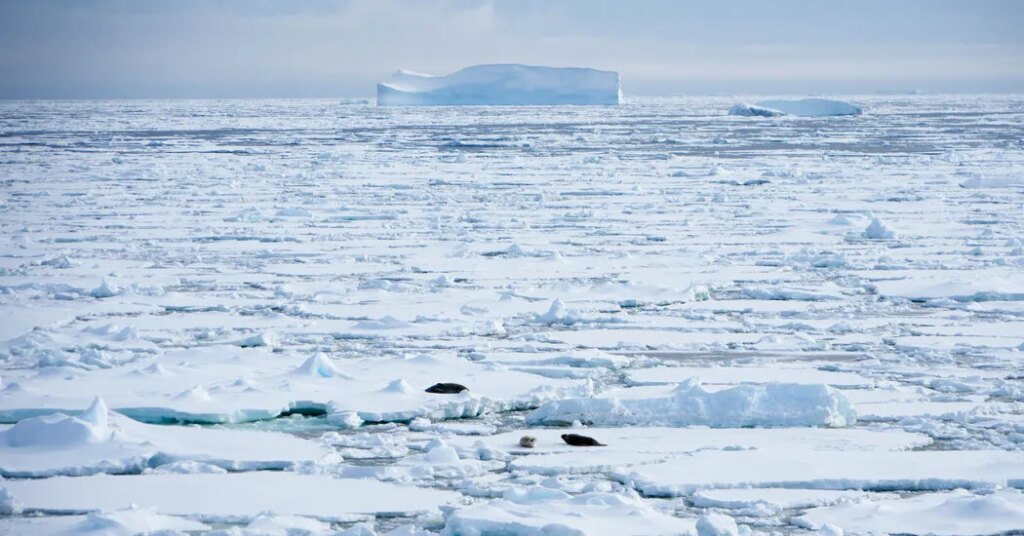
We’ve done a lot of work understanding Antarctic sea ice — the sea ice in the Southern Ocean that grows and forms and melts and moves around the Antarctic continent in the very far south.
And that sea ice is really important for ecosystems in the region. I’ve had the great privilege to have long-term collaborations with scientists who are studying penguins and seals. That work has really revealed that some of these amazing ecosystems are at risk because the sea ice is declining. In the last decade or so we’ve seen some very large declines in Antarctic sea ice, and we project that those declines will continue into the future.
That’s because of rising greenhouse gases in the atmosphere from the burning of fossil fuels and human activity. And we’ve investigated through the whole life cycle of penguins (emperor penguins in particular), which rely on sea ice for breeding and molting. They rely on it in different ways at different stages of their life cycle.
Editor’s note: Holland’s projection of sea ice loss informed the decision to add emperor penguins to the Endangered Species List. The Times’s Raymond Zhong and Chang Lee spent nearly two months on a research ship at the beginning of the year with scientists studying Antarctica, including its penguins, seals and sea ice. Read about their trip and watch their reports at nytimes.com/antarctica.)
What’s a Kelvin wave, and what does it mean for California?
In the coming days, sea levels off Southern California are expected to begin rising by half a foot or more and then stay elevated for months, as an enormous pulse of wave energy generated by El Niño travels up the coast, lifting the water as it goes.
“It’s one of the first, if not the first, indication that El Niño is here,” said Dillon Amaya, an assistant professor in the department of marine, earth and atmospheric sciences at North Carolina State University.
The pulse, known as a Kelvin wave, will boost the ocean’s height across an area extending 12 to 18 miles offshore. It is coming on top of several other factors that are raising the seas off California and increasing the threats from coastal flooding, erosion and saltwater intrusion. — Raymond Zhong
Read more and see a mapof sea height changes near California.
Environmental Rollbacks
States sue over Trump’s repeal of climate rules for power plants
A coalition of 21 states and four cities sued the Trump administration on Thursday over its move to erase all limits on planet-warming emissions from power plants.
The lawsuit was filed in the U.S. Court of Appeals for the District of Columbia. The mostly Democratic-run states and cities, led by New York, contend that the Environmental Protection Agency acted unlawfully when it repealed Biden-era regulations on carbon dioxide emissions from power plants that burn gas and coal. — Brad Plumer
More climate news from around the web:
-
On Wednesday, Gov. Gavin Newsom of California signed a new law that lets residents set up small plug-in solar panels on balconies or in backyards without obtaining utility approval or paying interconnection fees, Quartz reports. (What you need to know about plug-in solar.)
-
A start-up whose founder has vowed to “make nuclear great again” is planning to place hundreds of reactors on federal land in Utah, NPR reports.
-
Do you know what petrichor is? It’s the distinct, earthy smell that fills the air after rain following a long dry spell — and it might be changing because of climate change, Scientific American explains.
Read past editions of the newsletter here.
If you’re enjoying what you’re reading, please consider recommending it to others. They can sign up here.
Follow The New York Times on Instagram, Threads, Facebook and TikTok at @nytimes.
Reach us at [email protected]. We read every message, and reply to many!
The post The MacArthur ‘Genius’ Studying Sea Ice Secrets appeared first on New York Times.