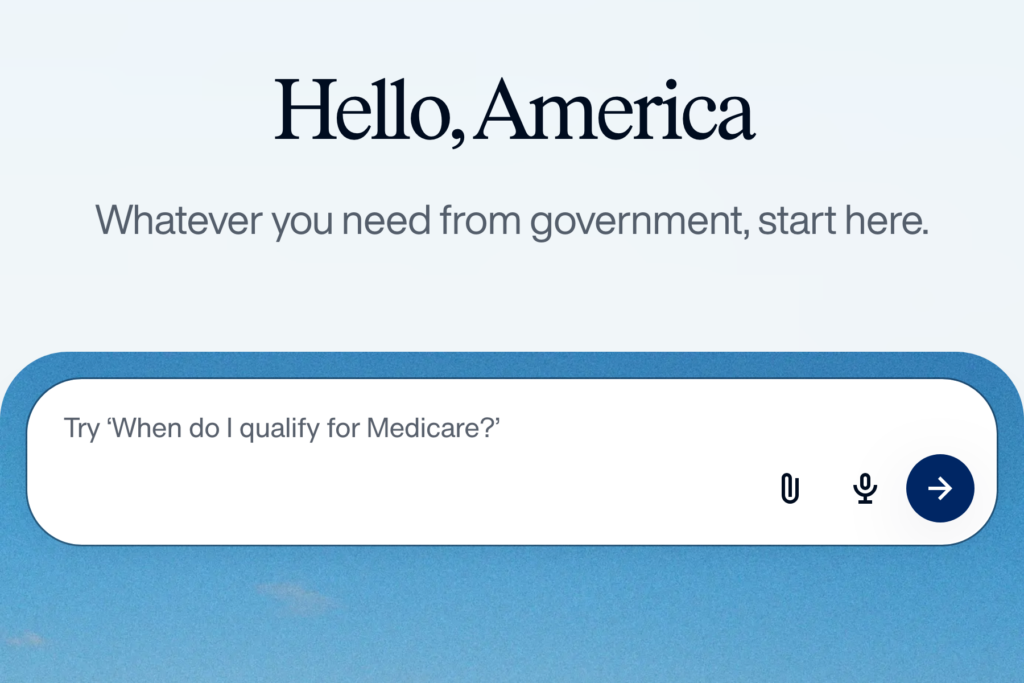
In the splashy rollout video of the Trump administration’s chatbot, Emily, a newly married woman, needs to register her new last name with a bunch of different agencies. America.gov, the official federal artificial intelligence app, leaps into action.
Officials envision the system as a secret weapon for arduous tasks, such as passport applications, enrolling in Medicare and applying for government jobs. Joe Gebbia, the Airbnb founder who oversees the project, calls it a “concierge.”
But actually talk to the bot and it will confess that reality has yet to catch up. “None of those tasks can be completed here today,” it said after being asked to help with a name change.
While the Trump administration has high hopes for America.gov, announced this week with the kind of fanfare usually reserved for highly anticipated Silicon Valley product launches, right now it’s only a basic information sharing service, pulling from thousands of official government sites.
Ed Forst, the head of the General Services Administration, one of the agencies responsible for the site, said the administration launched a bare-bones product to allow the public to ease into more complicated AI systems.
“People need to start with something simple to gain confidence and familiarity with it, and you kind of play with it,” Forst said in an interview. “Quite frankly, you don’t jump to the end game past that.”
Here’s a closer look at how the site works.
It often contradicts President Trump
Within an hour of the chatbot’s launch, people began posting screenshots to social media showing the bot contradicting the president about who won the 2020 election. The chatbot said correctly that Joe Biden won.
The bot will also answer questions about the Jan. 6 riot at the Capitol, describing a crowd forcing entry and assaulting police.
And asked about Trump’s recent claim that grocery prices have come down since he took office, the bot is clear: “Groceries have not fallen overall since January 2025.”
Those responses reflect how the system reaches its conclusions by drawing on federal data sources, like inflation measures maintained by the Labor Department.
And while the Trump administration has removed some data from its official sites and made changes on ideological grounds, many key statistics have continued to be published uninterrupted.
Forst said people should trust the answers they get from the chatbot.
“The data that’s going to be used is the government’s own information,” he said. “So we’re only using what we believe to be true source material because it’s government-provided. … That gives us a lot of confidence.”
But as the Trump administration continues to leave its mark on official government policy and websites, the chatbot may likewise change its tune.
Asked about the bot contradicting the president, a White House official said the site would “continue to be updated to provide Americans the most accurate and reliable federal information and resources.”
It knows a lot of government trivia
The chatbot is basically a version of ChatGPT that only cites official government sources. It is most useful today for surfacing obscure information from the depths of government websites. The system can draw on information from 29,000 government websites while answering questions.
Chatbots are an imperfect technology, though. The website carries a disclaimer that says users should verify information by visiting the websites it cited.
It doesn’t do politics
Like this writer at Thanksgiving, the bot attempts to avoid discussing politics at all costs. Most chatbots have a secret set of instructions that let their developers steer their behavior.
In The Washington Post’s testing, the America bot described having secret instructions but did not divulge their contents. The bot repeatedly said it does not provide political commentary.
The bot cannot fully avoid its knowledge of politics, though. When asked “Who does Lyin’ Ted represent,” the bot calmly responded “Senator Ted Cruz represents Texas.”
It cannot take actions like changing your last name (yet)
The most ambitious announcements from the release are absent from the chatbot’s capabilities. A video showed someone asking “How do I get my first passport?” The bot responded with a pair of questions before showing the user’s application was submitted and approved within seconds.
It’s hard to overstate how big a leap it is between a chatbot searching websites and a chatbot taking action for a user across bureaucratic agencies. Off-the-shelf technology for searching has been available for more than three years. The complexities of government forms, rules and special exceptions are endless.
The bot is currently aggressive about blocking users from giving it private information, like addresses, something that would have to change for it to provide personalized help. Type in a string of digits that looks like a Social Security number, for example, and the text turns red and flashes a message: “Remove personal information before sending.” The demos showed a separate site, login.gov, being used for identity checks, but it’s not yet clear how the two will work together.
The administration has promised that America.gov will eventually be able to handle complex requests, like helping Americans decide which Medicare plan they should choose.
Mehmet Oz, the administrator of the U.S. Centers for Medicare and Medicaid Services, acknowledged that such an application raises legal issues.
However, Oz said he thought that America.gov could be a more informative resource for Americans trying to decide what insurance plan to use than a commercial chatbot, which some people already use commercial models for.
“So the argument that I have been making to my team, and we have this battle a lot, is if we don’t do it, someone else is going to do a worse job,” Oz said. “So how do we do it safely? And the way to do it safely is to give as much transparency as possible.”
It is filled with Easter eggs
Multiple people involved in building the chatbot were formerly associated with the Department of Government Efficiency (DOGE), Elon Musk’s divisive effort to reduce government spending and cut the federal workforce. The National Design Studio’s chief engineer is Edward Coristine, the former DOGE staffer known as “Big Balls.”
Their fingerprints show up most clearly in a set of hidden jokes in the chatbot. Typing “hotdog” turns the chat bar into a hot dog. Typing “play minecraft” makes the bot recite a version of a poem from the video game. And yes, the chatbot reacts to the famous Konami code.
The post The government’s new chatbot won’t talk politics, but it will fact-check Trump appeared first on Washington Post.