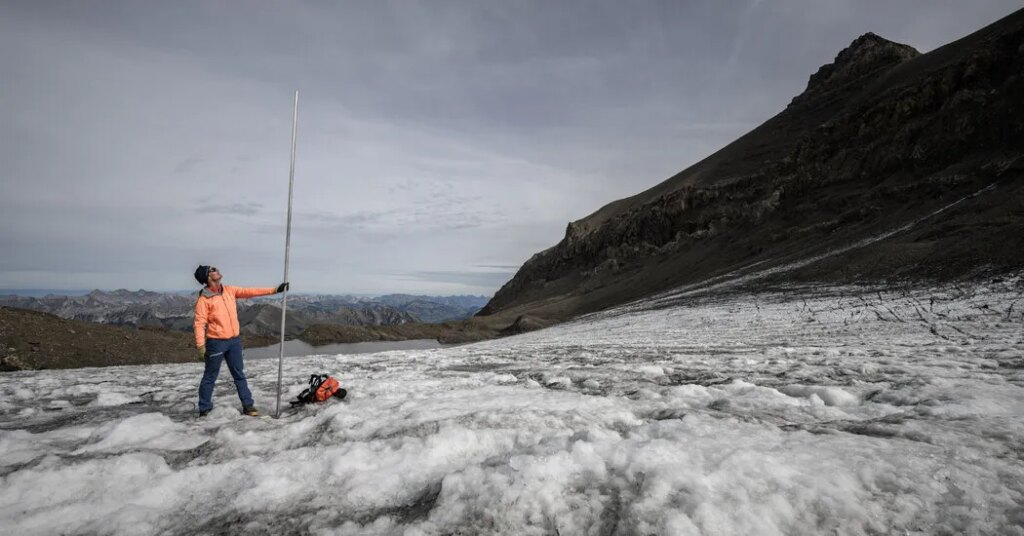
Glaciers in Switzerland have lost almost a fifth of their volume over the last five years, Swiss researchers said on Thursday, a stark reminder that Europe is the world’s fastest-warming continent.
More than five percent of Switzerland’s ice has disappeared in 2026 alone, the researchers said, as a winter with little snow was followed by a summer of broiling heat waves. Many small glaciers have fully disappeared already, they said.
“Alpine glaciers have no long-term chance of survival under such conditions,” the researchers said in a joint statement, by the Swiss Glacier Monitoring Network and by a Swiss body of scientists who document changes in the Alpine cryosphere.
Humans were to blame for the “staggering warming trend of the last years,” said Matthias Huss, who heads the glacier monitoring network.
“The global warming we are experiencing now can be attributed 100 percent to anthropogenic climate change,” Dr. Huss wrote in an email. “It’s as simple as that.”
By the numbers
The researchers in Switzerland shared sobering statistics.
-
In 2026, the average ice thickness of individual glaciers decreased by up to four meters, or about 12 feet.
-
Glacier tongues — narrow parts that stretch into a body of water — receded. This summer, some were reduced by up to 10 meters, about 30 feet.
-
Between July and September, Switzerland’s glaciers lost around 2.2 trillion liters of water, or 2.42 billion U.S. tons. That is four times the annual drinking water consumption of all Swiss households, the researchers said.
Enormous consequences
The glacier loss was a warning, said Bethan Davies, a professor of glaciology at Newcastle University in England.
“The Swiss glaciers are characteristic of mounting glacier losses in many regions,” said Professor Davies, who was not involved in the Swiss monitoring effort.
That’s a problem for glaciers — and people who live near them.
Sudden hazards are growing as glaciers shrink, snow melts, and permafrost thaws, she said. That has been destabilized mountainsides and caused disasters, including in Switzerland, where a landslide, set off when part of a glacier broke apart, caused widespread damage to a small village last year. More recently, Professor Davies pointed to the catastrophic flooding last month in Nepal, where an enormous break in a glacier set off a deadly cascade.
There are far-reaching, slower consequences, too.
Melting glaciers contribute to rising sea levels, she said. As glaciers shrink, they expose darker rocks below that reflect less of sunlight. Changing mountain ecosystems push people who cannot adapt to leave so they can build lives elsewhere.
But humans cannot stop glacier melt without addressing the bigger issues, Professor Davies said. “The only effective way to minimize loss is by reducing carbon emissions and curbing global heating,” she said.
Europe’s climate crisis
The climate crisis is causing catastrophes across the world. But no continent is warming faster than Europe. This summer, temperatures shattered meteorological records in several countries that endured fires, heat waves and storms.
-
The Arctic: The top of the world is warming several times faster than the rest of the globe. That is narrowing the temperature gap between the Equator and the North Pole. As a result, the jet stream, the belt of strong westerly winds that steers the weather, could be shifting in ways that make for longer summer heat waves in Europe.
-
Cleaner air: Maybe surprisingly, the efforts European countries have made to curb industrial emissions have knock-on effects. There are now fewer aerosols, which are light-colored particles in the air, that can bounce solar radiation back into space.
-
Less snow: This is similar to cleaner air — less snow means the ground is less able to deflect the sun’s energy.
Dr. Huss, the head of the Swiss glacier monitoring network, said that glaciers were important to raise the alarm about rising temperatures. The disappearance of their “eternal” ice makes it obvious the climate has shifted, he noted.
“Glaciers are the ambassadors of climate change,” he said. “They speak a very clear and simple language.”
He added: “This is a desperately needed warning sign.”
Raymond Zhong contributed reporting.
The post Swiss Glaciers Vanished by Nearly a Fifth in Recent Years, Scientists Say appeared first on New York Times.