The Senate adjourned Wednesday for the last time before the midterm elections after Democrats blocked Republicans’ last-ditch push to pass more legislation.
Several Republicans facing tough races in November took to the Senate floor to make the case for passing bills they could run on. But Democrats blocked them, leaving Republicans to head home to face voters without fresh legislative victories.
Republicans are confronting the once-unthinkable prospect that they could lose the Senate as polls show Democrats running competitively in states that President Donald Trump won by double-digit margins in 2024. Senate Minority Leader Chuck Schumer (D-New York) boasted Wednesday that Democrats are “on the edge of taking back the Senate.”
“We Dems have the wind in our sails heading into October and the final stretch,” Schumer said.
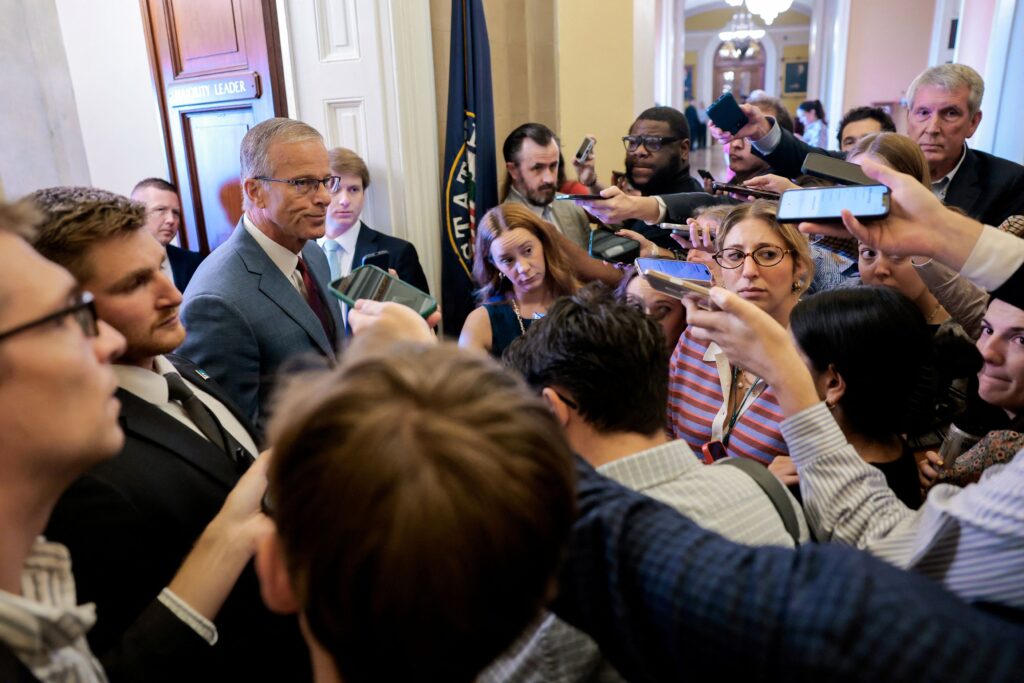
Senate Majority Leader John Thune (R-South Dakota) has accused Democrats of obstructing his party’s agenda and trying to deny Republicans victories ahead of the midterm elections.
All but four Democrats opposed a bill from Sen. Jon Husted (R-Ohio) meant to protect consumers from high electricity costs caused in part by the boom in construction of data centers. Husted is facing a tough race against former Democratic senator Sherrod Brown, who has spent millions of dollars on ads attacking him over his support for data centers.
Husted blamed Schumer for blocking a bipartisan bill that passed the House overwhelmingly two weeks ago.
“This is completely a Chuck Schumer play, trying to prevent us from actually accomplishing something on affordability,” Husted told reporters.
Democrats countered that Husted’s bill would do little to make electricity more affordable because it would not force data centers to pay for upgrades to the grid.
The Senate also rejected a bill from Sen. Pete Ricketts (R-Nebraska) to bar lawmakers from buying stock and mandate that voters show photo identification. It failed on a party-line procedural vote. Ricketts is facing a competitive race against independent candidate Dan Osborn in a state that Trump won by 21 points.
Democrats argue Ricketts’s bill does not go far enough to prevent insider trading and objected to the photo identification provision they said would disenfranchise voters.
Sen. Jeff Merkley (D-Oregon) sought Wednesday to pass a different bill that would ban the president, the vice president and members of Congress from buying, selling or owning individual stocks. That bill was blocked by Sen. James Lankford (R-Oklahoma).
Another Republican incumbent in danger of losing in November, Sen. Dan Sullivan (Alaska), tried Wednesday to pass a bill to protect oil and gas development in northern Alaska, warning that Democrats would hurt his state if they regained control of Congress.
“One of their core principles is to come up to the great state of Alaska and try to shut it down, kill thousands of jobs, try to turn this great state — my state — into a national park,” Sullivan said on the Senate floor.
Sen. Martin Heinrich (D-New Mexico) blocked the legislation, describing it as “another bill that would prioritize oil and gas over literally everything else.”
The Senate adjourned late Wednesday night after voting along party lines to confirm Keith Sonderling as labor secretary. Sonderling had served as acting labor secretary since Labor Secretary Lori Chavez-DeRemer resigned in April.
The chamber is not scheduled to return to Washington until after the midterms. Democrats need to pick up four seats to retake the Senate, including at least two in states that Trump won by double digits such as Ohio and Alaska.
Republicans are running on earlier achievements, including the tax and domestic policy bill that Trump signed into law last year, which cut taxes on tips and overtime. Still, some Senate Republicans have pushed for months for leadership to take up more legislation to address voters’ concerns about the cost of living.
Sen. Susan Collins (R-Maine), who is facing a tough reelection race, said Wednesday she would still press for a vote on a bipartisan bill to force insurers to cap the cost of insulin at $35 but acknowledged it would probably need to wait until after Election Day. Troy Jackson, the Democrat challenging Collins, has led her in most polls, although a New York Times/Portland Press Herald/Siena poll conducted earlier this month found Collins with a narrow lead.
Collins pointed instead to another accomplishment: a bill she authored to fight tick-borne disease that Trump signed into law Wednesday.
“Ticks are a major problem in the state of Maine,” Collins told reporters. “We’ve had a huge increase in the number of cases of Lyme disease.”
Sen. John Kennedy (R-Louisiana), who has pushed to take up the insulin bill and other legislation focused on the cost of living, lamented that the Senate would not have the chance to pass them until after the midterms, which he blamed on “bad planning.”
“When you push everything to the last minute, you generally run out of time,” Kennedy told reporters.
The Senate also did not vote on legislation to overturn environmental regulations that Republicans argue are driving up costs. Kennedy warned Monday on the Senate floor that failing to vote on the bills before leaving town would be “legislative malpractice.”
“All of us have been out there talking about the cost of living and how we need to get it down,” Kennedy said. “Well, here’s a chance. All we’ve got to do is vote. We ought to stay here until we vote.”
Wednesday capped a sometimes-frustrating three-week stretch for Senate Republicans following their summer recess. Democrats defeated a cryptocurrency regulation bill on a procedural vote that the two parties had spent months negotiating. The Senate also did not take up legislation to regulate artificial intelligence despite attempts by senators in both parties.
Republicans spent much of the past two weeks working to pass a bill from Sens. Ted Cruz (R-Texas) and Maria Cantwell (D-Washington) to overhaul regulation of college sports. It cleared the Senate on Monday. But some Republicans groused that the bill was hardly the most urgent priority barely a month ahead of the midterms. Cruz urged the House — which left Washington earlier this month — to come back to pass the bill, but it is not expected to return.
Four senators — Shelley Moore Capito (R-West Virginia), Mike Lee (R-Utah), Sheldon Whitehouse (D-Rhode Island) and Heinrich — also announced Wednesday that they had reached a deal on legislation overhauling federal permitting after months of negotiations.
The bill would make it easier to build power lines and other projects, which the senators argue will bring down the cost of electricity. But the Senate will not take it up until the “lame-duck” period after Election Day.
Capito said she was confident that Congress would vote on the legislation no matter the election results.
“We were sent here to do big things,” Capito said. “Sometimes big things can happen in the lame-duck. And so we’re banking on it.”
The post Senate leaves town until after the midterms as final bills founder appeared first on Washington Post.