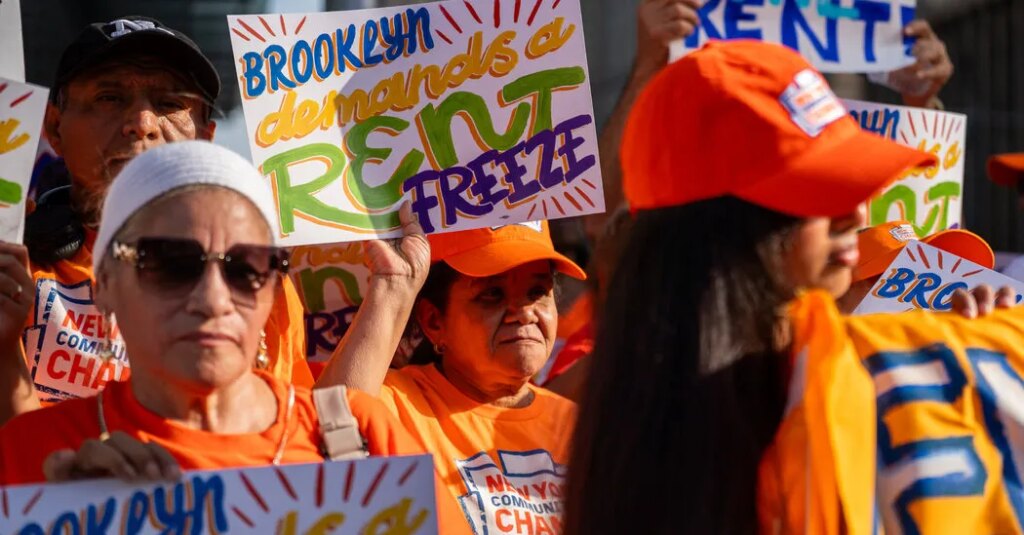
A “rent freeze” on nearly one million rent-stabilized apartments in New York City went into effect on Thursday, prompting cries of victory from tenant advocates. At the same time, a group of landlords seeking to overturn the freeze made public dozens of pages of internal communications between city officials and members of the panel that approved it, claiming they showed improper efforts to influence an independent process.
The city turned over the documents as part of a lawsuit arguing that the administration of Mayor Zohran Mamdani pressured the panel, the Rent Guidelines Board, to prioritize tenants’ concerns and disregard landlords’ financial challenges in its decision-making.
The communications made public on Thursday are mostly mundane exchanges about the logistics of when and where to hold public meetings and make announcements, and the schedules of board members and the organizations and people invited to testify before the board. They do not show Mr. Mamdani or a member of his team explicitly directing members of the board to approve a rent freeze.
Still, they provide a rarely seen view of the board’s process, which is typically opaque. And lawyers for the landlords claimed that the documents showed “coordination and collaboration” between the city and the board — enough for the court to invalidate the policy.
At an unrelated news conference on Thursday, Mr. Mamdani said he was confident in the board’s “independent decision,” adding that it had been made “on the basis of all the information that they had in front of them.”
It is unclear when the judge in the case, Brendan T. Lantry of State Supreme Court in Manhattan, will make a decision. Any leases starting on or after Thursday will be subject to the freeze, at least until he issues a ruling.
If Justice Lantry sides with the landlords, the freeze will be nullified and will not apply to lease terms that begin after the ruling. And the board will have to start its process over again, which could result in members’ approving rent increases rather than a freeze, imperiling one of Mr. Mamdani’s key campaign promises.
The nine members of the Rent Guidelines Board are appointed by the mayor, and often align with the ideology and priorities of City Hall. But in deciding each year whether and how much rents should go up in rent-stabilized housing, they are supposed to consider a voluminous amount of data, taking into account the economic pressures facing the real estate industry as well as renters.
During the mayoral campaign, Mr. Mamdani promised to “freeze the rent,” drawing complaints that he was trying to inappropriately influence the board’s process. Earlier this year, he appointed a majority of members to the board, and in June, the board delivered a freeze on both one-year and two-year leases for the first time in city history.
Within weeks, landlords filed their lawsuit. In a rare step last month, Justice Lantry sided with the landlords in their request that the city turn over communications between City Hall officials and members of the board.
“The question naturally arises: How would the mayor comply with his ‘guarantee’ to the voters to ‘freeze the rent’ unless he, or his staff, communicated with the board to ensure that the board refrained from imposing any rental increase?” Justice Lantry wrote in his Sept. 16 order.
It is not illegal for the mayor’s office to communicate with members of the board, and mayors commonly appoint members who are likely to be sympathetic to their priorities. But landlords claim that given Mr. Mamdani’s clear stance on the issue, the outcome of this year’s vote was “predetermined.”
“The City has now produced documents from no less than eight different top City Hall officials who communicated directly with R.G.B. members and staff during the first six months of this year,” Randy Mastro, a lawyer representing landlords and a critic of the mayor, wrote in a letter to the court on Thursday. He asked the judge to schedule a hearing to allow the landlords’ lawyers to question city officials and board members.
In a letter filed with the court on Tuesday, Steven Banks, the city’s top lawyer, said that the communications showed that the board acted “with the utmost honesty, integrity and independence, reflecting a genuine desire of the board members to serve the public and meaningfully participate in this quasi-legislative process.”
Mr. Mamdani on Thursday also cited reporting by the news publication Gothamist indicating that Randy Mastro, a lawyer representing the landlords, had himself tried to influence the board last year when he was first deputy mayor under Eric Adams.
In a statement, Mr. Mastro acknowledged that he had communicated with the board’s chairman at the time, but said he had merely conveyed Mr. Adams’s disagreement with the board’s anticipated decision shortly before its vote. Mr. Mastro said there was “a world of difference” between his efforts and “orchestrating a sham process with a preordained outcome to do exactly what the mayor dictated and promised in his campaign.”
Vicki Been, a former deputy mayor for housing and economic development under Mayor Bill de Blasio who is not involved in the lawsuit, said it was typical for City Hall to be in touch with the board about logistical matters.
Asked about the communications revealed on Thursday, Ms. Been said, “I don’t see anything concerning.”
According to the documents, at least one City Hall staff member was in regular contact with the board’s chairwoman.
They include a March text message exchange between the chairwoman, Chantella Mitchell, and Arvind Sindhwani, a deputy chief of staff under the deputy mayor of housing and planning, in which Ms. Mitchell agrees to push back the date of a preliminary vote on rent increases to May 7 from April 30.
Another exchange between Mr. Sindhwani and Ms. Mitchell took place in April, a few days before a hearing where the board was set to discuss research about how much costs had gone up for landlords.
Mr. Sindhwani said that he had “notes” related to the subject matter, and asked Ms. Mitchell to set up a call to discuss them. “Please take a look before we chat,” Mr. Sindhwani wrote.
It is not clear what the two discussed.
The communications also show that Ms. Mitchell agreed to share with Mr. Sindhwani a list of groups invited to testify before the board.
And they show that the mayor’s staff, including Cea Weaver, the director of his Office to Protect Tenants, and Leila Bozorg, the deputy mayor for housing and planning, set up meetings with board members before and after their appointments, though no details were included about what transpired during those meetings.
The only messages included in the documents from Mr. Mamdani himself are a brief exchange in which he shared his cellphone number with one of his appointees to the board, Brandon Mancilla, on Feb. 10, days before Mr. Mancilla’s appointment was made public.
Mr. Mancilla then asked if he should call the mayor.
“No need my man but thank you! Hope you’re well,” Mr. Mamdani replied.
Sally Goldenberg contributed reporting.
The post Landlords Release Emails and Texts in Lawsuit Over Mamdani’s Rent Freeze appeared first on New York Times.