When I say that “Lady” goes in unexpected directions, I am not exaggerating. I described the plot briefly to a friend, who looked at me as if I might have sustained a concussion, and hastened to explain that it all somehow worked while I was watching it. It was even poignant. But it’s definitely weird.
Credit goes to the writer and director Samuel Abrahams for pulling it off in his first feature film. Shot in a mockumentary style, “Lady” starts with stark, luridly colored shots of a woman in pink pants, a purple shirt and long green gloves lying motionless in places that suggest an accident, or foul play: facedown in a bed of roses, headfirst down a flight of stairs. They look a little like a photo Gregory Crewdson might shoot, if he suddenly grew a fondness for the garish.
But we’re soon in a car headed down a country lane. A hand-held camera is trained on a youngish filmmaker named Sam (Laurie Kynaston), who is talking to whoever’s behind the camera, explaining that he has no idea what to expect when they arrive. “I like the mystery of it, though; like what is it, and who,” he says. “There’s barely any info on her.”
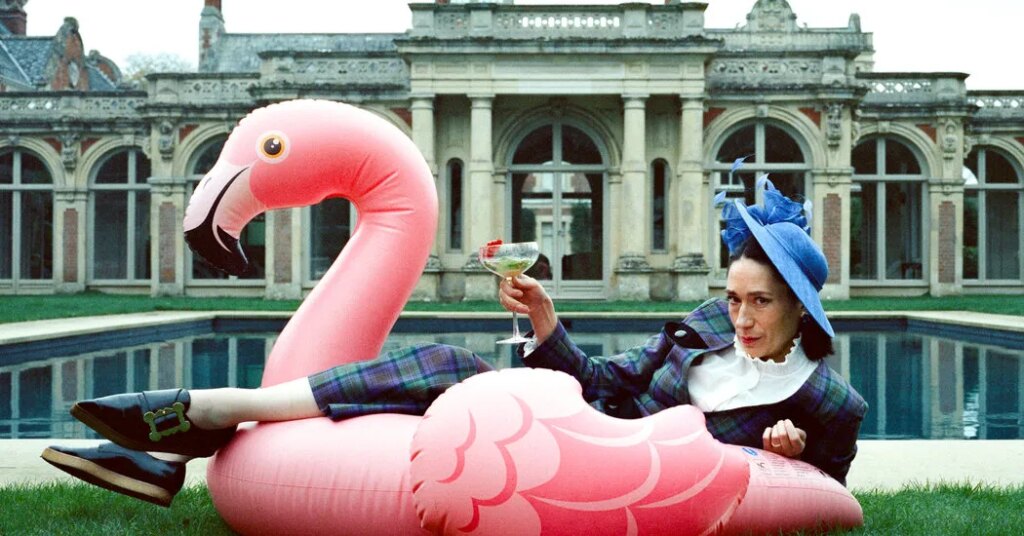
The “her” is Lady Isabella (Sian Clifford, who is marvelous), the mistress of Ravenhyde Hall, a rambling country estate that has, among other things, 26 bedrooms and a taxidermy collection because, as she tells Sam, “We’re big animal lovers here.” Who else belongs to that “we” is unclear, as the house seems empty other than Lady Isabella and her housekeeper, Becky (Juliet Cowan).
Sam is under the impression he’s been sent here to make a TV show about Lady Isabella, who tells him, “Everyone’s saying I’m the aristocracy’s answer to the Kardashians.” But she seems to have designs on Sam, too. She tells him that she’d like the crew to document the talent show for the community that Ravenhyde Hall hosts every year — called “Stately Stars” — which she intends to enter and win, despite the rest of the entrants being children. It doesn’t take long for Sam to realize that this woman is off her rocker. When the truth comes out about why he is there, things start to get really, really strange.
I’ll stop there so you can enjoy the mad pivot. A good mockumentary has to stick to its conceit, explaining why the camera crew is present and suggesting how they are seeing everything that we’re seeing. Sometimes mockumentaries don’t pull this off, showing us intimate moments that the cameras wouldn’t have captured, but “Lady” sticks to the bit, and it’s better for it. There are mysteries aplenty, and seemingly around every corner some bizarre object that Lady Isabella waves away when questioned.
“Lady” is clearly meant to skewer the daffy, delusional eccentricities of the fading aristocracy, evoking “Grey Gardens” and “Sunset Boulevard” but through a distinctly British lens. But it’s equally interested in poking fun at self-serious filmmakers — Abrahams names his director after himself, after all, and imbues him with pretensions and anxieties that suggest knowing this character from the inside.
And “Lady” also has something to say about the fear of disappearing, of being nothing, of nobody ever wanting to look at you or your work. This is what Isabella and Sam have in common, though it takes them a while to figure it out. Correctly, the film understands that for many of us, cameras are the way we prove to ourselves that we exist and matter. Not everyone has a camera crew following them around, but many of us document our lives as if we’re interesting. We struggle to leave social media platforms because we feel, in some way, like we might disappear if we do.
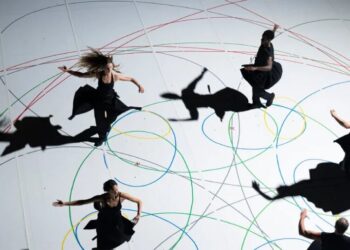
All of this is accomplished with a riotous and wicked sense of humor, and whenever the story starts to stray too far into sentimental territory, Abrahams reins it back in with a jab at the characters. You can never get too maudlin about a character like Lady Isabella, who declares that “the universe is gifting me the kind of unspeakable suffering which can make an artist transcendent!” and then compares herself to van Gogh and Frida Kahlo (who was afflicted with “her monobrow”). The cinematographer Korsshan Schlauer credibly mimics the footage that a crew would capture, as well as creating surreal images of Isabella’s performance art, inserted occasionally between scenes.
And most of all there’s Clifford, who’s likely best known for her work on “Fleabag,” but manages here to be magnetic, repulsive and sympathetic all at once, playing a woman driven equally by her own despair and ego. Clifford has a gift for cringe comedy, and she filters it through a woman with no self-awareness but somehow a deep well of emotion, too. By the end of “Lady,” we might not love Lady Isabella. But we understand her. And if we’re brave enough to turn our gaze on ourselves, we might see that she’s not all that unusual, after all.
Lady Not rated. Running time: 1 hour 37 minutes. In theaters.
The post ‘Lady’ Review: The Grande Dame and the Director appeared first on New York Times.