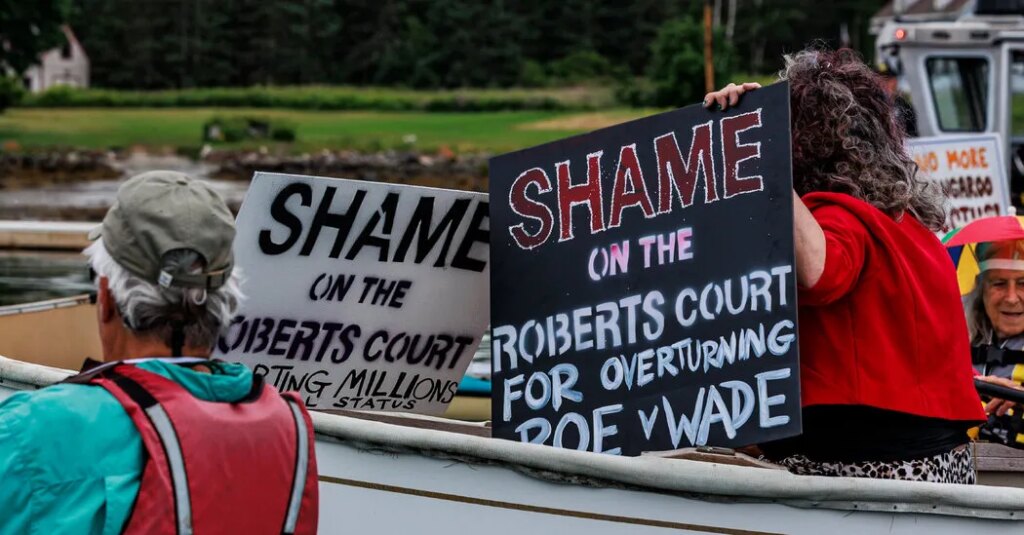
To many people on this remote stretch of Maine coastline, where every day looks like a fresh painting made of light and water, Chief Justice John G. Roberts Jr. is just “John.”
John, who has spent over 20 summers on Hupper Island, a refuge about 90 miles northeast of Portland with no cars and barely two dozen homes. John, who swaps favors with neighbors and endures jokes about his boating skills from more experienced operators. John, who has spent many mornings on the dock in Port Clyde, the postage-stamp-sized town across the water from the island, nursing a half-caff and a cinnamon bun.
For a long time, the chief justice’s life here was a story of potluck dinners and easy friendships, according to a summer of interviews with more than two dozen residents. Neighbors reveled in his position but kept exchanges with him about it brief or light. At a long-ago annual summer party, he used to participate in touch football, then call dinner to order by proclaiming: “Oyez, oyez, oyez, the lobsters are ready.”
But in recent years, as the Supreme Court has reshaped American life and handed more power to President Trump, a very personal form of anger has been rising here at the chief justice, transforming his getaways.
His summer retreats, long a well-known fact, are now a source of debate. Neighbors have taken to the water to protest him. Calling themselves “kayak-tivists,” they form flotillas facing his island home, holding waterproof signs conveying their disappointment. A local newspaper columnist recommended that people in town give him the finger.
Even some longtime friends who would not dream of joining the kayakers said they have been drawing back socially because of their distress over his decisions, notably the court’s 2024 decision granting the president broad immunity from prosecution.
He is now ringed by far more security than in the past, residents say, adding to the distance.
The chief justice’s narrowing world in Maine shows how the court’s controversial decisions and languishing public trust, along with increasing peril for public officials, have reshaped the lives of the justices, leaving them more isolated than ever before.
In Washington and beyond, ever-present security threats as well as protests are separating and shielding the justices from the people whose lives will be affected by their decisions. They are less likely to spontaneously interact with people who disagree with their work, and their exposure to the texture and mess of everyday life is diminishing. Being just John, even here, has grown much harder.
“From what I see, the barrier runs both ways,” said Mary Anne Mason, a friend and former law partner of the chief justice who lives in Port Clyde. “It’s harder for him to feel comfortable approaching people — and vice versa.”
The protests have split Port Clyde and the nearby villages on this peninsula, as people here have debated how best to convey displeasure with a justice, if at all. Is it better to ensure their famous neighbor hears from those who disagree or to leave him alone, because his job is to be impervious to pressure?
For the demonstrators, the hour is too dire, the threat to democracy too serious for niceties. They argue that citizens have no other way to hold justices, with their lifetime appointments, accountable.
“Maine is not here as your happy place, your wind-down from all of your hard work destroying my civil liberties and democracy,” wrote Becca Shaw Glaser in her column for the local newspaper, shortly after the Supreme Court eliminated the federal right to abortion in 2022. “No. May you never feel welcome here again.”
But others argue that disturbing the chief justice and his family at home is invasive, scary, and out of line with Maine’s tradition of maintaining respectful distance. They also worry such actions could be counterproductive, alienating the justice.
“John is a credit to the community and an asset to all of us whether you agree with him or not,” Kevin Lipson, his closest friend and chief defender here, wrote as neighbors debated the protests on Facebook. “Civility should be our guiding principle.”
The chief justice used to preside over a Supreme Court whose members were afforded more privacy and freedom than many other public officials. Once, years ago, Mr. Lipson and the chief justice found themselves up the peninsula from Port Clyde without a car, Mr. Lipson recalled in an interview. So he stuck out his thumb by the side of the road and a pickup truck pulled over. He and the nation’s top jurist hopped in the back and hitchhiked back to town.
Now, Mr. Lipson said, he is cautious about introducing his friend to strangers. This year, on an outing to nearby Monhegan Island, people recognized the chief justice as he walked by a brewery and started to chant: You should be ashamed.
Pride and Deference
Chief Justice Roberts purchased his gray-shingled waterside home on Hupper Island in 2006, the year after he ascended to the court. He generally does not give interviews about the law, let alone his vacation plans, and declined to provide comment for this article.
But the location of his retreat clearly says, Get Me Away From Washington. An hour and a half north of Portland, out on a green, rock-ringed finger of land jutting into the sea, lies the town of Port Clyde. Across the water is the island, accessible only by private boat. There is no ferry or bridge.
The spot is secluded, but also a place where the nation’s highest judge, his wife and their two children could become part of a tight-knit community where people live and vacation for generations. Each year during the court’s break, from early July to the start of October, the chief justice could enter a different world. His circle included well-heeled “summah people” like him, but also year-rounders like lobstermen and a local kayak outfitter, Democrats and Republicans alike.
Hupper Island has no municipal trash pickup, and friends remember the chief justice jumping up from a dockside chat and exclaiming in a panicked tone: “I’ve got to get to the dump!”
Mr. Lipson, a former law partner of the chief justice who has been vacationing in the area for 40 years, introduced him to the island and made a project of settling him in. Mr. Lipson located the Roberts home, negotiated the deal, assigned him the lobster-dinner-announcement shtick, and integrated the Roberts family into what he described as an unusually cohesive place.
“This is a community where people actually rely on each other,” Mr. Lipson said. “You live on the ocean. Things happen on the water. Sometimes your boat breaks down. Sometimes you need assistance. This is the kind of community where you can depend upon your neighbors.”
Plenty of news stories documented the court leader’s presence, and local pride in him was so great that the boat service to another local island started pointing out his house to passengers. (Friends requested the announcements end.) At fund-raisers, yard sales and parties, “a chat or a seat near the justice was a social chit,” said Joline Godfrey, a financial educator who lives a few miles up the road.
But there was also an unspoken deference, a rule against initiating conversation with him about the court, numerous residents said in interviews. If a stranger asked what he did for work, his standard response was to say he was a judge, without elaborating.
Residents had strong reactions to some of his decisions, from dismantling campaign spending limits to saving President Barack Obama’s health care plan, but saw him overall as “a defender of the Constitution, a trustworthy, reasonable man,” she said.
In person, the chief justice came across to his summer friends as affable, very conservative and confident in his views. With double Harvard degrees, and days spent in hushed chambers, he struck them as a little removed from real life, but also eager to connect.
During the pandemic, when the summer crowd gathered on Zoom, John and Jane Roberts appeared in a little box onscreen, just like everyone else.
‘Yell, Boo, Whisper’
The first visible crack between the chief justice and his Maine community came soon after the abortion decision, with the publication of Ms. Shaw Glaser’s column in the now-defunct Free Press in 2022. “We Need to Talk about Chief Justice John Roberts Blissfully Summering Off Port Clyde,” read the headline.
Ms. Shaw Glaser had spent most of her life in midcoast Maine, living year-round in Port Clyde as a child and as an adult in nearby Rockport, where she was a professional gardener and activist and then a newspaper columnist as well.
She wrote that she could no longer bear watching her state welcome a jurist who had gutted the Voting Rights Act, voted against declaring a constitutional right to same-sex marriage, and just that summer, had overseen Dobbs v. Jackson Women’s Health Organization, which eliminated the federal right to abortion. She called her neighbors to action.
“Should you see Chief Justice John Roberts duck into Squid Ink coffee or the Port Clyde General Store this summer, consider letting him know exactly what you think of him and his illegitimate, ultraconservative court,” she wrote. “Yell, boo, whisper, weep audibly, give him the thumbs down or the finger, hand him a note, refuse to serve him.”
She urged residents to speak with the chief justice, but also to organize boat protests in front of his home. “He might see you,” she wrote.
The chief justice’s position in the Dobbs case had in fact been nuanced: He had taken a lonely, losing stand in favor of keeping the constitutional right to abortions before 15 weeks. But he had voted with the majority, he was the court’s leader, and Ms. Shaw Glaser saw him as responsible for its decisions. Plus he was right there in the community.
In letters to the editor, some cheered Ms. Shaw Glaser, but many said she had gone too far.
“Our children and grandchildren will learn nothing from this type of printed vitriol other than a complete disrespect for public servants at any level,” wrote one person.
“I believe she is inciting violence,” wrote another, adding: “If people go out and destroy Chief Justice Roberts’s home or property, it’ll be on you.”
Ms. Shaw Glaser was soon fired from her columnist gig, and the newspaper published an apology to the chief justice. Her attempt at rousing others looked like a bust.
But then, others slowly started to follow her instructions.
The newspaper received a new round of infuriated letters, this time expressing anger over how Ms. Shaw Glaser had been treated. Bumper stickers started to pop up on cars all over the peninsula opposing the abortion decision: “Roe, Roe, Roe Your Vote,” they read.
Two years later, the court awarded Mr. Trump sweeping immunity from prosecution for actions he took in his official role ahead of the Jan. 6, 2021, storming of the Capitol. The chief wrote the majority opinion. As Mr. Trump was re-elected and pushed constitutional boundaries, the court approved many of his policies, decisions that were technically temporary but allowed him to reshape the federal government.
No one on the outside knew the chief justice’s actual voting record, because many of those cases were handled on the secretive emergency or “shadow” docket, in which the court publishes orders without vote counts and sometimes without reasoning. But he had long favored expanding presidential power. Maine had voted twice against Mr. Trump. Now many of the chief justice’s neighbors felt he was maddeningly hesitant about confronting the president or defending the rule of law.
A Dockside Encounter
The waterborne protests began last year and have now become regular parts of the landscape. Twice each summer, two rows of demonstrators face his island home. The first group sits on kayaks, linking oars, just a few hundred yards from his house. Behind them, others stand on the Port Clyde dock.
The number of participants, on land and sea, has never been more than a few dozen. But their message has spread throughout the peninsula and beyond. A local artist started making and displaying cardboard sculptures of kangaroos, as in “kangaroo court,” and named them after the conservative justices. Signs have proliferated, including on major roads, where the chief justice seems sure to see them.
“Roberts Benched the Constitution,” reads one popular one.
“Mainers Against the Roberts Agenda,” reads another.
One day in September last year, residents of Port Clyde woke up to an instant piece of graphic art. Across an intersection leading into town, someone had chalked in bold, bright letters “Equal Justice Under Law,” the same words carved into the Supreme Court’s facade.
The chief justice did not respond. As a lawyer, he had been regarded as one of the most talented courtroom advocates of his generation, with a gift for explaining concepts simply. He still has flawless aim with toasts and eulogies, winning over room after room, friends say.
But as the court’s leader, he has gained a reputation for silence, declining to give interviews, delivering few public remarks and preferring for the most part to speak through his written opinions. To those incensed with his rulings, he has appeared distant and aloof.
But the protesters did encounter another member of his household. After an August 2025 protest, Ms. Shaw Glaser and other demonstrators were standing near the Port Clyde dock when a young woman approached them with a serious look on her face. She asked them: What did they hope to accomplish? Had they considered how their actions affected the chief justice’s wife and children?
Only then did she identify herself. She said she was Josephine Roberts, the chief’s daughter, then 25, according to Ms. Shaw Glaser, who wrote about it in her journal. Another protester also wrote about the scene in a message to a friend afterward.
Her father wasn’t even home, Ms. Roberts told them. He respected that she had her own left-leaning political views, she said, according to the protesters’ written accounts. And he was a wonderful father, she added.
Ms. Roberts did not respond to The New York Times’s inquiries about the encounter. That night, when Ms. Shaw Glaser wrote about it in her journal, she noted she was still horrified by the court’s decisions.
But, she wrote, “I am now left with this feeling of empathy for her as a person.”
The Cigar Club and the Picnic
In May, at the start of the summer season, Jane Roberts sent an email to fellow members of the Port Clyde Cigar Club, a loose social organization. “Look forward to seeing you all this summer,” she wrote.
But all season, the state pulsed with controversy, over a U.S. Senate race and the July killing of a 25-year-old Colombian delivery driver by immigration agents just south of Portland. The Supreme Court’s approval rating dropped to a historic low of 33 percent in a Gallup poll. More anti-Roberts signs sprang up. The activists added small weekly vigils to their monthly protests. Local factions supporting and opposing the protests dueled in person and on social media.
At a July protest on the Port Clyde dock, Mr. Lipson, the chief justice’s close friend, approached Ellen Koches, a retired museum educator from Washington, Maine, who was mounting a sign along the railing showing the American flag imprinted with some of the court’s most conservative decisions.
“I’m going to take a picture of your license plate, look up where you live, and stand in front of your house and protest,” Mr. Lipson said, according to both he and Ms. Koches.
“Is that a threat?” she responded.
“It’s a promise,” he replied.
The law seemed unlikely to settle their dispute. A federal statute prohibits picketing outside judges’ homes, but few people have been prosecuted. Timothy Zick, an expert on the subject at William & Mary Law School, said that a water protest facing a justice’s home was a novel question, and that he was stumped by how the rules might apply.
Longtime neighbors and friends said the chief justice drew back. With rising violent threats against public officials, including a 2022 attempt on Justice Brett Kavanaugh’s life, security has been tightened. The chief justice took walks and briefly dropped in on a concert this summer, but his detail stayed close around him. On Sundays after church, he used to hang out on the dock. Now, with the protesters, he stayed away all day.
The shift has been “hard to watch,” said Tamara Cody, the owner of Port Clyde Kayaks and a longtime friend of the chief justice’s.
The chief justice and his wife did attend cigar club gatherings, friends said, but some former members said in interviews that they sent their own regrets, in part because they were not interested in socializing with the Roberts.
He was also busy. In contrast with his early years in Maine, the court was no longer really on vacation over the summer. The justices issued emergency orders on several Trump administration policies, standing up to Mr. Trump on some issues, including nixing his attempt to change mail-in ballot rules. In August, the chief justice made a strong statement against the president’s renovation of the White House ballroom, writing a rare, passionate dissent against the court’s decision to let it go ahead.
One event that the chief justice did attend was the annual Hupper Island Independence Day picnic. On July 4, he gathered with 60 or so neighbors on a lawn overlooking the water to hear a patriotic benediction from a rabbi, a reading of the entire Declaration of Independence and a performance of “God Bless America.”
Wendy Schlotterbeck, a neighbor who had been summering on Hupper Island since the days when it had no docks or electricity, grew upset at the sight of the chief justice’s celebrating. He and his colleagues had just narrowed protections for trans athletes and minors and allowed Mr. Trump’s immigration crackdown to proceed. Three of Ms. Schlotterbeck’s relatives were transgender. Immigrant friends of hers had been arrested.
She fantasized about having a real conversation with the court’s leader, looking into his eyes. “Do you realize what your decisions are doing to my family and my community?” she wanted to ask.
Instead, she left the picnic. The next morning, she protested her neighbor for the first time, grabbing a sign that said “Justice for All” and paddling back and forth in front of his home, hoping he would see.
Julie Tate contributed research.
The post John Roberts and His Island appeared first on New York Times.