The Hong Kong police detained an independent journalist on “suspicion of incitement by spreading disinformation,” according to the local media. It was the first known case of a member of the press being arrested for sedition under a 2024 security law, a watchdog group said.
Local newspapers identified the journalist as Tang Ho-wing, who was covering a gathering marking the anniversary of a 2019 crackdown on protesters. Mr. Tang founded Boom News, an online outlet that publishes on-the-ground reports and broadcasts interviews on social media.
Boom had previously been targeted as part of Hong Kong’s crackdown on the press, and was one of at least six outlets that had been subject to random tax audits in the last three years, according to Reporters Without Borders.
According to the Hong Kong Journalists Association, Mr. Tang’s detention was the first time a journalist had been arrested for sedition under Hong Kong’s 2024 security law. Reporters Without Borders said Mr. Tang’s case “is yet another demonstration of how national security proceedings are weaponized to silence independent news professionals in Hong Kong.”
Sedition offenses could carry up to seven years of imprisonment. But if the authorities deem that someone is “in collusion with external forces,” the maximum penalty could be increased to 10 years.
On Wednesday at 7 a.m., Mr. Tang, 37, also known as “Boomhead,” was taken away by Hong Kong’s national security police, according to the South China Morning Post and Sing Tao, two Hong Kong newspapers. Video captured by Sing Tao showed a handcuffed man they identified as Mr. Tang being put into a car.
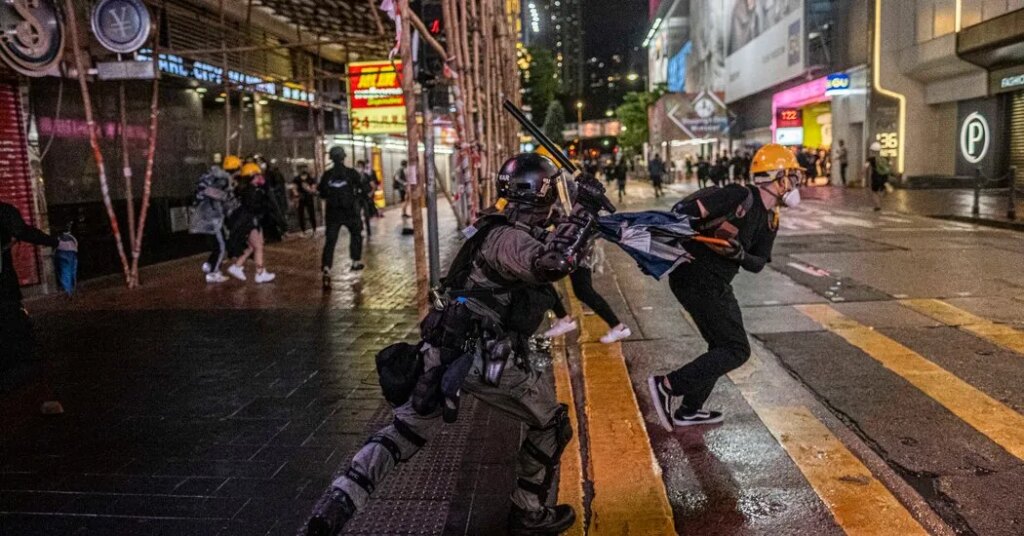
On Aug. 31, Mr. Tang covered a gathering that marked the seventh anniversary of the storming of Prince Edward station by Hong Kong riot police, who indiscriminately used batons and pepper spray against protesters and commuters inside trains during mass pro-democracy demonstrations in 2019.
On social media, Mr. Tang posted photos of people who had placed bouquets and opened yellow umbrellas — a symbol of the past protests. Some of the umbrellas were decorated with political slogans and the logo of Apple Daily, a now-defunct newspaper founded by Jimmy Lai, an imprisoned media mogul.
The Hong Kong police said in a statement that, from Sept. 3 to 30, it had arrested eight people for “doing an act that has a seditious intention,” after it found them standing outside Prince Edward subway station on Aug. 31, “holding bouquets and shouting seditious slogans.” The police did not identify them, but said a 37-year-old man was among those arrested on Wednesday. They did not respond to a request for further comment.
“The persons concerned were suspected of spreading false information and attacking the Hong Kong Special Administrative Region Government with lies, as well as smearing the Police Force, with the intention of inciting hatred against the HKSAR Government and law enforcement agencies,” the police said in a statement.
Journalists in Hong Kong and press watchdogs say the space for free expression has shrunk considerably in a city that was once considered a bastion of press freedom. After Beijing passed a first national security law in 2020, civil liberties were eroded and journalists said they were forced to self-censor. But Hong Kong’s 2024 security law, which expands the government’s power to stamp out dissent, has compounded the risks.
In particular, Mr. Tang’s arrest has raised questions about new red lines that are being drawn to criminalize journalism.
Selina Cheng, chair of the Hong Kong Journalists Association, said she was struggling to understand how a journalist “filming exactly what’s happening on scene” could lead to a charge of sedition. She added that it was the latest example of the authorities’ “never-ending expansion” of a campaign against freedom of expression.
“If authorities move forward with prosecution, it would have a lot of implication on what even live broadcasts could mean,” Ms. Cheng said.
Li You and David Pierson contributed reporting.
The post Hong Kong Journalist Arrested After Covering Gathering Linked to 2019 Protests appeared first on New York Times.